
Loading, please wait...
LOT 1171
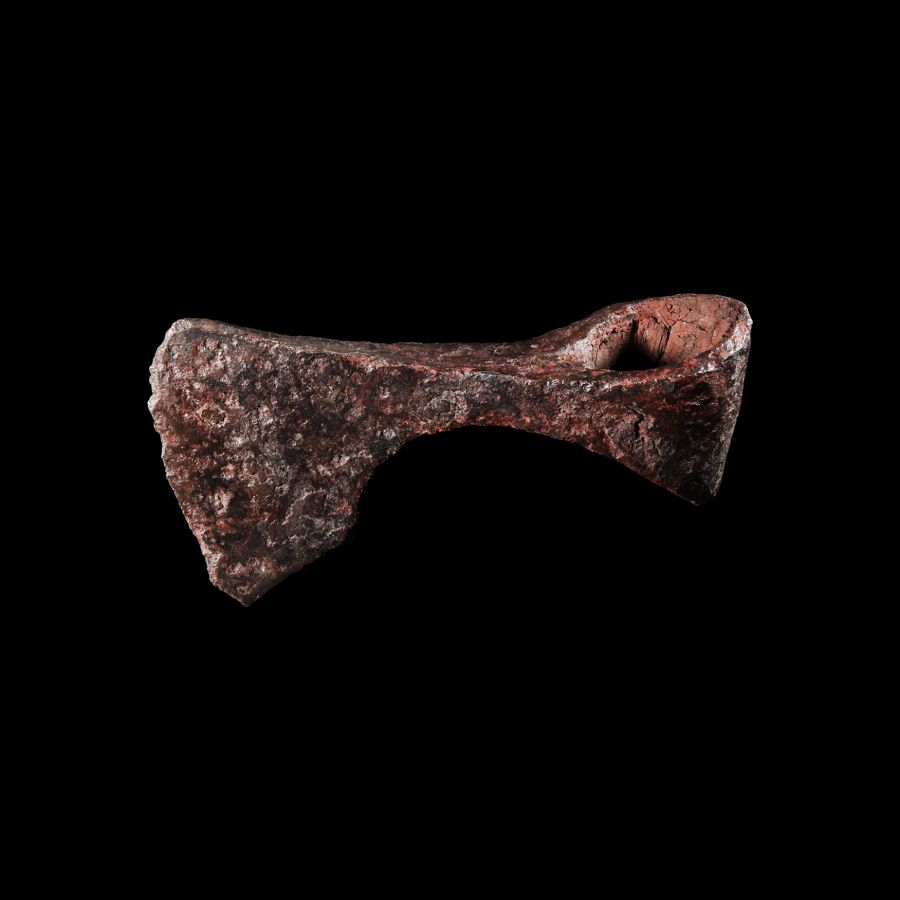
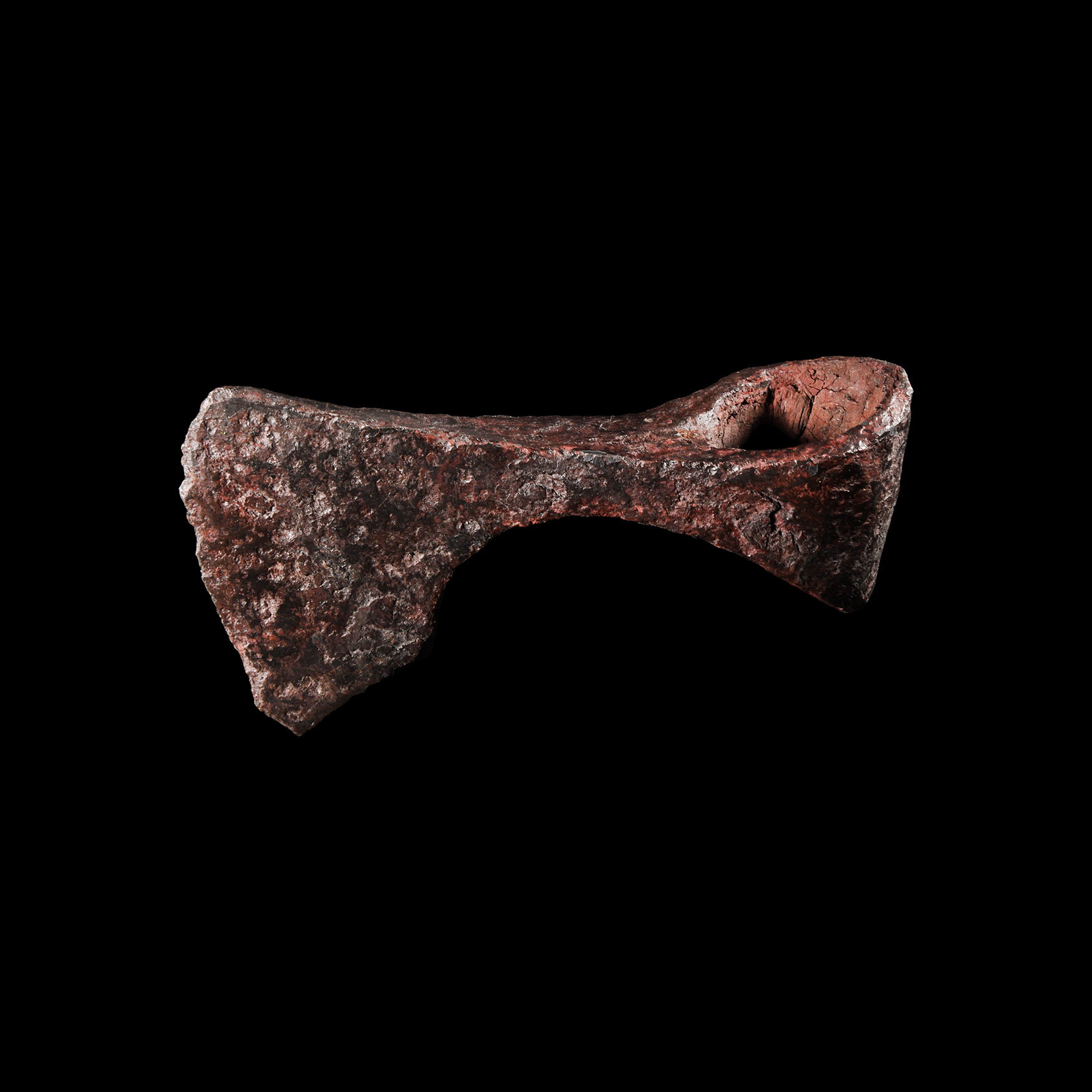
'The Repton' British Viking Iron Bearded Axehead
9TH-11TH CENTURY A.D.
6 in. (464 grams, 15 cm).
Hand-forged with triangular-section narrow blade widening to a broad bevelled edge with square chin, socket with rounded extensions to the rear. [No Reserve]
ProvenanceFound Repton, Nottingham, UK, in the 1960s.
Gary Edwards, York, UK.
Private collection, Preston, UK.
Accompanied by a certificate of authenticity and receipt from Gary Edwards, no.12386.
Cf. Sedov, B.B., Finno-Ugri i Balti v Epokhi Srednevekovija, Moscow, 1987, pl.CXXIV, item 3.
FootnotesThe bearded axehead were called skeggöks, in Norse language, and had a long edge designated to work split tree-trunks into planks and beams.
CONDITIONTimeLine Auctions follows a vetting process to ensure the authenticity and legality of all items, reinforcing our commitment to integrity and responsible trading. Each antiquity, antique, and coin lot undergoes thorough examination by a vetting committee of at least ten external specialists, professional trade association members, scientists, and archaeologists: Our Vetting Process
AUCTIONS:
TimeLine is a leading auction house specialising in antiquities, ancient art, collectables, natural history, coins, medals, and books. Our auctions offer museums, collectors, historians, and enthusiasts the opportunity to acquire unique and historically significant pieces.
-
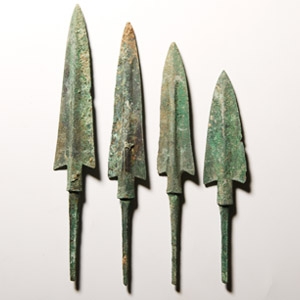
Luristan Arrowhead Group
13th-9th century B.C.Sold for (Inc. bp): £143
Comprising four tanged arrowheads, having large elongated triangular blades and raised midrib, sharp central groove, rectangular section stem with handle for the shaft, barbed shoulders and convex or squared sides. 161 grams total, 13-17 cm
From the private collection of the late Mr S.M., London, UK, 1969-1999; thence by descent.
These arrowheads seem to belong to the type V, subcategory types A and C according to the classification of Khorasani and Negahban. In the four categories of triangular bronze arrowheads from Luristan, Marlik and Northern Iran individuated by Negahban, subtypes A and C of type V are larger arrow heads with barbed shoulders and triangular heads. These types of arrowheads were commonly used in Anatolia and Mesopotamia from the 2nd millennium B.C., but apparently their employment began earlier in this area, where types like these occur alongside the non-barbed, predominantly ribbed and tanged types. -
.jpg)
South German Burgonet Helm
Circa 1560-1570 A.D.Estimate: £2,000 - 3,000 (+bp*)
Opening Bid: £1,111
The one-piece skull rising to a prominent baluster-shaped finial, facetted upper half, the lower writhen projecting forward to flat obtusely pointed integral peak and backwards to a similar but shorter integral neck-guard, hinged cheek-pieces embossed with a star with four points, an auditory hole between each arm; fitted internally with a quilted canvas lining; with possible punched 'eagle' maker mark to visor projection. 1.54 kg, 24 cm high
with Thomas Del Mar Ltd, 6th December 2017, lot 199. The Kusmirek Collection, UK. Accompanied by an academic report by Dr Raffaele D'Amato. Accompanied by a copy of the relevant Thomas Del Mar Ltd catalogue pages and purchase invoice. This lot has been checked against the Interpol Database of stolen works of art and is accompanied by search certificate number no.11770-203982.
Most original burgonets feature some form of decoration. Rolled and roped edges and pierced cheek-pieces are common, and the finest burgonets were engraved, inlaid and/or selectively coloured and polished. Some were covered in fine cloth in the tradition of sallets. The name seems to be a corrupted form of bourguignotte, the contemporary French term for this helmet type. -
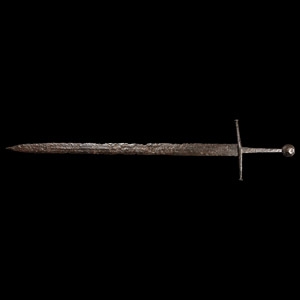
Medieval Iron Hand and Half Sword with Polyhedral Pommel
Late 14th-early 15th century A.D.Sold for (Inc. bp): £2,860
Of Oakeshott's Type XVIIIa or b, cross style 11, pommel style I1; strongly tapering pointed blade with straight edges and evident battle nicks; straight cross guard, long grip and an octagonal pommel. 1.26 kg, 1 m
From the private collection of a London gentleman, from his grandfather's collection formed before the early 1970s.
This magnificent example was well-suited to a cut-and-thrust style of fighting, a logical development of the Oakeshott XVI typology. This is mainly visible in the specimens of typology XVIIIb, typical of English effigies and brasses between 1370-1425. Because the previous types of swords were practically useless against the fully armoured man-at-arms, Western European warfare needed a sword capable of piercing the weak points of the enemy's protective equipment, leading to the development of types XV, XVI and XVII, and eventually of type XVIII. The subtypes XVIIIa and b had a longer blade, and type XVIIIb was a very long-gripped bastard sword. This word (often referred to as ‘hand-and-a-half sword’) was applied through the late Middle Ages to the long-gripped weapons. Marc de Vulson, writing on the occasion of a duel fought in 1549 before Henry II of France, stated 'Deux epées bâtardes, pouvant servir à une main ou à deux' (two bastard swords able to serve with one hand or with two).
