
Loading, please wait...
_900x900.jpg "'The Mildenberg' Greek Gold Bull's Head Pendant")
_200x200.jpg "'The Mildenberg' Greek Gold Bull's Head Pendant")
_900x900.jpg "'The Mildenberg' Greek Gold Bull's Head Pendant")
_200x200.jpg "'The Mildenberg' Greek Gold Bull's Head Pendant")
.jpg "'The Mildenberg' Greek Gold Bull's Head Pendant")
.jpg "'The Mildenberg' Greek Gold Bull's Head Pendant")
LOT 0071
'The Mildenberg' Greek Gold Bull's Head Pendant
CIRCA 4TH CENTURY B.C.
7/8 in. (3.05 grams, 21 mm).
Hollow-formed in sheet gold with finely modelled details and applied granulated wreath between its horns; attachment hole to the rear of the head.
ProvenanceChristie's, London, 'A Peaceable Kingdom: The Leo Mildenberg Collection', 27 October 2004, no.102.
This lot has been checked against the Interpol Database of stolen works of art and is accompanied by search certificate number no.13359- 259201.
Walker, A.S. (ed.), Animals in Ancient Art from the Leo Mildenberg Collection, Part III, Mainz am Rhein, 1996, no.281.
LiteratureCf. similar bull-head pendant in a necklace, in the Hermitage Museum, from Karagodeuashkh Mound, Northern Caucasus, Kuban region, 4th century B.C., Inv.no.2492/2.
FootnotesIn many Greek sanctuaries, large numbers of bull figures of different sizes have been found, which must be regarded as representatives of actual sacrificial offerings. Many of them come from the venerable Sanctuary of Zeus at Dodona, with whom the bull has a special relationship.
CONDITIONTimeLine Auctions follows a vetting process to ensure the authenticity and legality of all items, reinforcing our commitment to integrity and responsible trading. Each antiquity, antique, and coin lot undergoes thorough examination by a vetting committee of at least ten external specialists, professional trade association members, scientists, and archaeologists: Our Vetting Process
AUCTIONS:
TimeLine is a leading auction house specialising in antiquities, ancient art, collectables, natural history, coins, medals, and books. Our auctions offer museums, collectors, historians, and enthusiasts the opportunity to acquire unique and historically significant pieces.
LOT 0071
'The Mildenberg' Greek Gold Bull's Head Pendant
Estimate £3,000 - 4,000€3,480 - 4,640 (for guidance only)$4,050 - 5,400 (for guidance only)
-
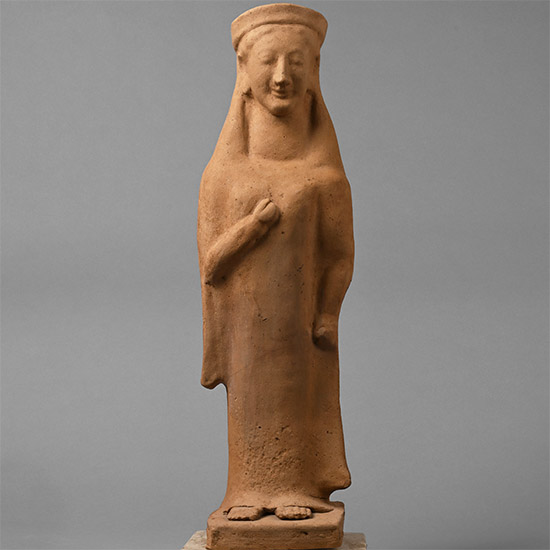
Large Greek Terracotta Figure of a Kore
6th century B.C.Estimate: £4,000 - 6,000 (‡+bp*)
Opening Bid: £2,222
Hollow-formed with scaphoid headdress, long hair hanging behind the shoulders, heavy peplos dress extending to the floor with splayed hem and feet visible beneath; left hand held straight at the thigh, right hand in a fist between the breasts; mounted on a custom-made stand. 6.7 kg total, 57 cm including stand
Swiss private collection, assembled in the 1970s-1980s. with Galerie Serodine, Ascona, Switzerland, 1993. Collection of Dr E.N., Zug, acquired in 1995. This lot has been checked against the Interpol Database of stolen works of art and is accompanied by a search certificate number no.12858-241755.
One of the most typical 6th-century B.C. terracotta female figurines was that of a standing or seated woman wearing a chiton tunic and a himation over it. It was a votive figure offered to the shrines or temples, usually representing the goddess Demeter. The headgear, polos, was an element usually identifying the goddess Demeter or her daughter Persephone. Attica was one of the principal centres of figurine production, but Corinth continued to produce solid standing or seated females with moulded fronts and flat backs. -
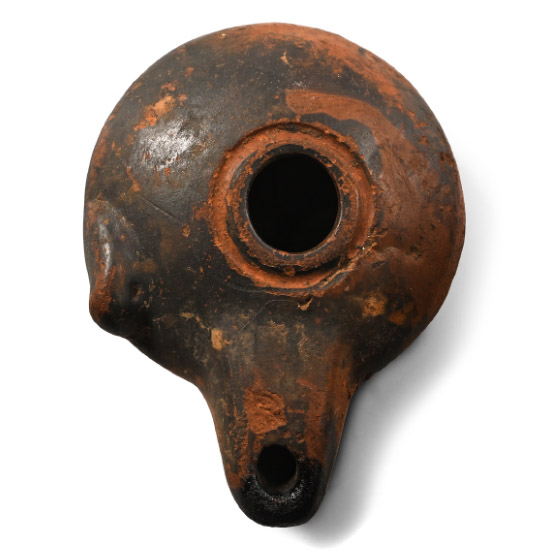
Greek Terracotta Oil Lamp
Hellenistic, circa 3rd-2nd century B.C.Sold for (Inc. bp): £59
Rounded body with large central filler hole and pointed lug on the shoulder, the rim with a low-relief ovolo decoration, elongated nozzle with scooped nozzle; low basal ring. 103 grams, 99 mm
From a UK collection formed in the 1980s. Property of an Essex, UK, gentleman. -
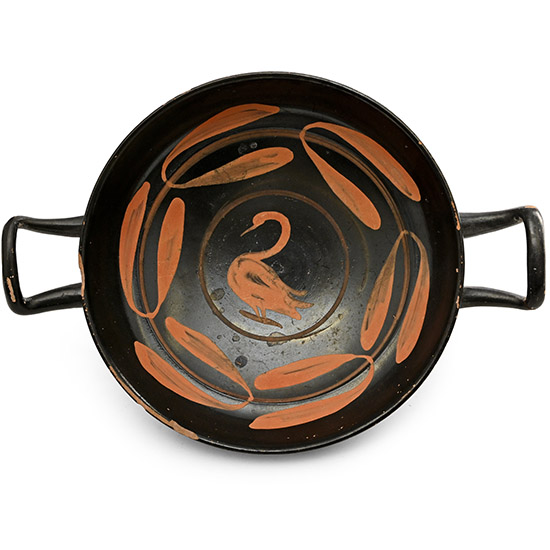
Greek Black-Glazed Twin-Handled Stemless Kylix with Swan
Apulia, 4th century B.C.Sold for (Inc. bp): £4,160
Shallow with arched loop handles below the rim, low stepped foot; tondo with painted wreath of laurel leaves surrounding a standing swan in profile; to the outer face, two horizontal sprigs of laurel leaves; possibly by the Swan painter. 206 grams, 20.6 cm
Bonhams, Knightsbridge, London, 20 October 1994, no.43. Private collection, Suffolk. Accompanied by copies of the relevant Bonhams cataloguing pages.
