
Loading, please wait...
LOT 0340
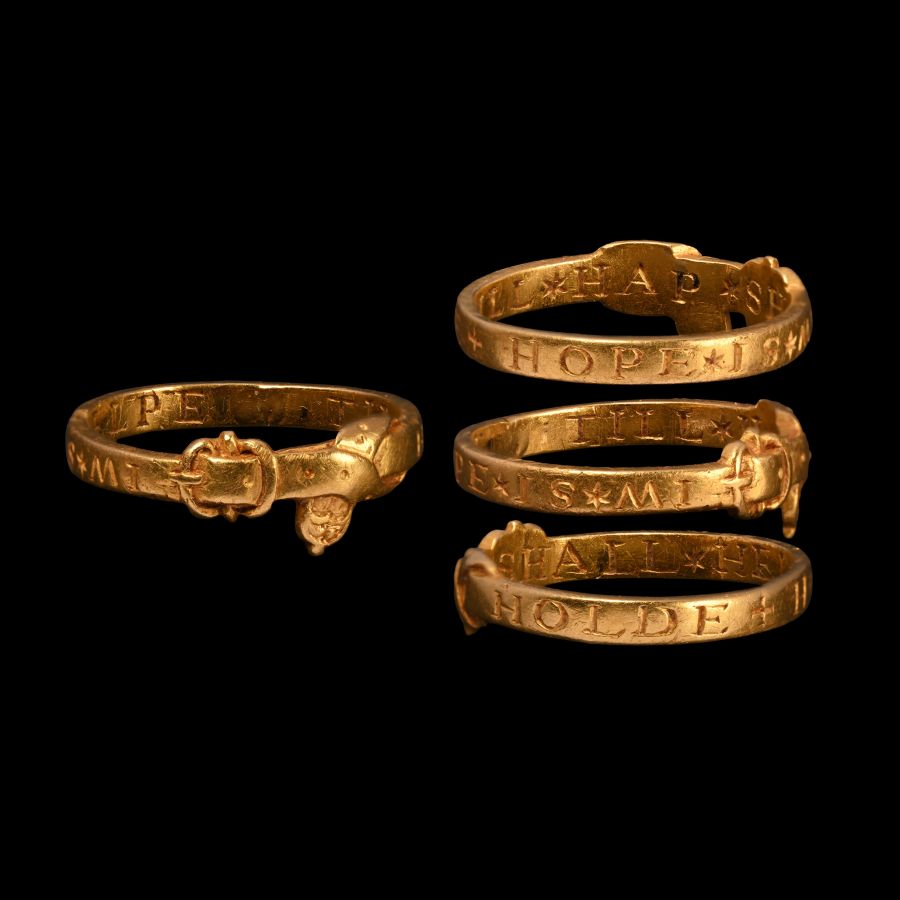
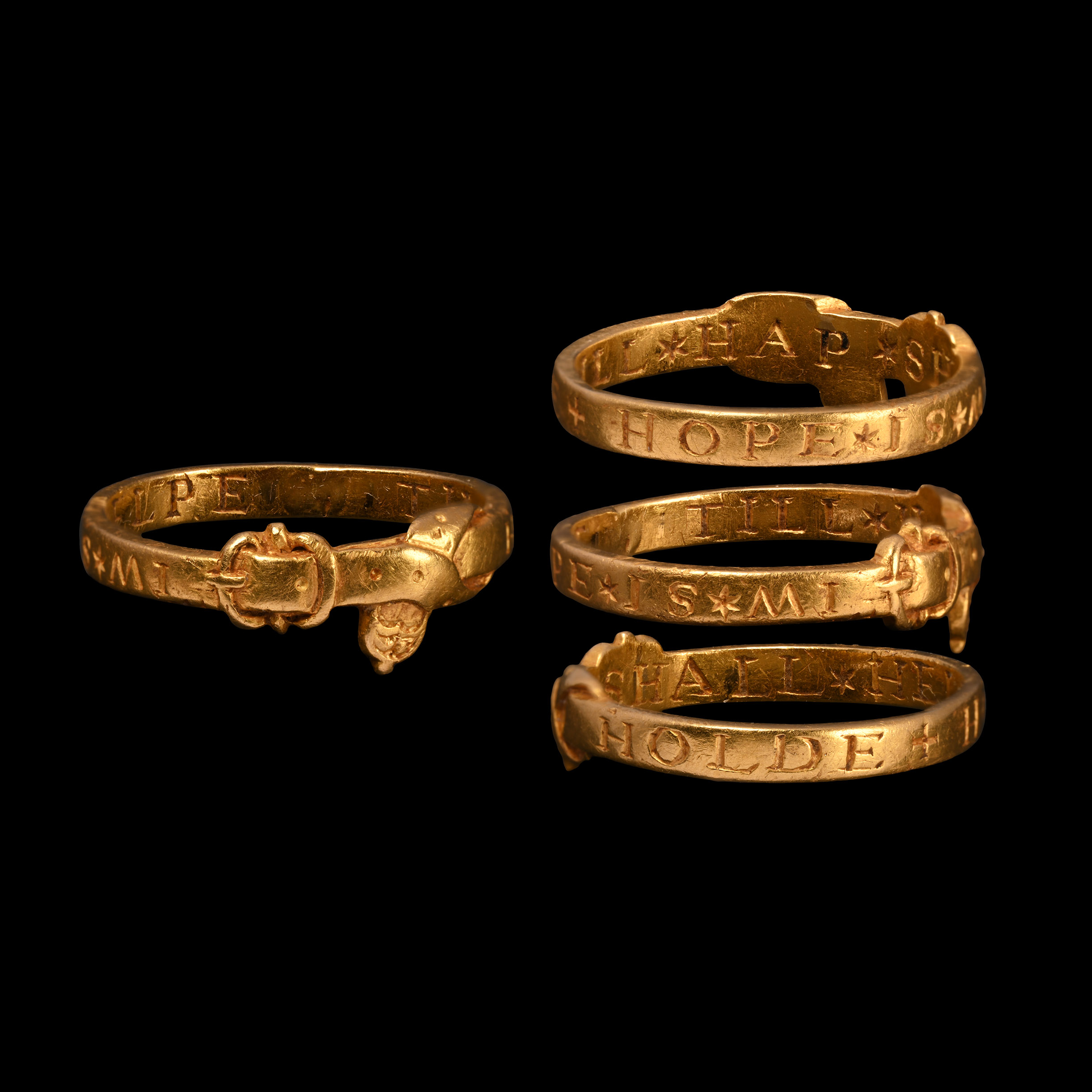
'The Hursley' Tudor Gold 'Hope Is Mi Holde Till Hap Shall Helpe' Buckle Posy Ring
CIRCA 16TH CENTURY A.D.
3/4 in. (2.76 grams, 19.17 mm overall, 16.63 mm internal diameter (approximate size British M, USA 6 1/4, Europe 12.34, Japan 12)).
A gold posy ring with rectangular-section hoop in the form of a buckled belt with looped end tie and chape with double-bowed and pinned buckle, the outer face inscribed '+HOPE * IS * MI HOLDE' in Roman capitals, continuing 'TILL * HAP * SHALL * HELPE' around the interior; accompanied by a vintage ring box.
ProvenanceFound whilst searching with a metal detector near Hursley, Hampshire, UK, on Sunday 26th August 2012.
Acquired from Berganza, Hatton Garden, London, 2017.
Property of an East Sussex collector.
Disclaimed under the Treasure Act with reference no.2012 T805.
Accompanied by a copy of the British Museum's Portable Antiquities Scheme report no.HAMP-62C152.
Accompanied by a copy of the Berganza invoice.
This lot has been checked against the Interpol Database of stolen works of art and is accompanied by search certificate no.11667-197581.
Cf. The British Museum's Portable Antiquities Scheme, record id. GLO-244613 and Treasure Act, reference 2009 T135, for similar; cf. The V&A Museum, accession number M.225-1962, for a similar type dated 1400-1500 A.D.
FootnotesThe inscription is somewhat enigmatic and does not seem to have been previously recorded for a posy ring; the form of the buckle and the knopped chape are typical of examples seen, often in base metal, from the late medieval period to the 16th century A.D. The name of this genre of ring is derived from the 'poesy' or motto usually engraved around the hoop. In medieval examples the posy is mostly engraved around the outside of the hoop but later examples find it on the inner surface. Rings with amatory inscriptions have their origins in the 14th century A.D., when they served as love gifts, betrothal and wedding rings, as attested by surviving documentary evidence. Posy rings were also given to friends or used to mark significant occasions.
CONDITIONTimeLine Auctions follows a vetting process to ensure the authenticity and legality of all items, reinforcing our commitment to integrity and responsible trading. Each antiquity, antique, and coin lot undergoes thorough examination by a vetting committee of at least ten external specialists, professional trade association members, scientists, and archaeologists: Our Vetting Process
AUCTIONS:
TimeLine is a leading auction house specialising in antiquities, ancient art, collectables, natural history, coins, medals, and books. Our auctions offer museums, collectors, historians, and enthusiasts the opportunity to acquire unique and historically significant pieces.
LOT 0340
'The Hursley' Tudor Gold 'Hope Is Mi Holde Till Hap Shall Helpe' Buckle Posy Ring
Estimate £15,000 - 20,000€17,400 - 23,200 (for guidance only)$20,250 - 27,000 (for guidance only)
-
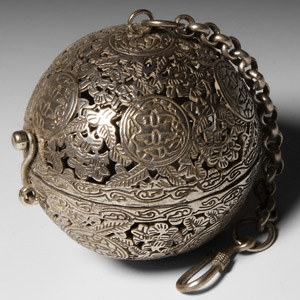
Post Medieval Gimballed Incense Burner
20th century A.D.Sold for (Inc. bp): £130
A silver hinged spherical incense burner with swivel clasp and gimbal; pierced decoration of foliate form with roundels incised with flying insects; swivel clasp and suspension chain with decorated hook; Chinese characters (possibly a maker's name) inscribed to hook. 91 grams, 16 cm long
with a London, UK gallery 1971-early 2000s. -
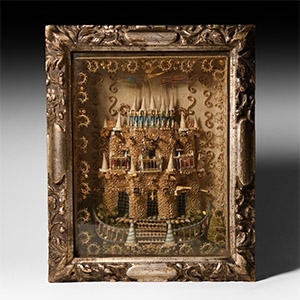
Post Medieval Reliquary Display Box
18th-19th century A.D.Sold for (Inc. bp): £780
A framed and glazed reliquary display box featuring a castle created from polychrome and gilt paper scrolls. 682 grams, 29 x 23.5 cm
English private collection. -
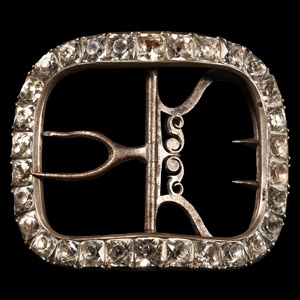
Georgian Period Silver Shoe Buckle
18th-early 19th century A.D.Sold for (Inc. bp): £52
A silver shoe buckle with articulate tongue, set with cut jewels. 33 grams, 57.5 mm
Acquired 1960s-1990s. From the late Alison Barker collection, a retired London barrister.
