
Loading, please wait...
_900x900.jpg "'The Guttmann' Large Greek Bronze Funerary Situla")
_200x200.jpg "'The Guttmann' Large Greek Bronze Funerary Situla")
.jpg "'The Guttmann' Large Greek Bronze Funerary Situla")
LOT 0076
'The Guttmann' Large Greek Bronze Funerary Situla
7TH CENTURY B.C.
10 1/4 in. (1.56 kg, 26.2 cm).
Formed with a single-piece bottom and two-piece body riveted together; the underside recessed, sidewall flared with a carination at the shoulder and rolled rim; attachment point for handles at the seams below the shoulder and to the inner face of the rim; small repair panel to the inner face.
ProvenanceEx Axel Guttmann Collection of Ancient Arms and Armour, Germany [1944-2001], AG 490.
Private collection, UK.
Accompanied by a copy of the relevant pages where this situla is published.
This lot has been checked against the Interpol Database of stolen works of art and is accompanied by search certificate number no.13059-248969.
Born, H. and Hansen, S., Fruhgriechische Bronzehelme: Sammlung Axel Guttmann, IX, Mainz, 2001, (AG 490), p.32.
LiteratureCf. similar situla in the Museo Nazionale di Villa Giulia, Roma, and others in Giuliani-Pomes M.V., ‘Cronologia delle situle rinvenute in Etruria’ in Studi Etruschi,volume 23, 1957, pp.149-188, figs.1,2,3,6,7-8.
FootnotesThe situla (type A of the Giuliani-Pomes classification) comes from a funerary complex that may have also included a geometric helmet with a horse protome. A very similar example comes from the Bernardini Tomb in Palestrina, now in the Archaeological Museum of Villa Giulia, Rome.
CONDITIONTimeLine Auctions follows a vetting process to ensure the authenticity and legality of all items, reinforcing our commitment to integrity and responsible trading. Each antiquity, antique, and coin lot undergoes thorough examination by a vetting committee of at least ten external specialists, professional trade association members, scientists, and archaeologists: Our Vetting Process
AUCTIONS:
TimeLine is a leading auction house specialising in antiquities, ancient art, collectables, natural history, coins, medals, and books. Our auctions offer museums, collectors, historians, and enthusiasts the opportunity to acquire unique and historically significant pieces.
-
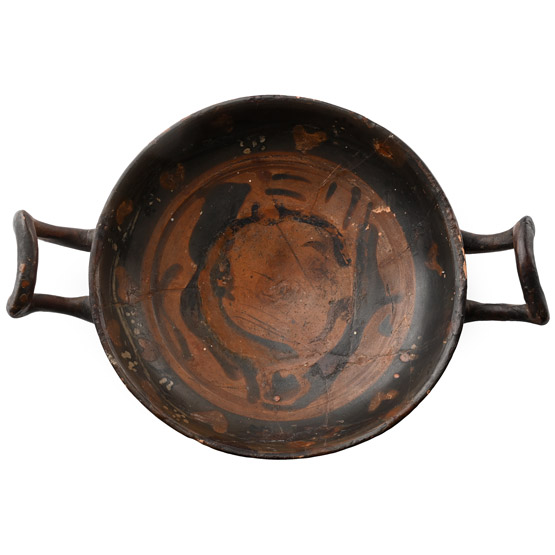
Greek Blackware Kylix
Circa 5th century B.C.Sold for (Inc. bp): £364
Broad and shallow with two strap handles, tondo displaying a wreath of ivy leaves with tendrils and volutes underneath; the underside of the bowl with acanthus motifs; restored. 215 grams, 21.5 cm wide
Acquired on the UK art market, early 2000s.
Drinking cups (kylikes and skyphoi), along with mixing bowls and wine coolers (kraters and psykters), wine jars (amphorae), water jars (hydrai), pitchers (oinochoai), and ladles (kyathoi), were essential equipment for drinking parties. The kylix appears to have been the most popular form of drinking cup, probably because it was especially well-suited to the Greek custom of eating and drinking while reclining on a couch. These Attic kylikes were usually presented with a stemmed base, a deep bowl and two upturned loop handles, on a concave base. -
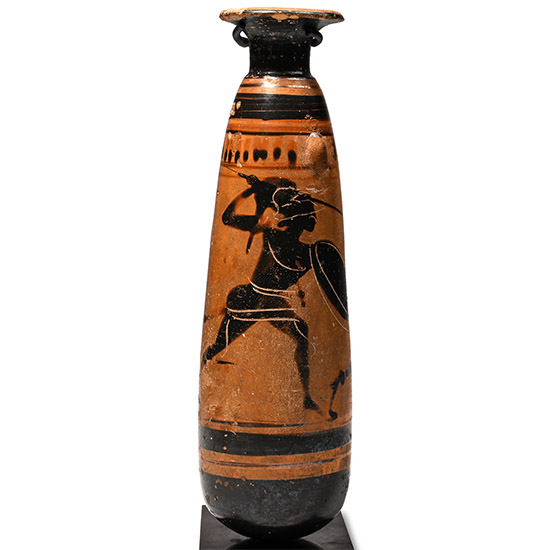
Greek Black-Figure Alabastron with Fighting Warriors
Attic, 500-480 B.C.Estimate: £30,000 - 40,000 (‡+bp*)
Opening Bid: £15,000
Of ovoid shape, short neck and expanded flat rim; painted in horizontal bands with black vertical strokes the shoulder, ovules in the upper part, the central scene representing a Greek Ekdromos fighting a Scythian archer; the Greek warrior, wearing a light sleeveless chiton, and a crested Corinthian helmet, carrying a wide hoplon shield, and a long spear with which he is slashing his opponent; the Scythian archer is wearing a typical tall cap flowing backwards and his long coat-suit, carrying a gorytos, (quiver) and composite bow with arrow; horizontal black stripes below; accompanied by a custom-made display stand. 262 grams total, 16 cm high including stand
Louis-Gabriel Bellon (1819-1899) collection, France. European private collection, 2009. Accompanied by an academic report by Dr Raffaele D’Amato. This lot has been checked against the Interpol Database of stolen works of art and is accompanied by a search certificate number no.13019-246753.
The importance of this alabastron is linked to its iconography, which represents episodes of the Persian Wars, fought 490-480 B.C. Such alabastra are part of a series realised during the period of the conflict and after, and they are an important source of information on the Persian and Greek armies. Here, the two opponents evoke the Greek victories, with a light-armed Greek ekdromos (hoplite fighting in light equipment) killing a Scythian archer, who formed part of the Persian army. The representation of Scythian costume in vase-painting reached its height of popularity between c. 530 and 490 B.C., and went out of fashion after the Graeco-Persian wars, when these clothes began to be associated with the Persian ethnic identity rather than the original Scythian. -
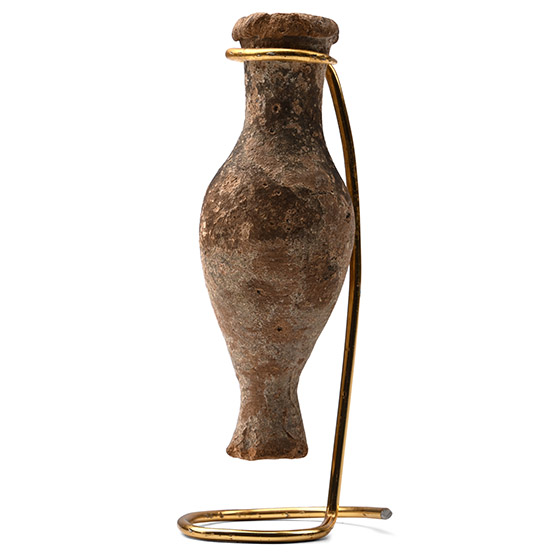
Greek Terracotta Spindle Flask
Hellenistic, late 2nd-1st century B.C.Sold for (Inc. bp): £78
With a narrow neck and carinated mouth, developing to a biconical body and flared foot; mounted on a custom-made stand. 24 grams total, 80 mm high, 93 mm including stand
From a Scottish gentleman’s collection, Glasgow, formed from the early 2000s.
