
Loading, please wait...
LOT 0213
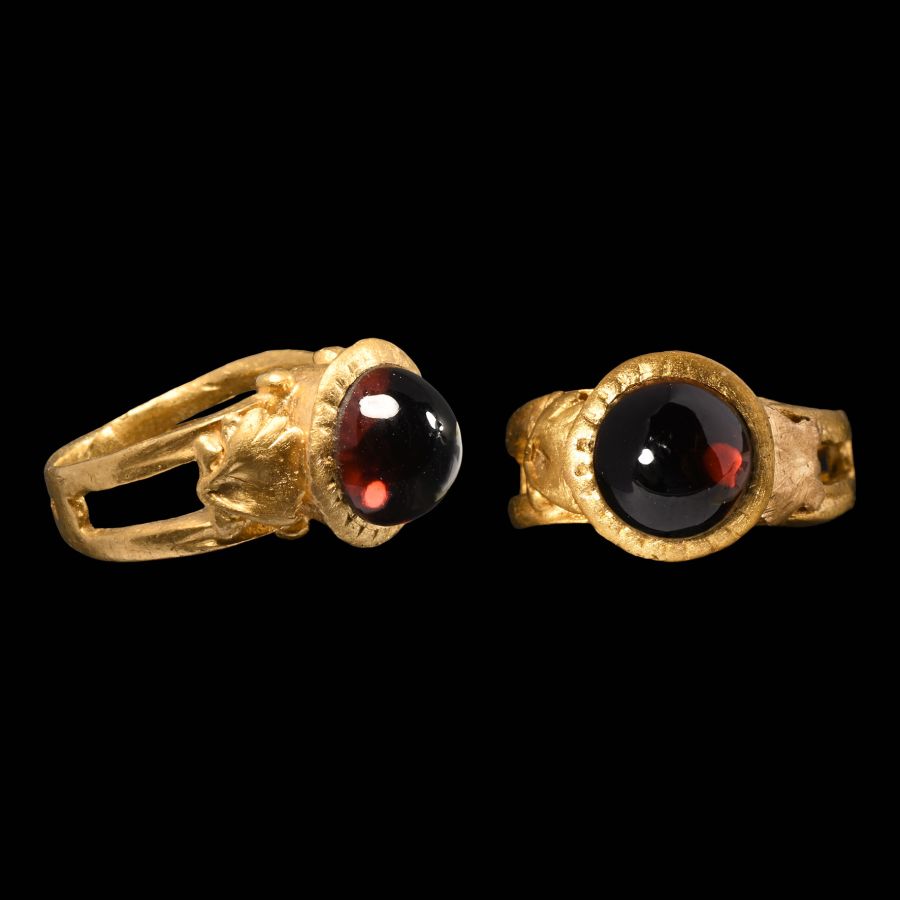
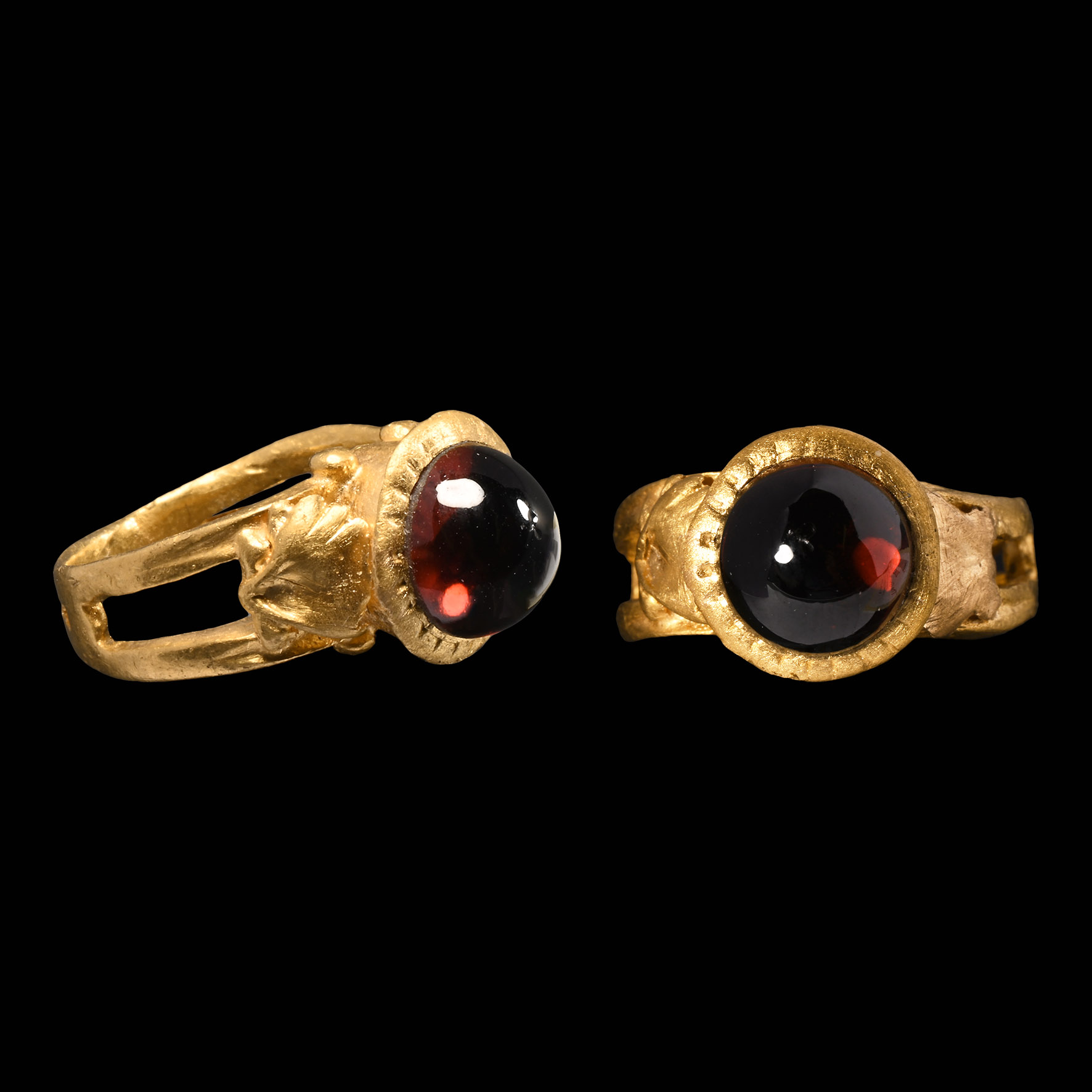
'The Great Chart' Roman Gold Ring
3RD-4TH CENTURY A.D.
3/4 in. (4.57 grams, 22.24 mm overall, 14.67 mm internal diameter (approximate size British F, USA 2 3/4, Europe 3.67, Japan 3)).
The hoop circular in plan and rectangular in cross-section, the sides divide into two segments which separate gradually to form triangular shoulders, on one of the shoulders applied scallop shells with one replaced, four pellets to the base of the bezel; the deep tubular bezel and everted rim decorated with radiating lines, reset with a cabochon garnet.
ProvenanceFound whilst searching with a metal detector near Great Chart with Singleton, near Ashford, Kent, UK, by Mr Keith Collins on Thursday 5th November 2020.
Accompanied by a copy of the British Museum's Portable Antiquities Scheme (PAS) report with record no.KENT-2D4C88.
Accompanied by a copy of the British Museum's report on a find of potential treasure for H M Coroner with Treasure reference 2021T808, subsequently disclaimed.
See Guiraud. H., Bagues et Anneaux a l'Epoque Romaine en Gaule, in Gallia, vol.46, 1989.
FootnotesRoman rings with circular hoops are categorised by Guiraud (1998) in her typology as Type 4, those with tubular bezels Types 4a- 4d, Type 4c is shown flanked by two pairs of spherical pellets, and with decorative shoulders (p.189, fig.29), however our example is more consistent with Type 4h.
CONDITIONTimeLine Auctions follows a vetting process to ensure the authenticity and legality of all items, reinforcing our commitment to integrity and responsible trading. Each antiquity, antique, and coin lot undergoes thorough examination by a vetting committee of at least ten external specialists, professional trade association members, scientists, and archaeologists: Our Vetting Process
AUCTIONS:
TimeLine is a leading auction house specialising in antiquities, ancient art, collectables, natural history, coins, medals, and books. Our auctions offer museums, collectors, historians, and enthusiasts the opportunity to acquire unique and historically significant pieces.
-
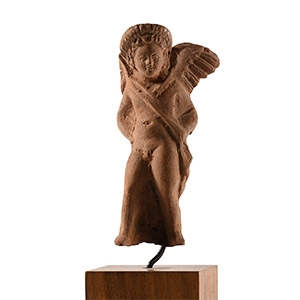
Roman Terracotta Figurine of Eros
Circa 1st century B.C.Sold for (Inc. bp): £338
Represented nude and winged, with detailed head crowned by dressed locks and a low petasos, the face beautifully modelled with delicate features; accompanied by a custom-made display stand. 49 grams total, 11.5 cm including stand
Fine brown clay, grey core.
Ex P. A., Hertfordshire, UK, specialist collection of Greek art, 1980-1990s.
These figurines were often deposited inside the graves of children. In Thessaloniki, a winged Eros very similar to this was deposited in a grave. From the small size of the skeleton, with a maximum length of 1,10 m, and from the grave offerings, the archaeologists deduced that it belonged to a boy who was accompanied by his beloved and necessary possessions, but also by those providing escort and entertainment beyond this world. Unguentaria were placed on either side of the femoral bones, two on one and a single one on the other, two strigils along the eastern side of the grave near the head, a coin on the chest, and several terracotta figurines near the north-eastern corner near the head, while a handle-less bowl was placed very close to the face. -
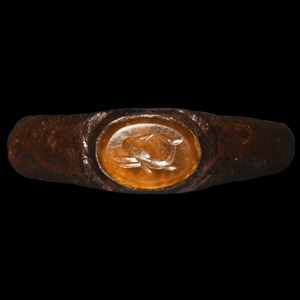
Late Roman Bronze Ring with Dolphin Gemstone
Circa 3rd-4th century A.D.Sold for (Inc. bp): £169
With facetted angled shoulders, small plaque with inset carnelian intaglio of a dolphin with raised tail. 3.15 grams, 24.52 mm overall, 18.01 mm internal diameter (approximate size British O 1/2, USA 7 1/4, Europe 15.61, Japan 15)
Acquired on the German art market before 2000. Property of a Surrey, UK, collector. -
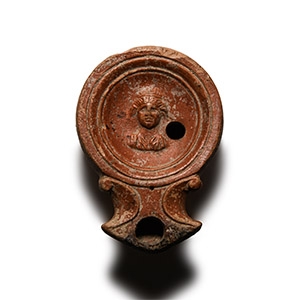
Roman Terracotta Oil Lamp with Bust of Ceres
Circa 1st century A.D.Sold for (Inc. bp): £156
Central motif of a bust of a goddess with modius (Ceres?); filling-hole in lower left field, voluted angular-tipped nozzle, base slightly raised. 41.3 grams, 80 mm
From the collection of a High Wycombe, Buckinghamshire, UK, gentleman, circa 2000.
The lamp belongs to the type Loeschcke Type I C. This kind of lamp belongs to the early Flavian phase of workshop production. The discus decorations are related to amphitheatre and circus, to mythology, animals, everyday life, and symplegma.
