
Loading, please wait...
LOT 0136
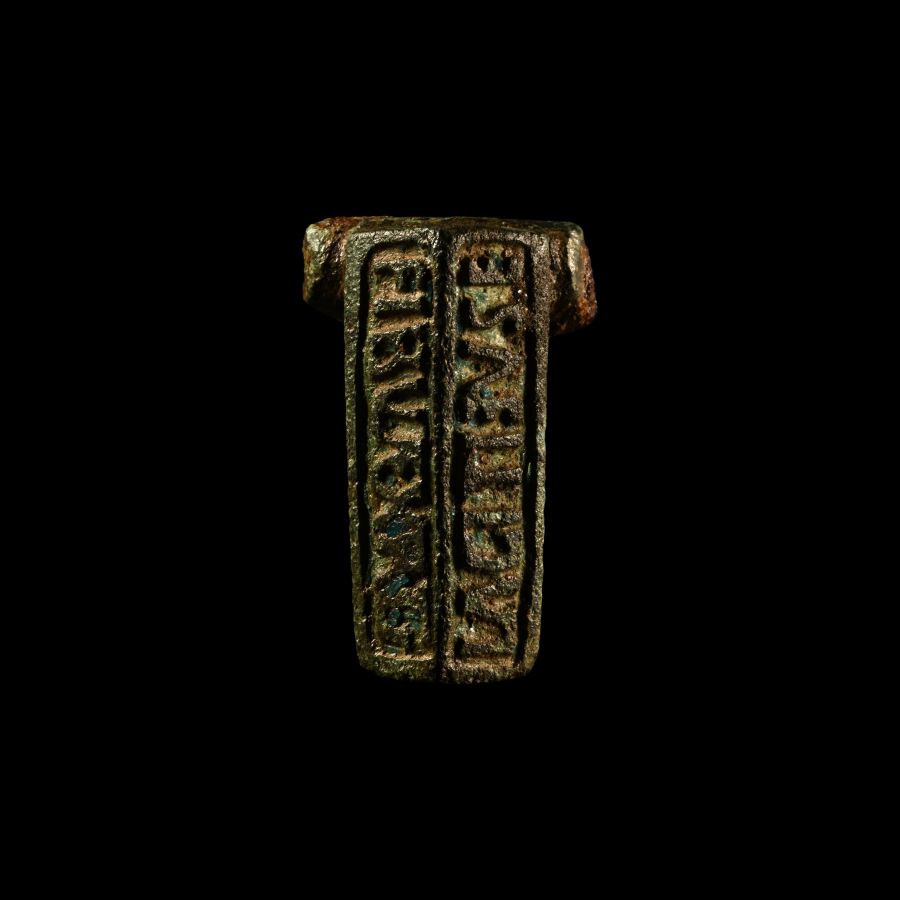
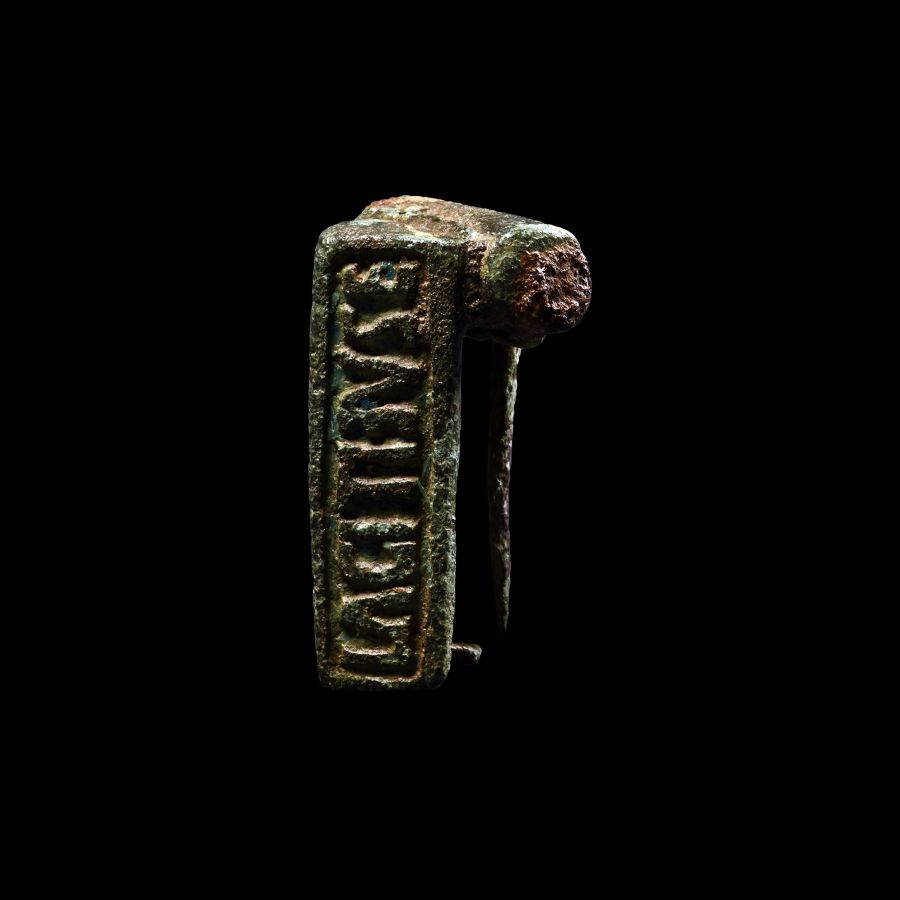
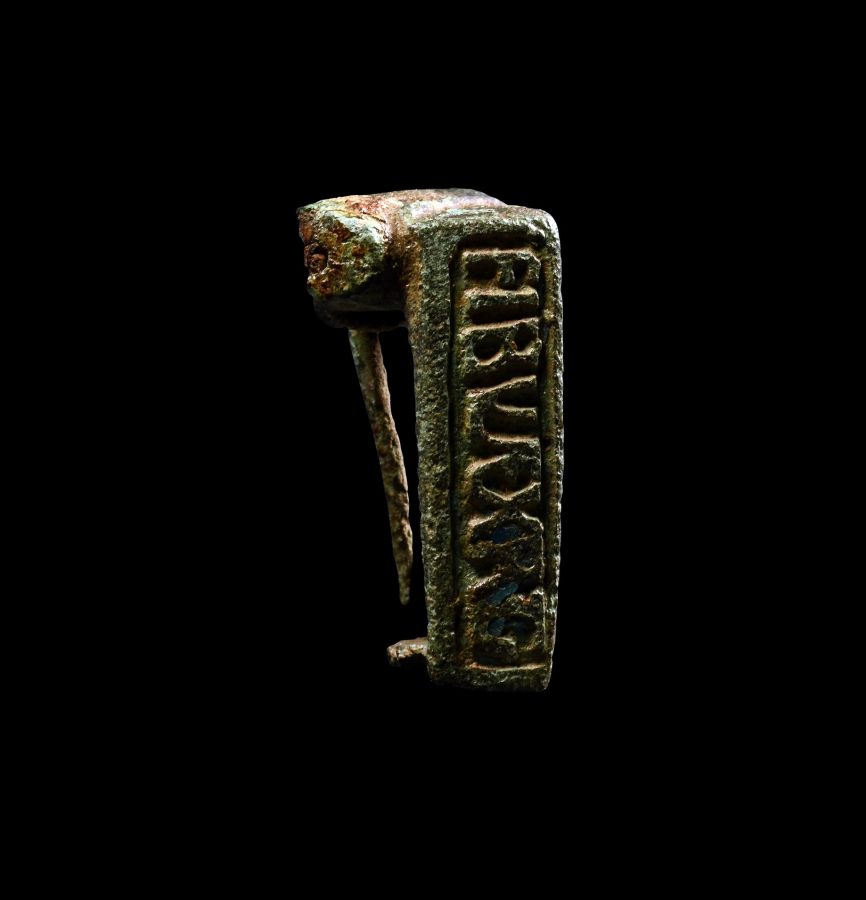
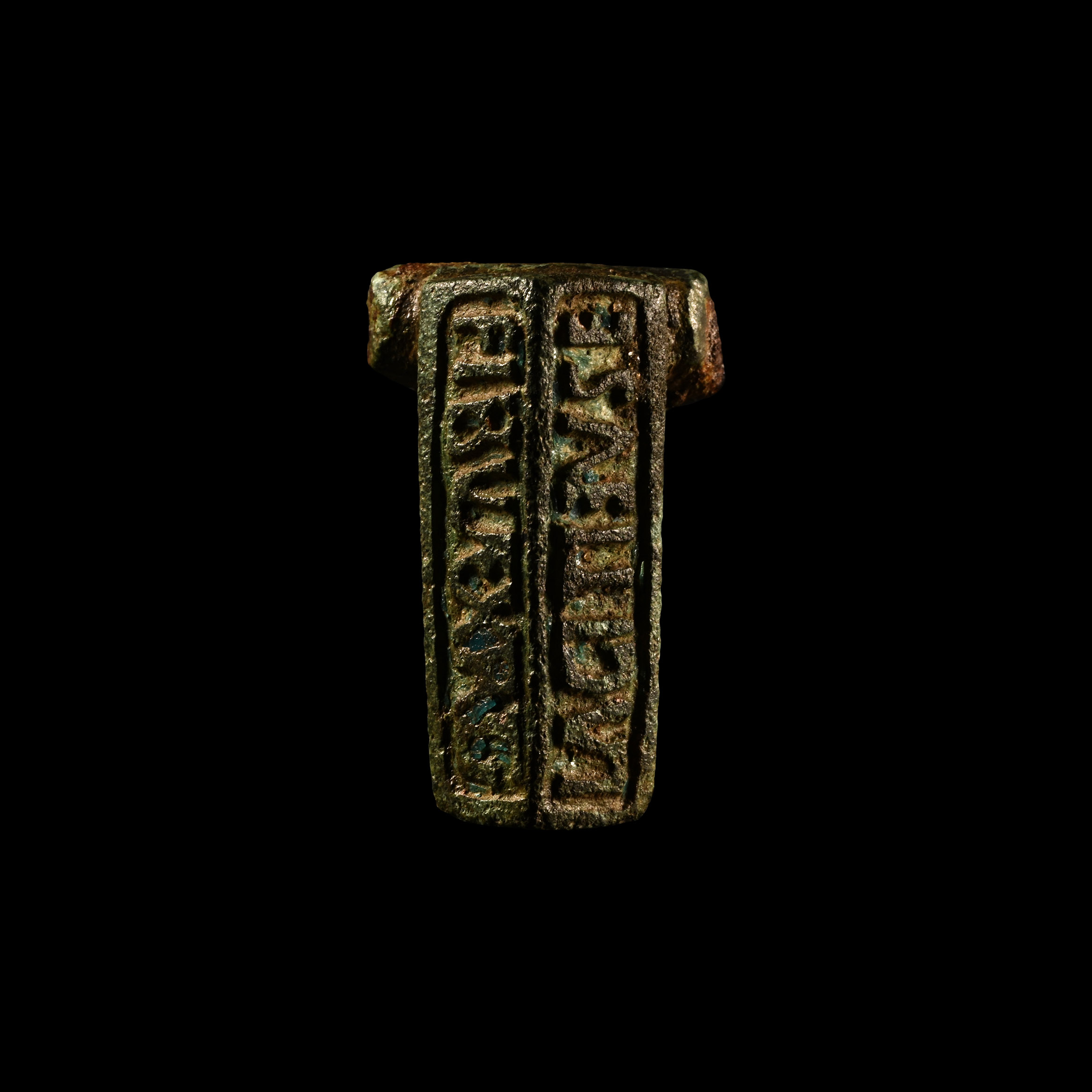
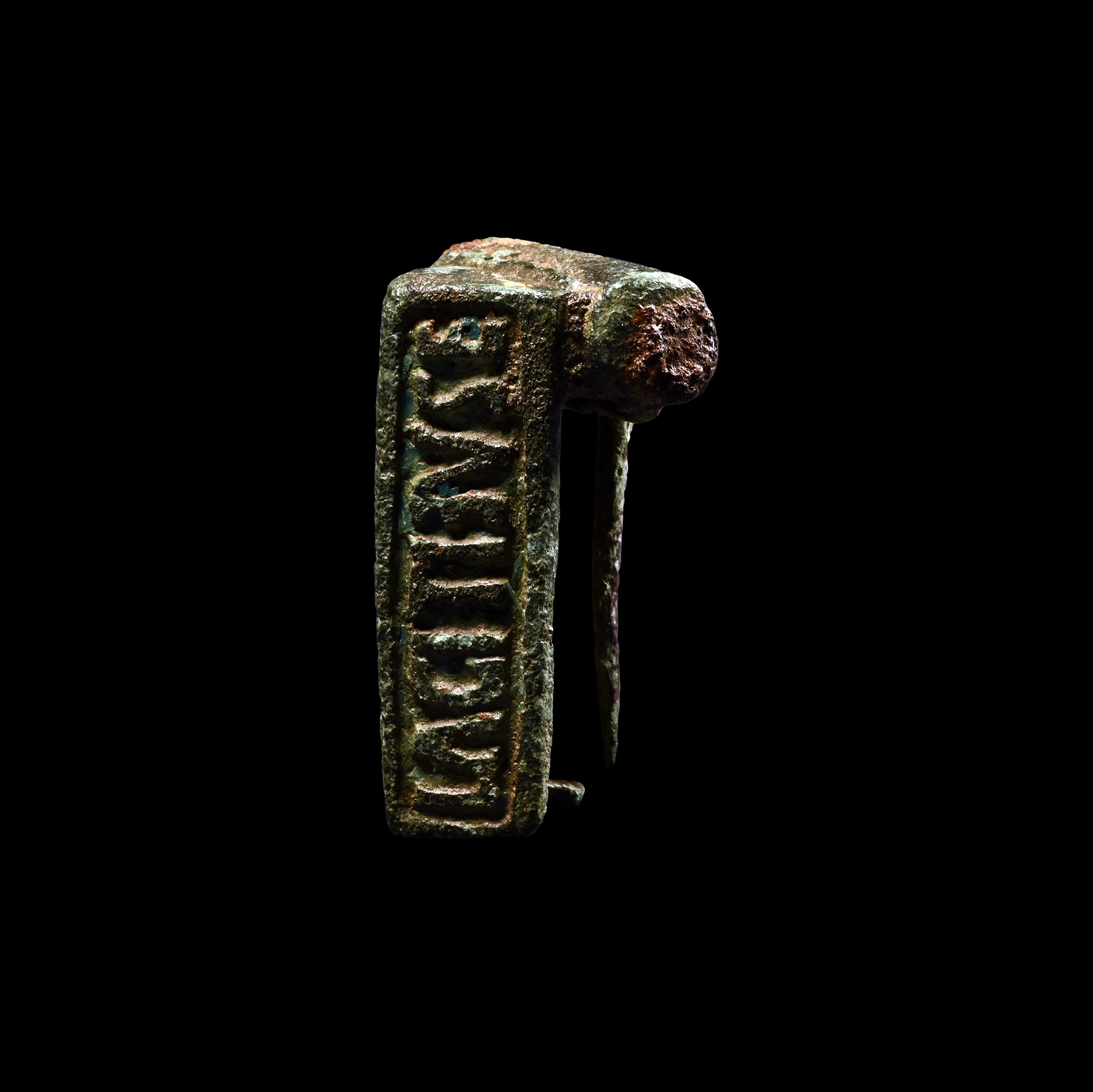
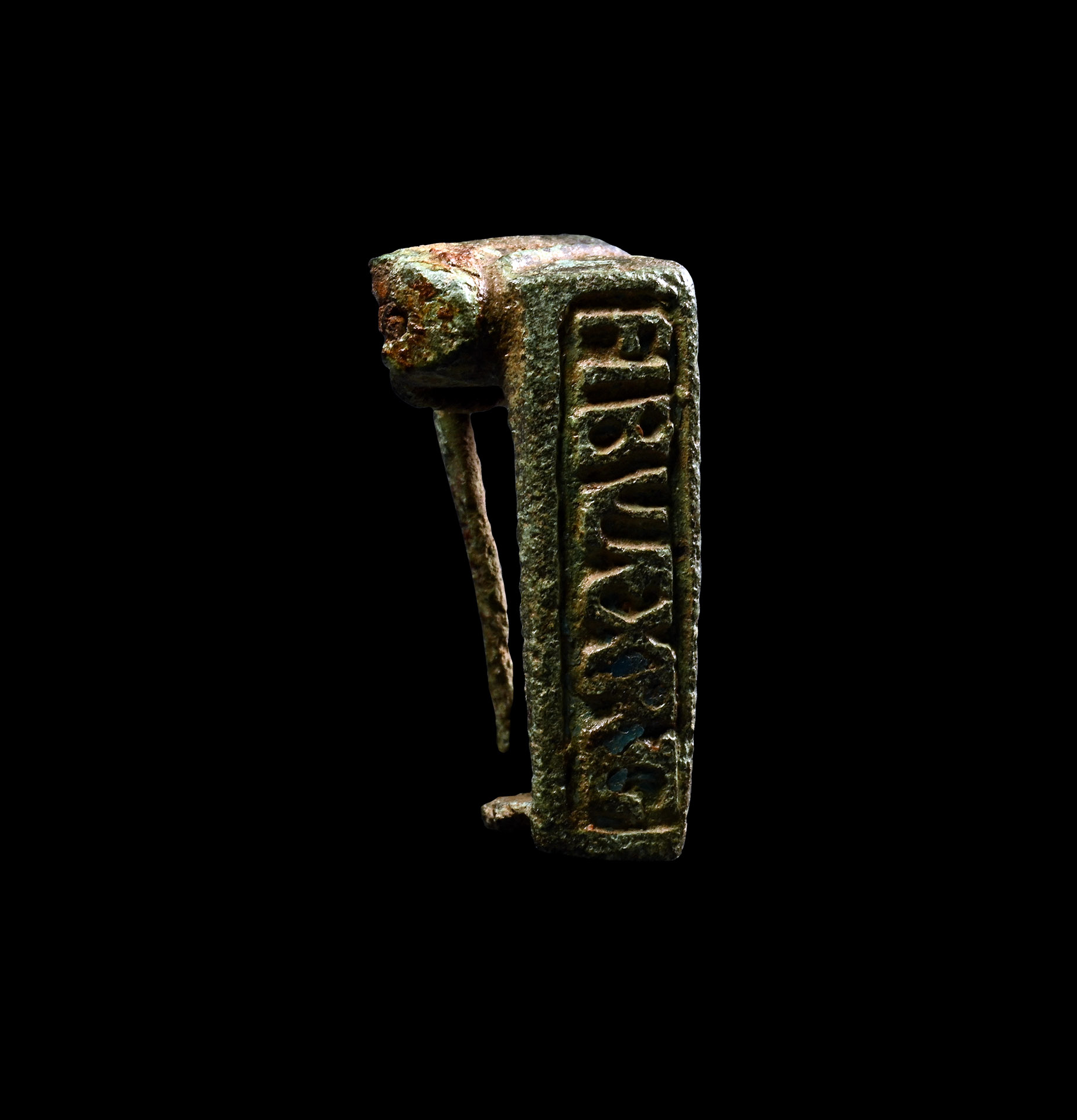
'The Castleford Military Garrison' Romano-British 'Regio Lagitiensis' Inscribed Brooch
LATE 2ND-EARLY 3RD CENTURY A.D.
1 1/8 in. (11 grams, 30 mm wide).
The best example of only three examples of this type known, a copper-alloy knee brooch composed of a rectangular-section body, spring pin within bow plate and remains of catchplate to reverse; both sides of the body with two panels of Latin lettering moulded in relief: 'FIBUL[A] EX REG LAGITIENSE', translating to 'Brooch from the Regio Lagitiensis' (Roman Castleford); remains of blue glass enamelling to the recessed fields.
ProvenanceFound whilst searching with a metal detector near Wickham Market, Suffolk, UK, on 24th September 2022.
Accompanied by a copy of the British Museum's Portable Antiquities Scheme (PAS) report with record number: SF-F57791.
Accompanied by a copy of an article on Castleford Vicus and a similar brooch found in the Alford area of Lincolnshire, UK.
The brooch can be classified as a knee brooch of Mackreth's Type 3 (2011, Vol 1: 190), an example of which is illustrated in Mackreth 2011, vol 2, p.134, pl.131, no.5243; also see article by Tomlin, R. and Hassell, M., Roman Britain in 2000: Inscriptions’ in Britannia, published in Britannia, vol.32, pp.387-400, 2001, for details of inscriptions found on Roman objects recovered in Britain in 2000 and discussion regarding the location of an extensive enamelled bronzeware manufactory in the vicinity of Roman Castleford.
FootnotesCastleford is known to have been a regiones, an administrative centre for lands owned directly by the Emperor. Other known regiones in Britain were Bath, Carlisle and Ribchester. Regiones appear to have been administered by military officers of centurion rank. Crucially for our item, Castleford’s status as one of the regiones is known from the separate finds of two metal brooches with the same inscriptions discovered by metal detectorists; one from North Lincolnshire, the other from an unknown find-spot, now our third example, found in Suffolk.
The third brooch, offered for sale here, is the best known example of the Castleford (Lagentium) vicus brooch, and the only complete example of the three known to exist. These brooches are seemingly unique amongst Roman artefacts in incorporating the name of their place of production into their decorative scheme. A vicus is the civilian settlement located outside the Roman fort. The triangular-section brooch body possibly alludes to the pitched and tiled roof of a military building.
Roman Castleford began life in circa 71 A.D. as a fort constructed as part of the conquest of northern England. The garrison attracted local traders and a small settlement grew nearby. Excavation of this settlement suggests that the inhabitants were making and repairing military equipment for the soldiers, and it is likely that these workshops continued to profit when the fort was abandoned around 100 A.D; Castleford is unusual in this respect, since the Roman army typically demolished their forts once the area had been pacified, at which point, any associated settlements usually disappeared too. At Castleford in contrast, the town remained and continued to prosper, likely because of its port location which facilitated trade with the wider Empire, together with its location on the main road between London and York.
TimeLine Auctions follows a vetting process to ensure the authenticity and legality of all items, reinforcing our commitment to integrity and responsible trading. Each antiquity, antique, and coin lot undergoes thorough examination by a vetting committee of at least ten external specialists, professional trade association members, scientists, and archaeologists: Our Vetting Process
AUCTIONS:
TimeLine is a leading auction house specialising in antiquities, ancient art, collectables, natural history, coins, medals, and books. Our auctions offer museums, collectors, historians, and enthusiasts the opportunity to acquire unique and historically significant pieces.
LOT 0136
'The Castleford Military Garrison' Romano-British 'Regio Lagitiensis' Inscribed Brooch
Sold for (Inc. bp): £4,940
-
.jpg)
Roman Medical Instrument Group
1st-3rd century A.D.Sold for (Inc. bp): £25
A group of two medical instruments comprising: a probe with one thick rounded end and a triangular blade to the other; a probe with one knopped end and a flat spoon or pallette to the other. 26.9 grams total, 12.3-16 cm
Fine condition.
Ex UK art market, 1970s. Property of a London gentleman. -
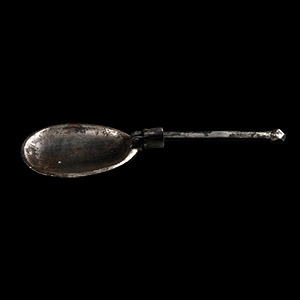
Roman Silver Folding 'Travel' Spoon
Circa 4th century A.D.Sold for (Inc. bp): £494
A short silver spoon with shallow piriform bowl, raised neck with movable pinned hinge attached to the hexagonal-section handle and shortened polyhedral knob finial, allowing the handle to be folded into the bowl. 28 grams, 11.2 cm long
Early 1990s London collection. Acquired on the UK art market. From a private collection, Lancashire, UK.
As today, the spoon was used as a measure for dosage in ancient times. Both the cochlear and the ligula could have been used to measure different quantities, particularly in the practice of medicine and in the kitchen. Isidore (Origines, XVI, 26.3) tells us that the cochlear was the smallest unit size and was worth half a drachma. -
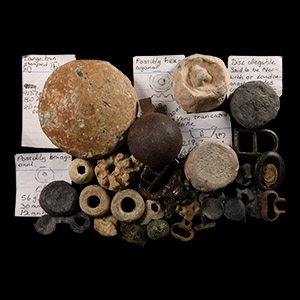
Roman to Civil War Artefact Group
1st-17th century A.D.Sold for (Inc. bp): £26
A group of detector finds including lead trade weights, thimbles, buckles, seals, buttons and other items. 1.87 kg total, 19-78 mm
Found UK. Ex property of a Nottingham, UK, collector.
