
Loading, please wait...


LOT 0384
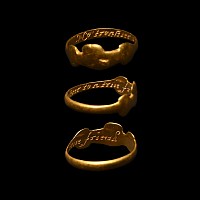
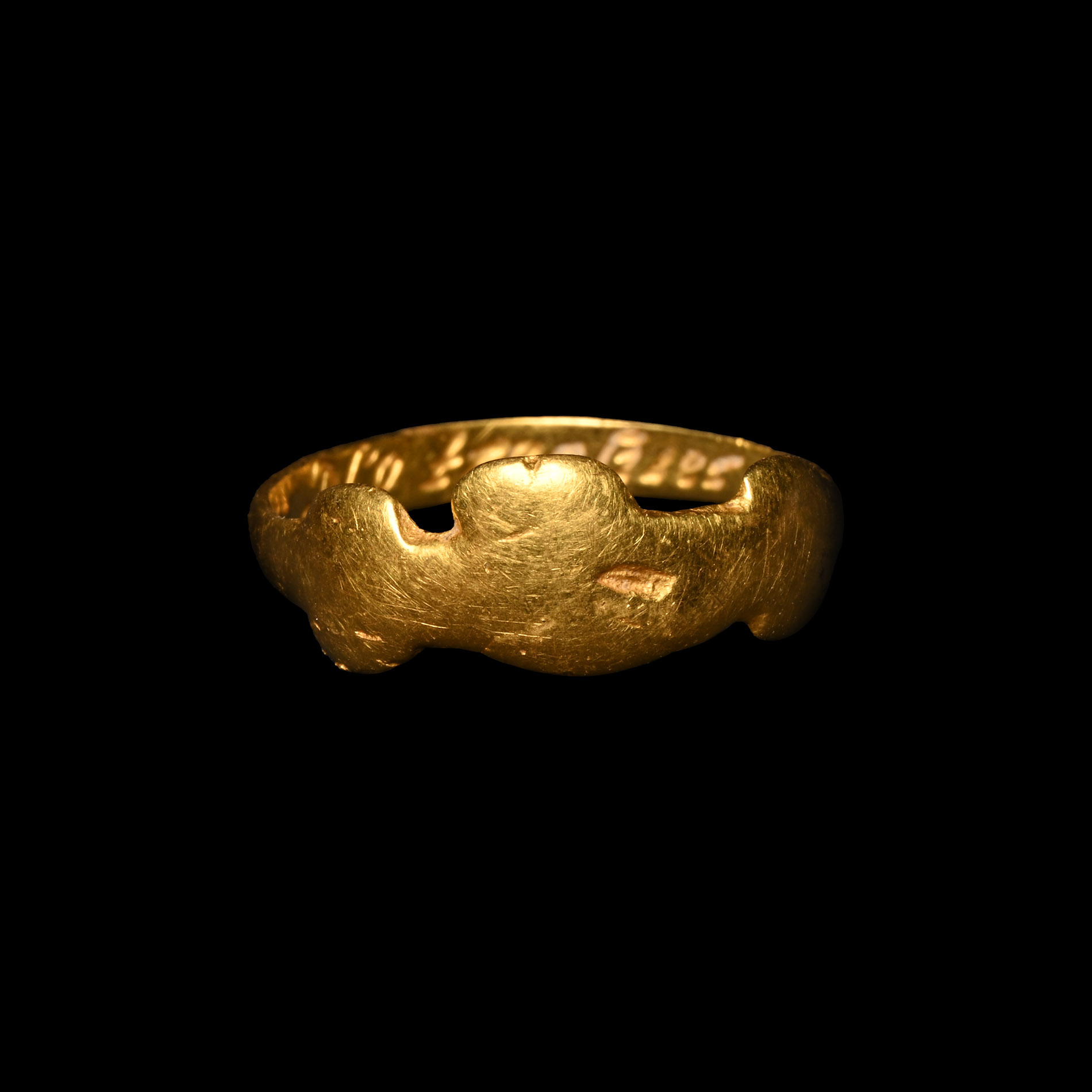
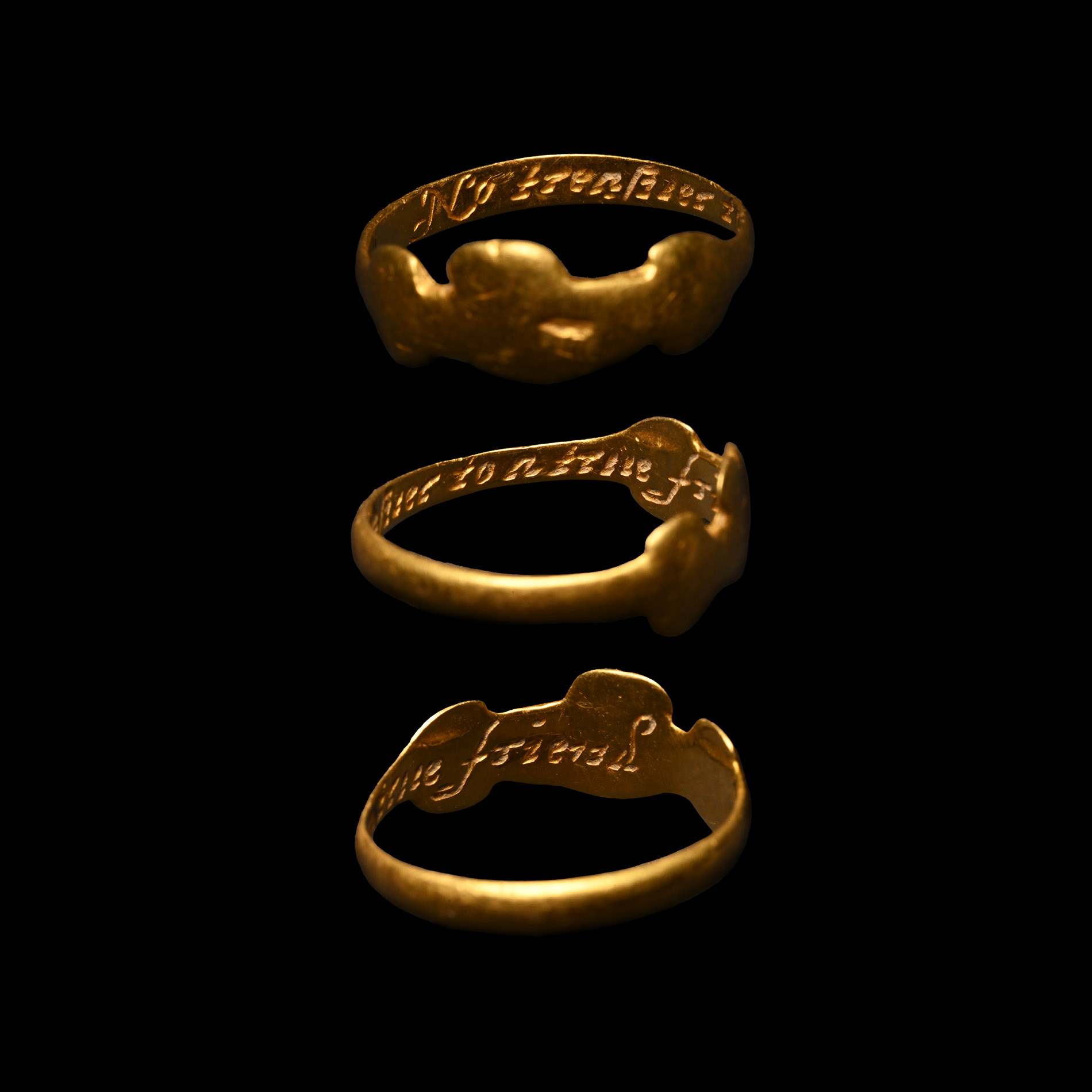
'The Burstow' Clasped Hands 'No Treasure to a True Friend' Gold Posy Ring
1650-1780 A.D.
3/4 in. (2.26 grams, 18.54 mm overall, 16.40 mm internal diameter (approximate size British L, USA 5 3/4, Europe 11.24, Japan 10)).
The bezel with a clasped hands motif with a heart at the centre and elaborate cuffs, narrow D-section hoop; inscribed to the inner face 'No treasure to a true friend' with a long S, worn maker's mark at the end of the inscription, appearing to have the letters 'IV' or IW' in Roman capitals within a simple escutcheon.
ProvenanceFound near Burstow, Tanbridge, Surrey, UK, on Monday 1st May 2023; disclaimed with treasure reference 2023 T419.
Accompanied by a copy of the British Museum's Portable Antiquities Scheme report no.SUR-OAA74B.
This lot is accompanied by an illustrated lot declaration signed by the Head of the Antiquities Department, Dr Raffaele D’Amato.
Cf. Jackson, C.J., English Goldsmiths and Their Marks: A History of the Goldsmiths and Plate Workers of England, Scotland and Ireland, London, 1905, for the maker's mark; cf. Evans, J., English posies and Posy Rings, London, 1931, p.85, for variations of this inscription.
FootnotesIf the maker's mark is 'IV' it may correspond to John Vickerman, a goldsmith active in London from 1768 to 1773. Alternatively, if the maker's mark is 'IW' it may correspond to a number of makers: John Williamson, 1650; John Ward, 1660; James Wilkes, 1722; or John White, 1724.
CONDITIONTimeLine Auctions follows a vetting process to ensure the authenticity and legality of all items, reinforcing our commitment to integrity and responsible trading. Each antiquity, antique, and coin lot undergoes thorough examination by a vetting committee of at least ten external specialists, professional trade association members, scientists, and archaeologists: Our Vetting Process
AUCTIONS:
TimeLine is a leading auction house specialising in antiquities, ancient art, collectables, natural history, coins, medals, and books. Our auctions offer museums, collectors, historians, and enthusiasts the opportunity to acquire unique and historically significant pieces.
LOT 0384
'The Burstow' Clasped Hands 'No Treasure to a True Friend' Gold Posy Ring
Sold for (Inc. bp): £624
-
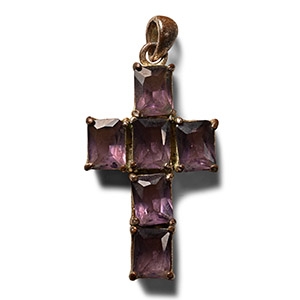
Silvered Cross Pendant with Amethyst Gemstones
Circa 19th century A.D.Sold for (Inc. bp): £85
Cruciform in plan with open reverse to each cell, inset table-cut amethysts, plain bale. 7.68 grams, 43 mm
Acquired on the London art market in the late 1980s-1990s. From the family collection of an East London, UK, gentleman. This lot is accompanied by an illustrated lot declaration signed by the Head of the Antiquities Department, Dr Raffaele D’Amato. -
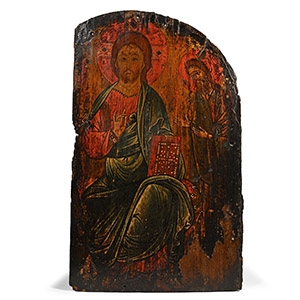
Large Cretan Wooden Icon Fragment of Deesis with Christ Pantocrator and Saint John the Prodromos
Circa 1670 A.D.Estimate: £1,200 - 1,700 (+bp*)
Opening Bid: £650
Depicting Christ Pantocrator and Saint John on his side, hand of Mary visible on the left; the Lord of the Universe represented seated upon a cushioned throne, the right hand in blessing gesture, the left hand holding a Gospel decorated with precious stones; wearing a blue chlamys and red sticharion; Saint John in proskynesis in front of Christ, dressed in a brown vestis talaris; the head of both surrounded by a red halo; later wire for hanging to the reverse with an information sheet in German. 1.8 kg, 57 cm
Ex Hargesheimen Auction House, Dusseldorf, Germany. Property of a London, UK, gentleman collector. This lot is accompanied by an illustrated lot declaration signed by the Head of the Antiquities Department, Dr Raffaele D’Amato.
The icon represents a middle section from a Deesis of a church iconostasis. Although preserved as a fragment, it is designed in the high style of the late 16th century. -

Roman Style Limestone Statuette Torso
20th century A.D. or earlierSold for (Inc. bp): £26
Carved in the round, hips and groin of a female with cloth to the rear. 76 grams, 62 mm
Acquired on the UK art market, before 2000. This lot is accompanied by an illustrated lot declaration signed by the Head of the Antiquities Department, Dr Raffaele D’Amato.
