
Loading, please wait...
_900x900.jpg "'The Bassetlaw' Hiberno-Saxon Gilt Bronze Mount with Dragons")
_200x200.jpg "'The Bassetlaw' Hiberno-Saxon Gilt Bronze Mount with Dragons")
.jpg "'The Bassetlaw' Hiberno-Saxon Gilt Bronze Mount with Dragons")
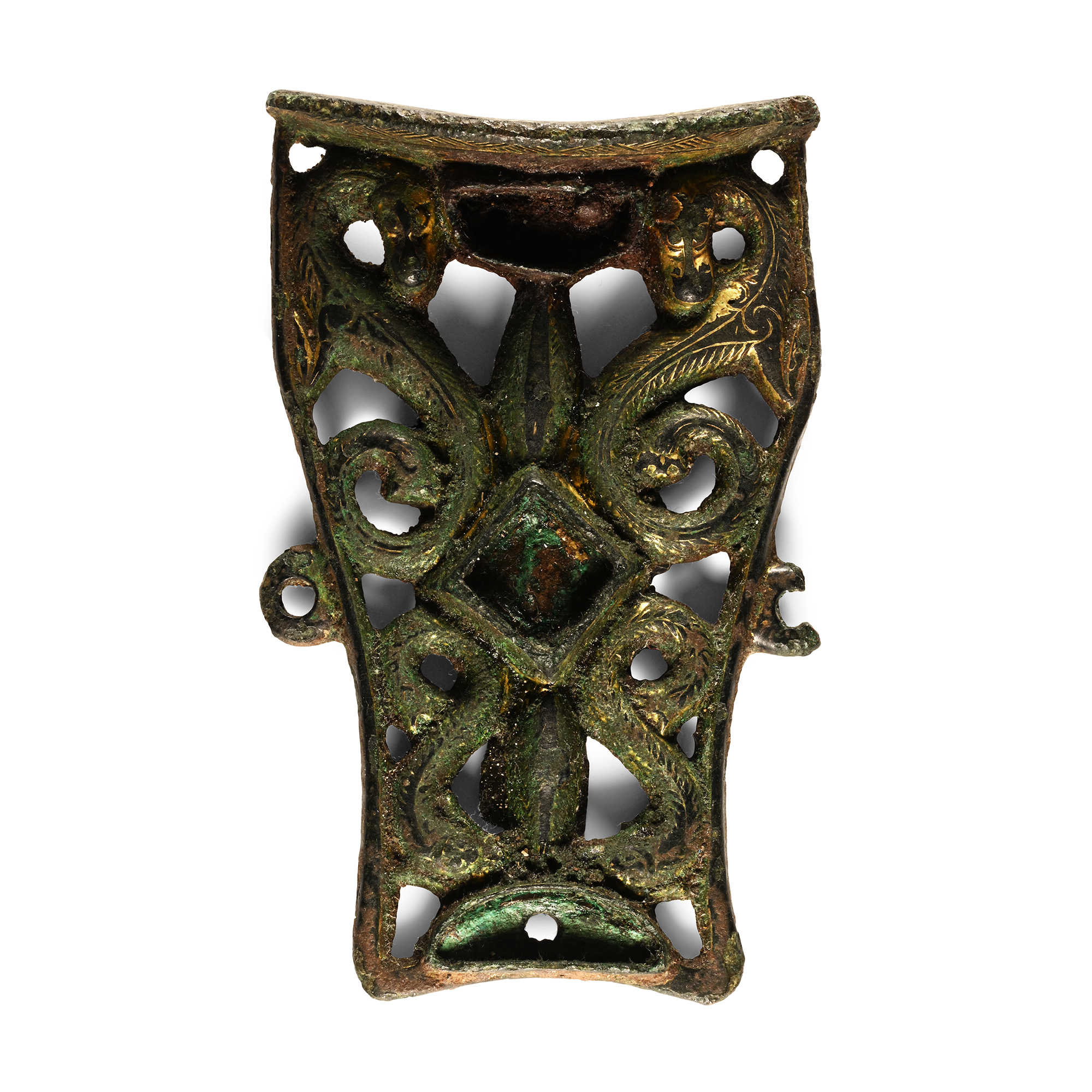
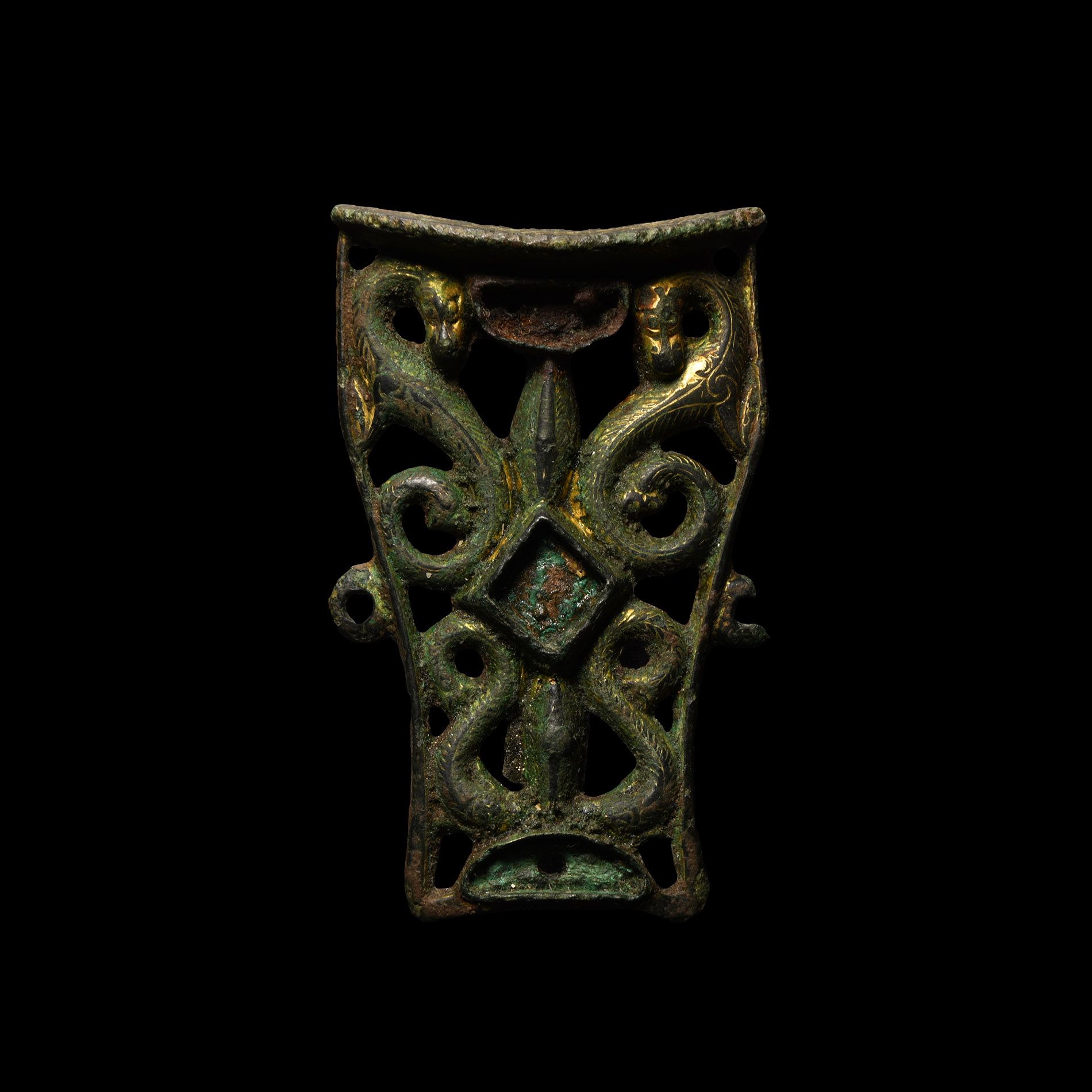
LOT 0376
'The Bassetlaw' Hiberno-Saxon Gilt Bronze Mount with Dragons
LATE 7TH-8TH CENTURY A.D.
3 1/2 in. (84 grams, 87 mm).
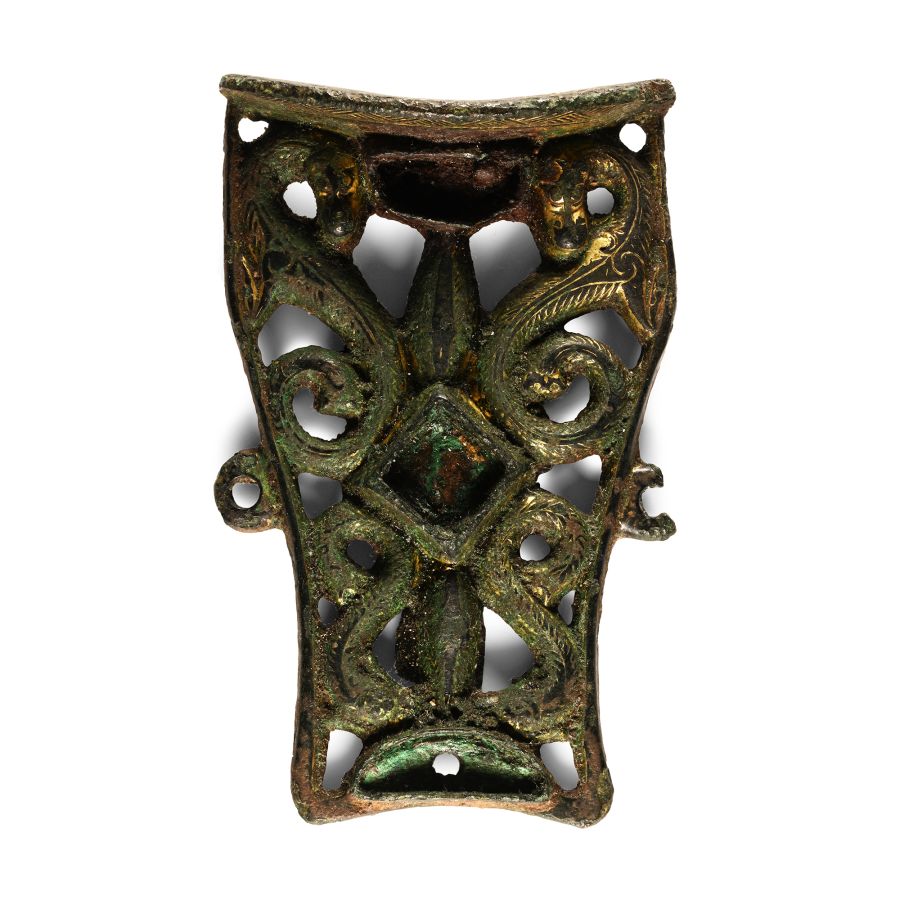
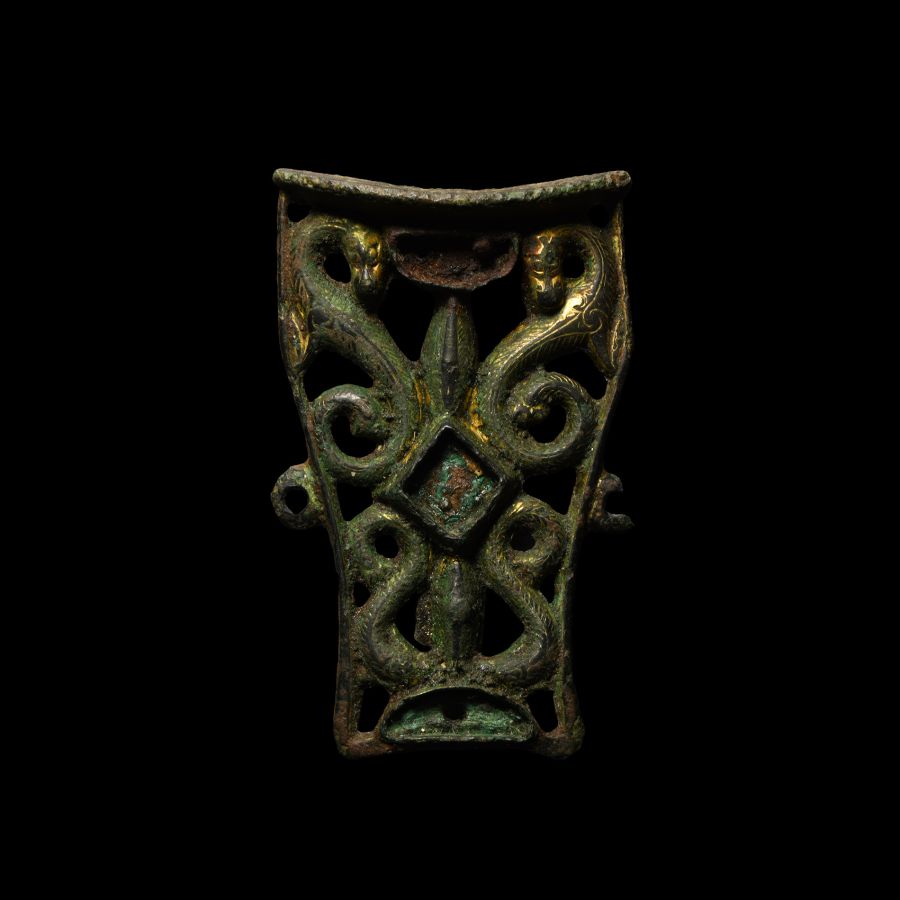
A large openwork fitting, D-shaped in section with incised running keystone and zigzag to the upper and lower faces; openwork plate waisted in profile and formed as three cells flanked by S-coiled beasts; the upper beasts with one raised three-toed forelimb, D-shaped facing mask with pellet eyes, hatched detailing to the body, tribrach to the shoulder, clubbed tail coiled against the body; the lower beasts similar with anguiform details; the upper and lower cells D-shaped, the central one a lozenge, with a column of a hatched fish between; pierced at the upper corners and lower cell, two lateral pierced attachment lugs; ferrous remains, lug and part of a separate rivetted bronze plate to the reverse.
ProvenanceFound whilst searching with a metal detector in Bassetlaw, Nottinghamshire, East Midlands, UK, from Tuesday 1 January to Wednesday 1 May 2013.
with TimeLine Auctions, 23 May 2017, no.494.
Accompanied by a copy of the British Museum's Portable Antiquities Scheme (PAS) six page report with refence no.DENO-4207C5 and is designated as 'a find of note'.
This lot has been checked against the Interpol Database of stolen works of art and is accompanied by search certificate no.12077-210997.
See Arrhenius, B., Merovingian Garnet Jewellery, Stockholm, 1985; Bourke, C. Irish Croziers of the Eighth and Ninth Centuries in Ryan, M. (ed.) Ireland and Insular Art AD 500-1200, Dublin, 1987; Webster, L. & Backhouse, J., The Making of England. Anglo-Saxon Art and Culture AD 600-900, London, 1991; Laing, L. A Catalogue of Celtic Ornamental Metalwork in the British Isles c.AD 400-1200, BAR British Series 229, Oxford, 1993, item 244 (Steeple Bumpstead boss); Carver, M., Sutton Hoo. A Seventh Century Princely Burial Ground and its Context, London, 2005.
FootnotesThis mount is unusual, although its decoration and manufacturing techniques point to an origin in the British Isles in the 7th-9th centuries. Its D-shaped upper face or ledge indicates that it is not the standard flat form of scabbard or harp fitting. The openwork nature of the casting is equally unusual, although the Steeple Bumpstead boss (British Museum accession no. 1916,0705.1) is formed with an openwork frame into which gilt bronze panels have been inserted, and several Irish croziers were manufactured in this manner (Bourke, 1987).
The cells were probably intended to accept a glass inset gem, or an ivory or millefiori panel, although the inner panel of the central cell shows signs of having been gilded as if to reflect light through a translucent gem in the same manner as the foils placed behind the garnets on 6th-7th century Anglo-Saxon jewellery and weapon-fittings (Arrhenius, 1985; Carver, 2005).
The beasts (especially the upper pair) show strong Irish influence in their design, which is found elsewhere in Northumbrian art in the 8th-9th century as for example on the brow fittings of the Coppergate helmet (Webster & Backhouse, item 47). Similar heads in profile appear on the scabbard chapes from the St. Ninian's Isle Treasure (Wilson, plate IV). The overall design of the piece is tentatively identified with the 'fish flanked by birds' motif seen for example in the Staffordshire Hoard, probably of later 7th century date.
TimeLine Auctions follows a vetting process to ensure the authenticity and legality of all items, reinforcing our commitment to integrity and responsible trading. Each antiquity, antique, and coin lot undergoes thorough examination by a vetting committee of at least ten external specialists, professional trade association members, scientists, and archaeologists: Our Vetting Process
AUCTIONS:
TimeLine is a leading auction house specialising in antiquities, ancient art, collectables, natural history, coins, medals, and books. Our auctions offer museums, collectors, historians, and enthusiasts the opportunity to acquire unique and historically significant pieces.
LOT 0376
'The Bassetlaw' Hiberno-Saxon Gilt Bronze Mount with Dragons
Sold for (Inc. bp): £845
-
Saxon Gold Pendant and Necklace Bead Group
Circa 6th century A.D. and laterSold for (Inc. bp): £234
Mixed group including gold-in-glass, melon, oblate, tabular and other types; gold disc pendant with punched pellets to the loop and flan. 66 grams total, 6-29 mm
From a collection acquired on the UK art market from various auction houses and collections mostly before 2000. From an important Cambridgeshire estate; thence by descent. -
Anglo-Saxon Greyware Pottery Fragment Collection
6th-8th century A.D.Sold for (Inc. bp): £20
Mixed group of pottery shards including Ipswich Ware and other types. 682 grams total, 33-90 mm
UK gallery, early 2000s. -
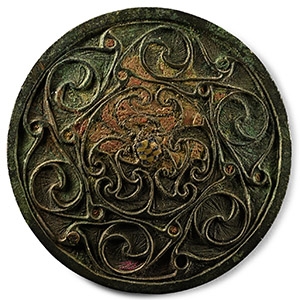
'The Driffield' Anglo-Saxon Enamelled Bowl Mount
Circa 500-700 A.D.Sold for (Inc. bp): £4,160
With a slightly domed profile and a raised circumferential border to the upper face; decorated with Celtic designs featuring elaborate curvilinear tendrils and triskele-style swirls enclosing an area of fine-line trumpet spiral designs, set around a central rectangular panel filled with millefiori-style enamel work in the form of an irregular chequerboard of blue and yellow enamel, the circular recesses retaining red enamel traces; two parallel rivets to the reverse. 23.4 grams, 51 mm
Found whilst searching with a metal detector near Driffield, East Riding of Yorkshire, UK, in 2018. Accompanied by a copy of the British Museum's Portable Antiquities Scheme (PAS) report no.YORYM-73B821. This lot has been checked against the Interpol Database of stolen works of art and is accompanied by search certificate no.12075-124454.
