
Loading, please wait...
LOT 0322
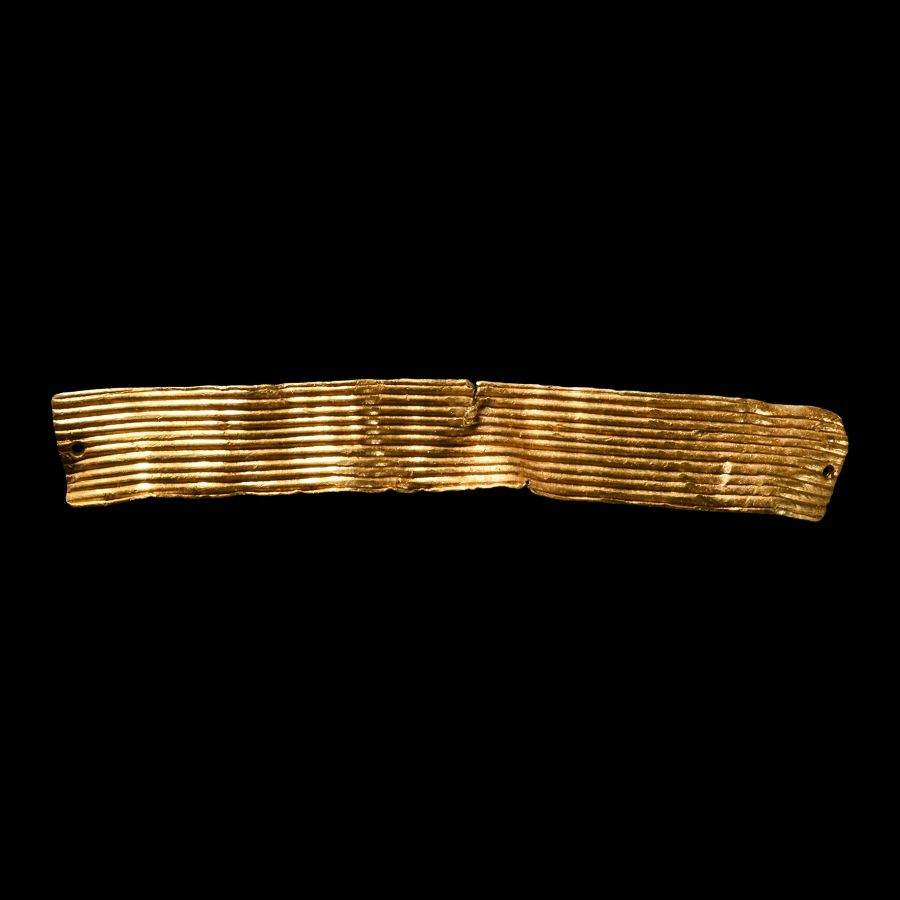
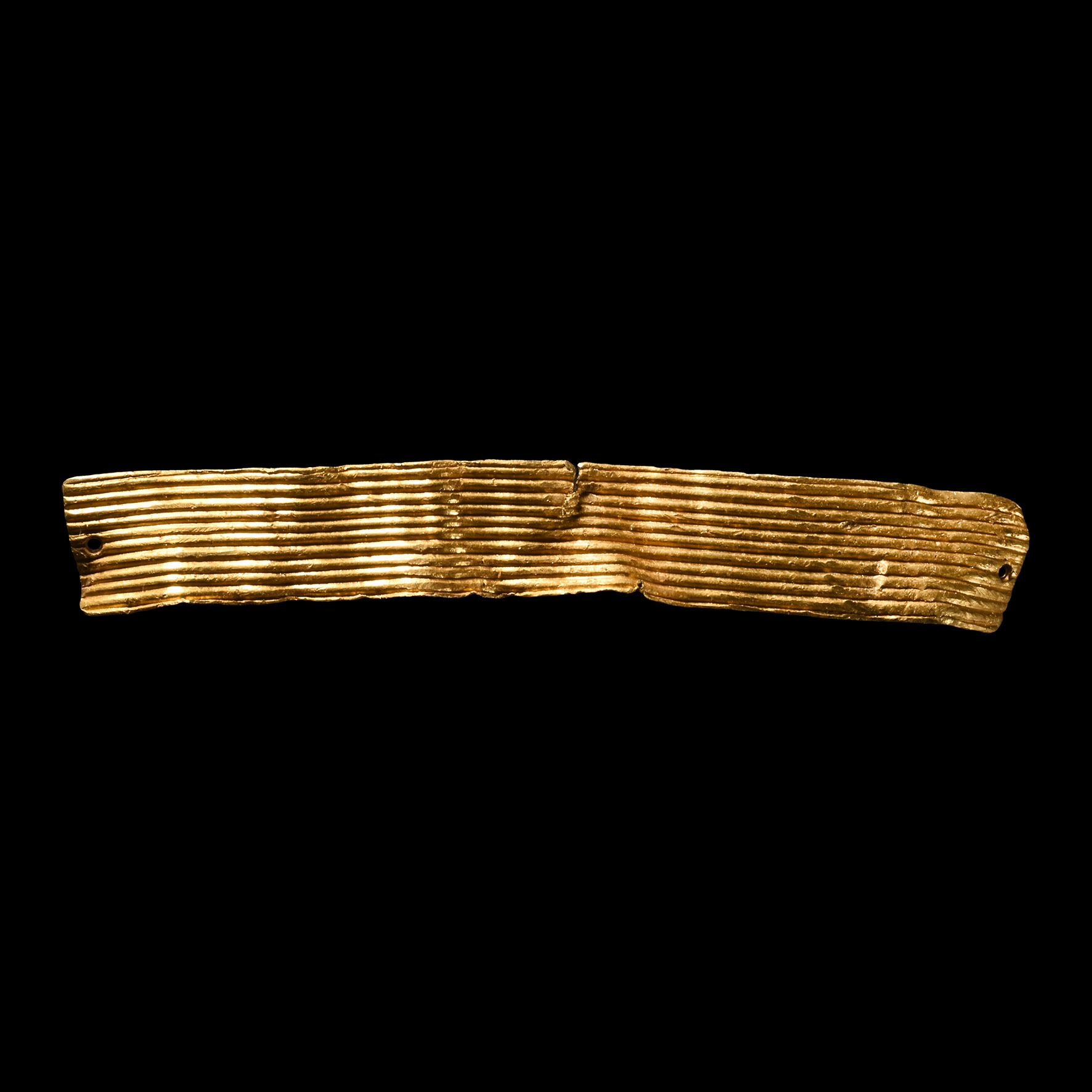
'The Alresford' Gold Bronze Age Cordon Adornment
CIRCA 2350-800 B.C.
3 in. (4.73 grams, 73.56 mm).
Rectangular sheet-gold ribbon, plaque or cordon with reeded outer face and plain reverse, mounting hole to each end.
ProvenanceFound whilst searching with a metal detector in Alresford, Essex, UK, on Thursday 2nd June 2022 by Peter Wilson.
Accompanied by a copy of the British Museum's Portable Antiquities Scheme (PAS) report no.ESS-71837F.
Accompanied by a copy of the Treasure Act 1996 DCMS object receipt.
Accompanied by a copy of the Report on find of Potential Treasure for H M Coroner from Alresford, Essex.
Accompanied by a copy of the letter from the British Museum disclaiming the Crown's interest in this find with Treasure case reference no.2022T575.
Accompanied by a typed and signed letter from the finder explaining the circumstances of discovery.
Cf. similar items in the British Museum under accession nos. 1906,1224.1, 1906,1224.2; see Eogan, G., The Accomplished Art. Gold and Gold-Wrkingin Britain and Ireland During the Bronze Age, Oxford, 1994.
FootnotesThe exact purpose of these gold ribbons is unclear although it is very likely that they were used to adorn either personal adornments or tableware. The Rillaton Cup (Royal Collection accession no. RCIN 69742) is one such item made of gold with a corrugated appearance. The strip is rather more substantial than the majority of Bronze Age finds and resembles those found in the Staffordshire Hoard (Fern, C., Dickinson, T. & Webster, L., The Staffordshire Hoard: an Anglo-Saxon Treasure, London, 2019).
CONDITIONTimeLine Auctions follows a vetting process to ensure the authenticity and legality of all items, reinforcing our commitment to integrity and responsible trading. Each antiquity, antique, and coin lot undergoes thorough examination by a vetting committee of at least ten external specialists, professional trade association members, scientists, and archaeologists: Our Vetting Process
AUCTIONS:
TimeLine is a leading auction house specialising in antiquities, ancient art, collectables, natural history, coins, medals, and books. Our auctions offer museums, collectors, historians, and enthusiasts the opportunity to acquire unique and historically significant pieces.
-
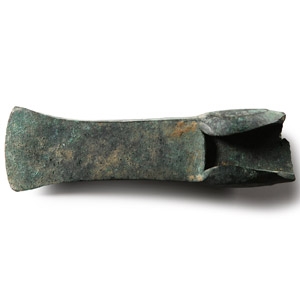
Bronze Age British Palstave Axehead
1400-1150 B.C.Sold for (Inc. bp): £169
With leaf-shaped lateral flanges, mid-stop with deep ledge, flared blade with curved edge; butt absent. 168 grams, 10.7 cm
Found Cambridgeshire, UK, 2000s. Property of an Essex gentleman. -
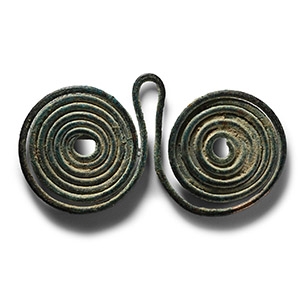
Bronze Age Spectacle Pendant
Circa 10th-6th century B.C.Sold for (Inc. bp): £91
Composed of two coiled wire discs with integral loop between. 7.21 grams, 50 mm
Ex old English collection. London art market, pre 2000. Property of a London, UK, gentleman. -
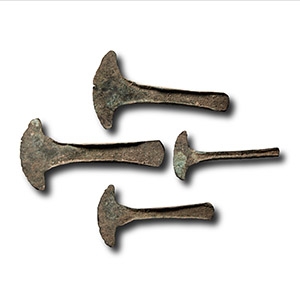
Bronze Age Miniature Graduated Votive Palstave Axehead Collection
3rd-2nd century B.C.Sold for (Inc. bp): £195
Group of miniature palstaves each with transverse lunate balde, raised lateral flanges to the shank. 12.9 grams total, 37-50 mm
Private collection formed in the 1990s. Acquired from a central London gallery. Property of an Essex gentleman.
