
Loading, please wait...
LOT 0227
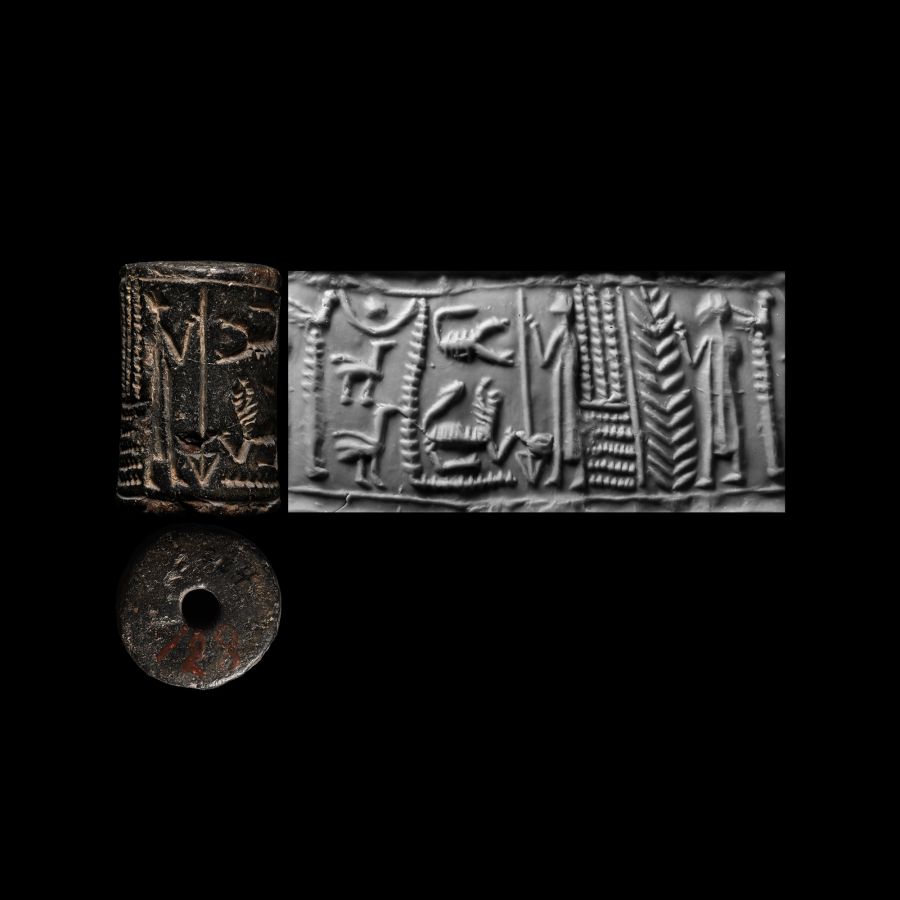
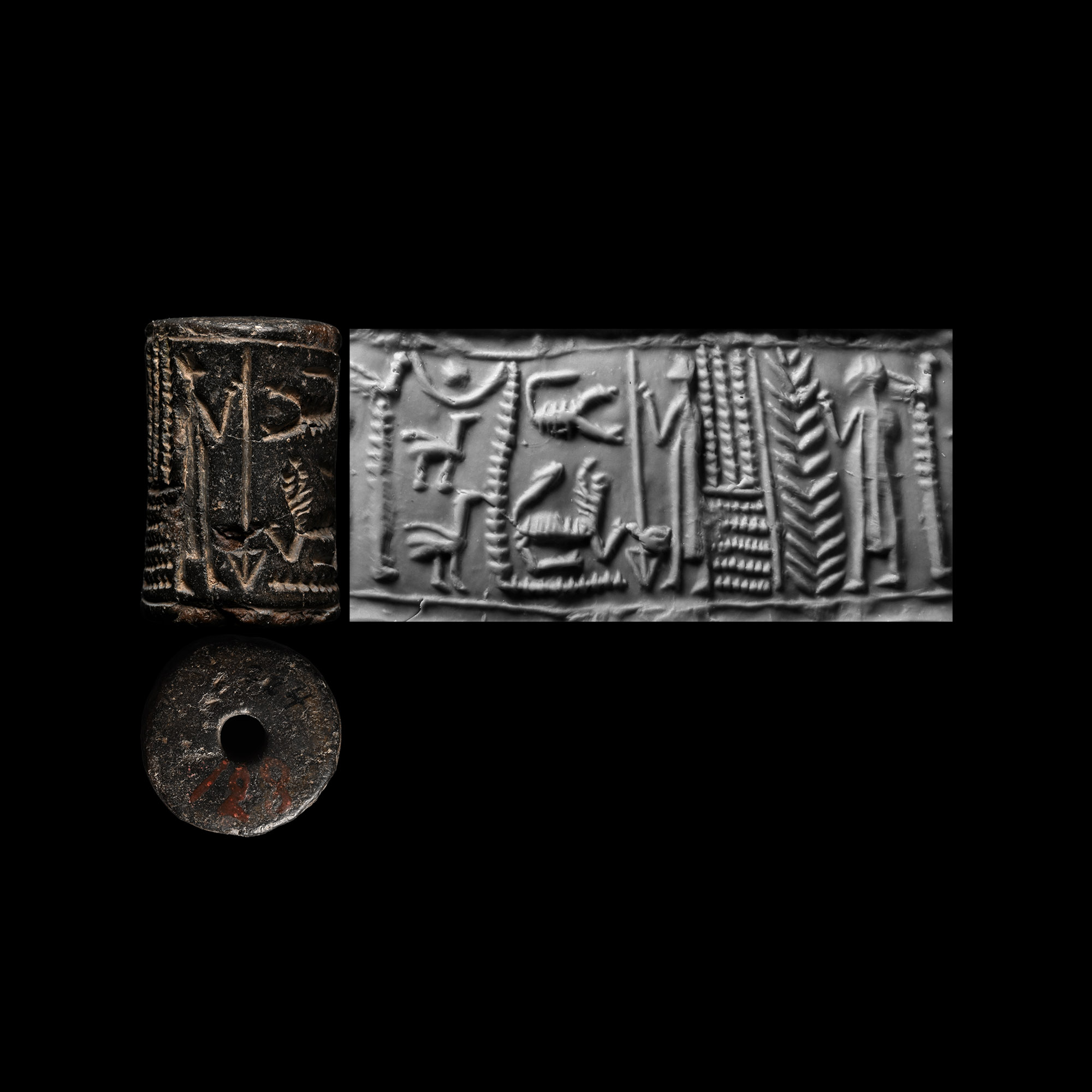
'The Ada Moore' Syrian Black Stone Cylinder Seal with Standing Figure and Scorpion
SYRIA, 2800-2400 B.C.
1 1/2 in. (35 grams, 38 mm).
Cylinder seal with frieze; accompanied by an old scholarly note, typed and signed by W.G. Lambert, late Professor of Assyriology, University of Birmingham, 1970-1993, which states: "Cylinder Seal of Soft Black Stone. 37 x 25 mm. There are two standing human-looking figures, both clad in robes reaching to mid-calf level, and both having one hand raised. The one faces a tree or bush, the other standing against a background design of uncertain interpretation seems to hold a long spear downwards. The remaining space is divided up by two notched lines, on the top of one of which a bird is perching, and the remaining space is filled with a scorpion, a lion, a quadruped and another bird, while a lunar crescent and very small star occupy an area in the sky. The whole design is placed between upper and lower rulings. This is a Syrian seal, c. 2000-1800 B.C. done in a crude style but one full of interest. It is large and in fine condition and though the style is known, seals of this large size and with such a varied design are extremely rare.'; supplied with a museum-quality impression. [No Reserve]
ProvenanceThe Collection of Mrs William H. Moore, Eisen, University of Chicago, 1940, no.188.
The Ada Moore Collection of Near Eastern Seals, Sotheby's, New York, Thursday, 12 December 1991, no.92.
Accompanied by a copy of an old scholarly note, typed and signed by W.G. Lambert, late Professor of Assyriology, University of Birmingham, 1992.
TimeLine Auctions follows a vetting process to ensure the authenticity and legality of all items, reinforcing our commitment to integrity and responsible trading. Each antiquity, antique, and coin lot undergoes thorough examination by a vetting committee of at least ten external specialists, professional trade association members, scientists, and archaeologists: Our Vetting Process
AUCTIONS:
TimeLine is a leading auction house specialising in antiquities, ancient art, collectables, natural history, coins, medals, and books. Our auctions offer museums, collectors, historians, and enthusiasts the opportunity to acquire unique and historically significant pieces.
LOT 0227
'The Ada Moore' Syrian Black Stone Cylinder Seal with Standing Figure and Scorpion
Sold for (Inc. bp): £1,430
-
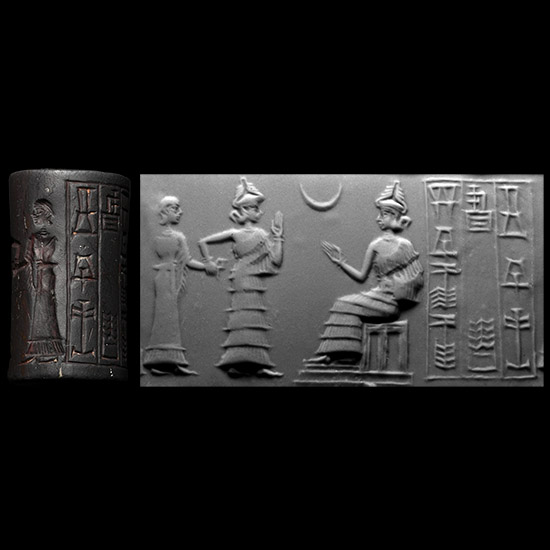
'Professor Erlenmeyer’s First Cylinder Seal' A Neo-Sumerian Haematite Seal of Abbamu, Scribe, Son of Bazige
Mesopotamia, Third Dynasty of Ur, circa 2100-2000 B.C.Sold for (Inc. bp): £8,450
Finely carved in haematite with a formal presentation scene: a goddess sitting enthroned upon a dais, clad in a flounced robe and a multiple-horned tiara, her arm extended in reception; before her a similarly attired interceding goddess approaching, leading a robed worshipper into the divine presence; lunar crescent in the field, with three-line inscription within a panel: 'Abbamu, scribe, son of Bazige'; supplied with a museum-quality impression. 18 grams, 27 mm
From the private collection of Professor Dr. Hans (1900-1967) and Mrs Erlenmeyer, Switzerland. The Erlenmeyer Foundation, Basel Switzerland, since 1981. with Sotheby's, Western Asiatic Cylinder Seals and Antiquities from the Erlenmeyer Collection (Part 1), London, 9 July 1992, no.109. Private collection, London, UK. Accompanied by copies of the relevant Sotheby's catalogue pages. This lot has been checked against the Interpol Database of stolen works of art and is accompanied by search certificate number no.13283-253486.
Prof Hans Erlenmeyer was a noted Swiss collector from 1943 to circa 1960; he and his wife established the Erlenmeyer Foundation. This seal is of particular note as the first cylinder seal given to Professor and Mrs Erlenmeyer. Its imagery belongs to the religious and political language of the Third Dynasty of Ur, when order was restored after the collapse of the Akkadian dynasty. In the eyes of the ancient Mesopotamians, that earlier collapse could be understood as a sign of divine displeasure; under Ur III, renewed piety and correct devotion assumed central importance. The presentation scene seen here reflects that world precisely: the seal owner is led by a minor goddess, or Lamma, into the presence of his personal deity. Seals of this class are valued for their exacting workmanship and disciplined clarity of design. Though they lack the freer energy of the Akkadian age, they possess instead a ceremonial gravity and devotional precision that are wholly characteristic of Neo-Sumerian art. -
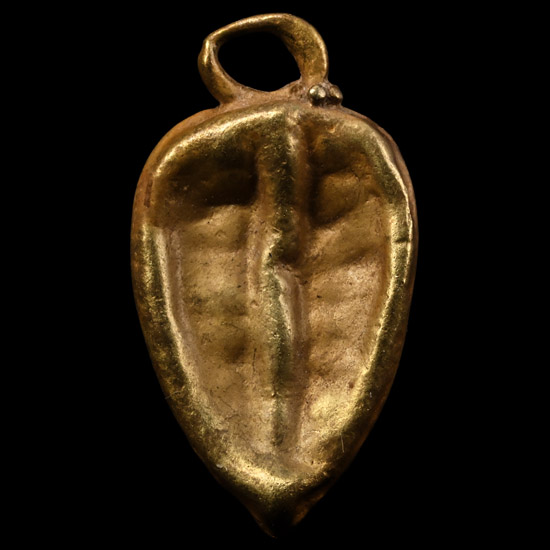
Western Asiatic Gold Heart-Shaped Pendant
1st millennium B.C.Sold for (Inc. bp): £52
Hollow-formed pendant with a raised mid-rib and edge on both sides. 0.56 grams, 13 mm
Ex private British collection, formed in the 1980s. Property of a West Northamptonshire, UK, gentleman. -
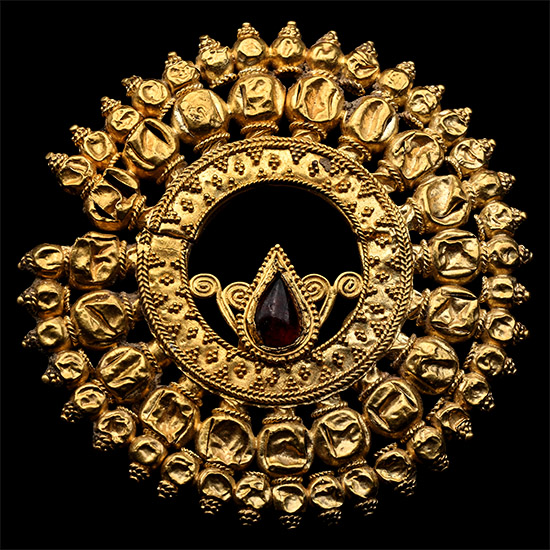
Achaemenid Elaborate Gold Earring
Circa 5th century B.C.Estimate: £3,000 - 4,000 (+bp*)
Opening Bid: £1,500
Crescent plaque with granulated inner borders and radiating triangles of granulation surrounded by a band of nineteen spheres, representing pomegranates, each with a filigree collar above and below, the outer band consisting of smaller spheres with a granulated pyramidal finial, at the centre a teardrop-shaped garnet cabochon set in a cell with a granulated border flanked by spirals. 13.55 grams, 51 mm
Ex David Lindhal, London, UK, in the 1990s. From a privately held London, UK, collection from the 1980s-1990s. This lot has been checked against the Interpol Database of stolen works of art and is accompanied by search certificate number no.13267-253966.
Fruits were generally considered to be a symbol of sensuality, temptation and fertility; the giving and accepting of fruit may be regarded as a symbolic sexual act, or at least a prelude to marriage. It follows naturally that the pomegranate, with its innumerable fleshy seeds symbolising life and fecundity, was an attribute of Aphrodite.
