
Loading, please wait...
LOT 0329
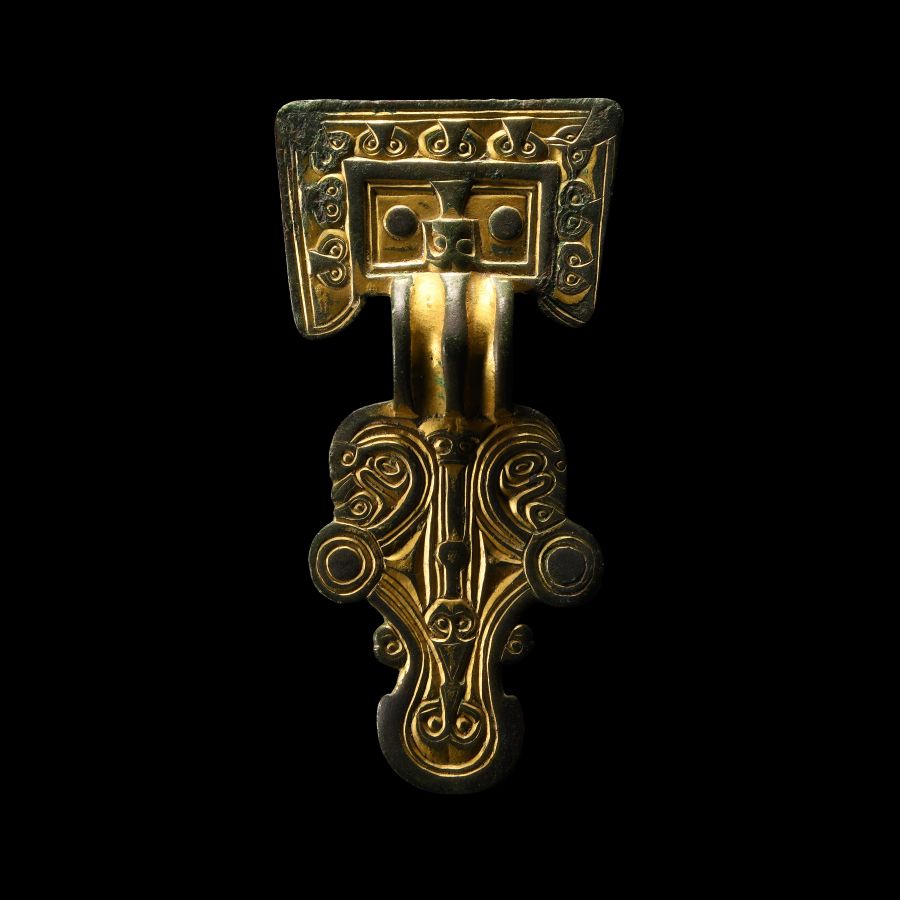
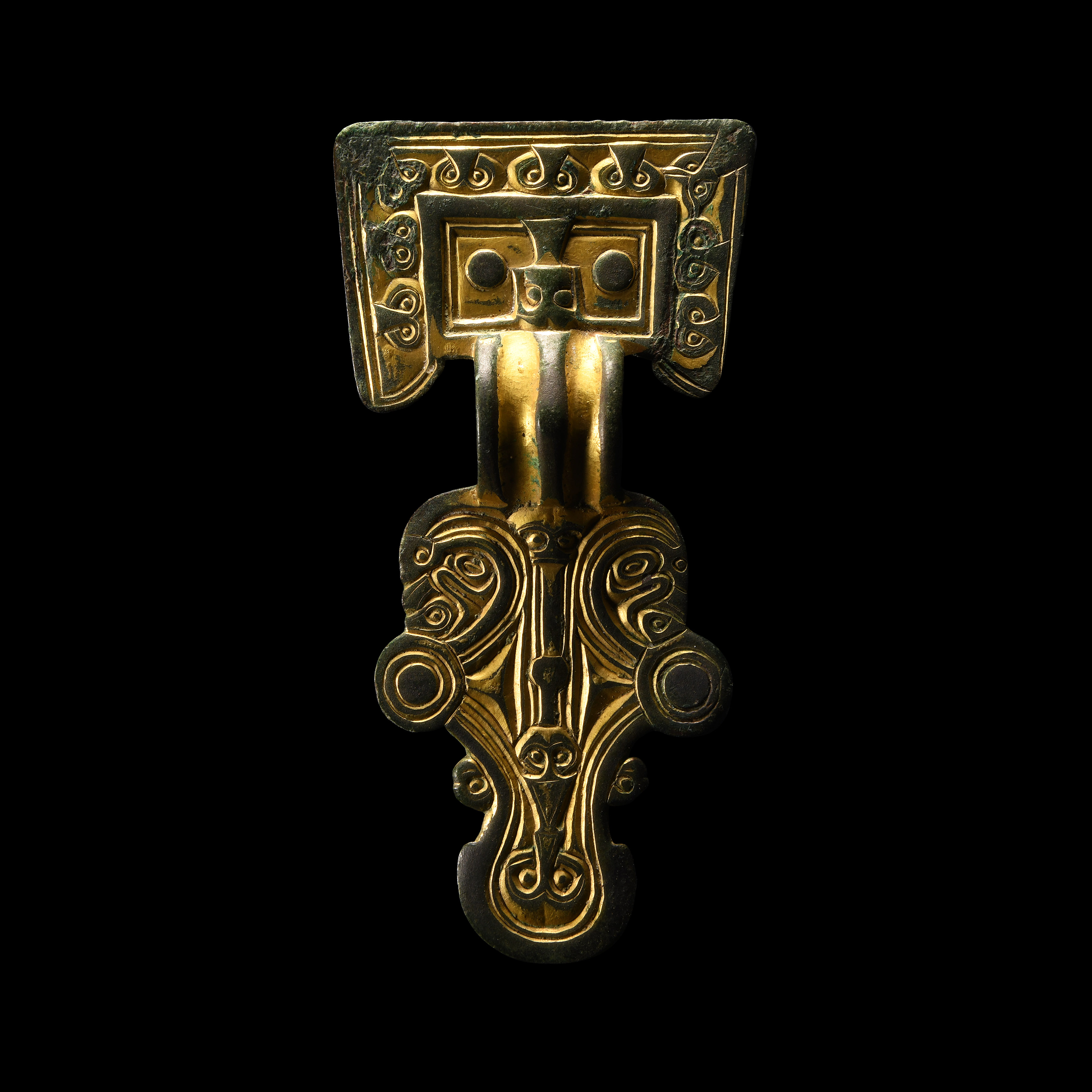
Superb Anglo-Saxon Gilt Bronze Great Square-Headed Brooch
6TH CENTURY A.D.
5 1/2 in. (128 grams, 14 cm).
Of Hines's Group X with two discs on the headplate in a rectangular frame surrounded by a frieze of facing human masks, and another mask placed centrally above the junction with the bow; shallow bow with three ribs; curved horse-head lappets flanking a vertical shank with facing mask detailing, discoid lobes and an inverted mask below; pin-lugs to the reverse and solder-scar where the catchplate was attached.
ProvenanceFound near Grimsby, Humberside, UK, circa 2010.
This lot has been checked against the Interpol Database of stolen works of art and is accompanied by search certificate no.11899-204377.
Cf. Hines, J., A New Corpus of Anglo-Saxon Great Square-Headed Brooches, London, 1997, pl. 101(a); Franceschi, G., Jorn, A. & Magnus, B., Mennesker, Guder og Masker i Nordisk Jernalderkunst, vol.1, Borgen, 2005; Mortimer, P., Woden's Warriors - Warriors and warfare in 6th-7th century Northern Europe, Ely, 2011.
FootnotesThe brooch has many of the characteristics of Hines's Group X but also bears a strong resemblance to an unclassified example from Barrington A, Cambridgeshire (Hines, 1997, pl.101). The frieze of facing masks which forms the border to the headplate has echoes of contemporary motifs found on the headplate of the brooch from Fridaythorpe (Hines, 1997, pl.8(b)) and the crests of helmets such as Valsgarde mounds 5 and 7 (Sweden) - see Mortimer, 2011, p.32-35). The inverted mask on the finial echoes the 7th century shield-fitting from Vall, Gotland (Franceschi et al, 2005, pl.209). The significance of the mask motifs has been discussed in the cited works of Franceschi et al and Mortimer. A link to generations of deified ancestors is one possibility.
CONDITIONTimeLine Auctions follows a vetting process to ensure the authenticity and legality of all items, reinforcing our commitment to integrity and responsible trading. Each antiquity, antique, and coin lot undergoes thorough examination by a vetting committee of at least ten external specialists, professional trade association members, scientists, and archaeologists: Our Vetting Process
AUCTIONS:
TimeLine is a leading auction house specialising in antiquities, ancient art, collectables, natural history, coins, medals, and books. Our auctions offer museums, collectors, historians, and enthusiasts the opportunity to acquire unique and historically significant pieces.
LOT 0329
Superb Anglo-Saxon Gilt Bronze Great Square-Headed Brooch
Sold for (Inc. bp): £11,700
-
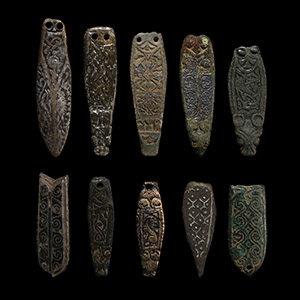
Saxon and Other Bronze Strap End Collection
Circa 8th century A.D.Sold for (Inc. bp): £208
Comprising mainly Thomas's Class A Types 1, 2 and 5, many with silver inlay and niello; two tongue-shaped types. 54.6 grams total, 34-51 mm
From the collection of a North American gentleman, formed in the 1990s.
Thomas' Class A is the classic ‘long’ 9th-century strap end with animal-head terminal, often depicted in the Trewhiddle style. During the 9th century, for the first time in the Anglo-Saxon period, we see the adoption of what may be termed a 'national' artistic style - the Trewhiddle style - which has been recognised on objects from Anglo-Saxon England, from as far as Cornwall and Talnotrie, Dumfries & Galloway, Scotland. -
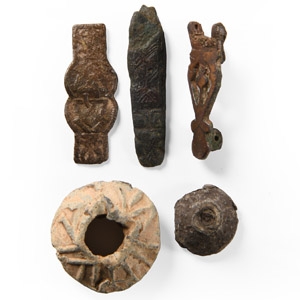
Saxon Period Bronze and Lead Artefact Collection
6th-11th century A.D.Sold for (Inc. bp): £33
Comprising: two lead spindle whorls, one biconvex and the other plano-convex; a bronze buckle plate with niello detailing; a fragment of a mount with low-relief knotwork ornament; a bronze strap end with inlaid silver ornament, stylised beast-head finial. 66.2 grams total, 20-46 mm
Acquired on the UK art market. The strap end from Lincolnshire, 1970s. Ex private Merseyside, UK, collection. -
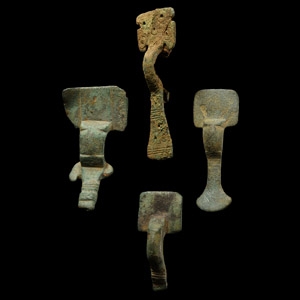
Anglo-Saxon Bronze Long Brooch Collection
Circa 6th century A.D.Sold for (Inc. bp): £111
Including one example accompanied by a Portable Antiquities Scheme record, the brooch with a rectangular head plate, arched bow and pelta-shaped foot; three additional brooches with transverse decoration. 63 grams total, 45-68 mm
Found Berkshire, UK. Accompanied by a copy of the British Museum's Portable Antiquities Scheme (PAS) report no.BERK-A98971.
