
Loading, please wait...
LOT 0243
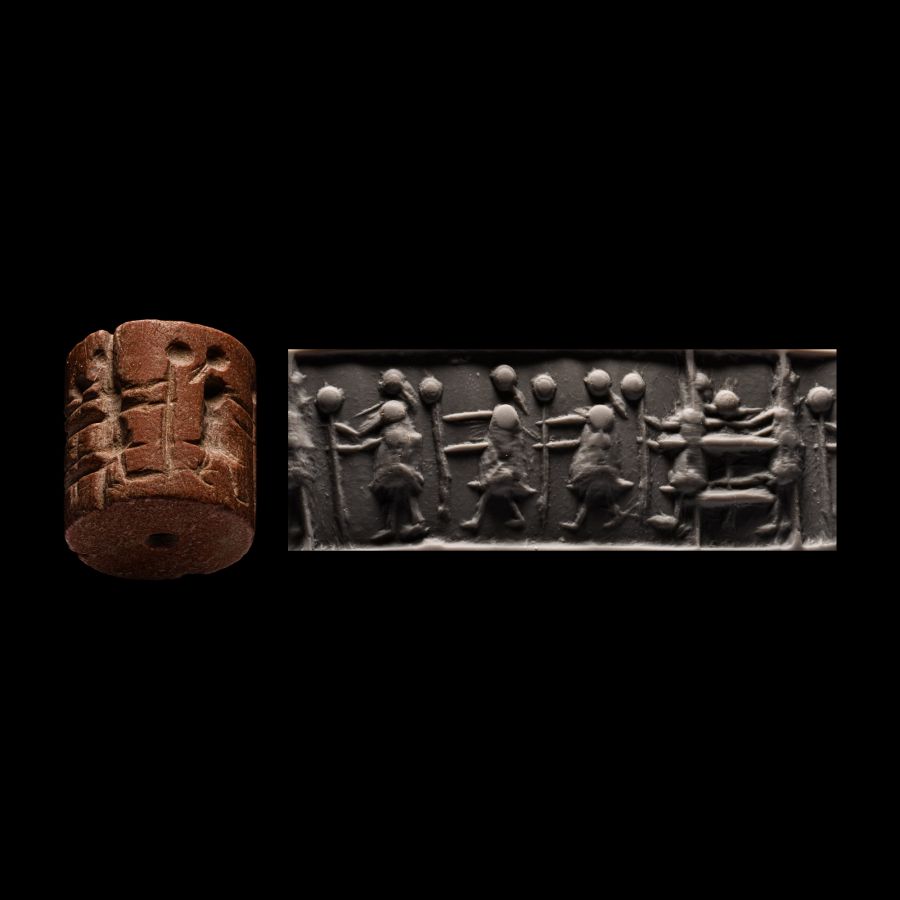
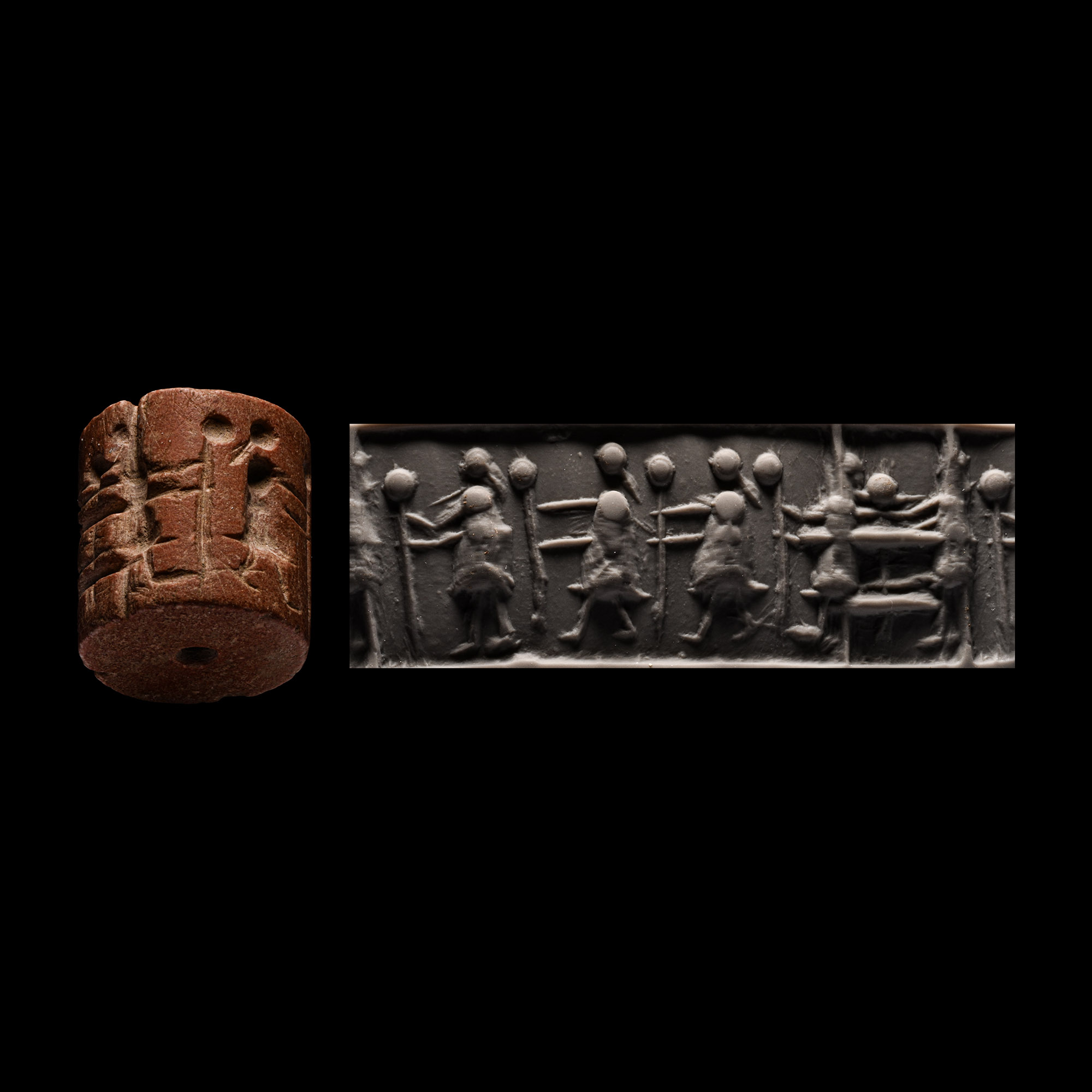
Sumerian Pink Stone Cylinder Seal with Processional Scene
CIRCA 3000 B.C.
1 1/8 in. (39.7 grams, 28 mm).
With incuse frieze of human figures executed by drilling including one seated on a dais; supplied with a museum-quality impression; signed scholarly note issued by W.G. Lambert, Professor of Assyriology at the University of Birmingham 1970-1993, which states: 'Cylinder seal of pink stone, 27 x 27 mm., Frieze of four walking women holding standards. Mesopotamia, c.3000 B.C. Large and condition fine save for patch of damage.'
ProvenanceEx S Collection, London, UK, 1970-1990s.
Accompanied by a typed scholarly note signed by Professor Wilfrid George Lambert FBA (1926-2011), historian, archaeologist, and specialist in Assyriology and Near Eastern archaeology, in the late 1980s and early 1990s.
TimeLine Auctions follows a vetting process to ensure the authenticity and legality of all items, reinforcing our commitment to integrity and responsible trading. Each antiquity, antique, and coin lot undergoes thorough examination by a vetting committee of at least ten external specialists, professional trade association members, scientists, and archaeologists: Our Vetting Process
AUCTIONS:
TimeLine is a leading auction house specialising in antiquities, ancient art, collectables, natural history, coins, medals, and books. Our auctions offer museums, collectors, historians, and enthusiasts the opportunity to acquire unique and historically significant pieces.
LOT 0243
Sumerian Pink Stone Cylinder Seal with Processional Scene
Sold for (Inc. bp): £975
-

Sumerian Domed Stone Stamp Seal with Animals
3rd millennium B.C.Estimate: £200 - 300 (+bp*)
Opening Bid: £100
With drilled design of two leaping goats, pierced for suspension; accompanied by a museum quality impression. 21.7 grams, 34 mm
From a Cotswold, UK, collection, item no.201; as seen and catalogued by the late Professor Wilfrid George Lambert pre 1990.
W.G. Lambert is the late Professor of Assyriology, University of Birmingham, 1970-1993. -

Western Asiatic Glass Bottle with Prunts
12th-13th century A.D.Estimate: £8,000 - 10,000 (+bp*)
Opening Bid: £4,000
Bell-shaped frosted glass vessel with flared neck and flange collar; applied trail detailing to the neck and mouth; applied trails to the shoulder in zigzag above groups of three prunts with blue glass ornament; two circumferential applied trails to the lower body with crenellated band between. 304 grams, 15.5 cm high
Acquired in the 1980s. with Christopher Sheppard, London, UK. Acquired from the above in 2007. This lot has been checked against the Interpol Database of stolen works of art and is accompanied by search certificate no.11973-210908. -
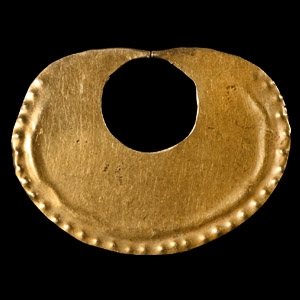
Large Western Asiatic Gold Lunar Pendant
Circa 2nd-1st millennium B.C.Sold for (Inc. bp): £546
Shaped as a crescent moon with pearled border. 5.08 grams, 45 mm
Acquired 1980-2015. Ex Abelita family collection.
The gold lunula was a characteristic type of necklace, collar, or crescent-shaped pendant of the late Neolithic, Chalcolithic, and most often early Bronze Age. The crescent appears in various forms in the material culture of the southern Levant. It also appears in Mesopotamian and Egyptian iconography. It is most frequently associated with the crescent moon and its related deity. Such pendants were worn at the neck, in contact with the body, as protective amulets.
