
Loading, please wait...
LOT 0335
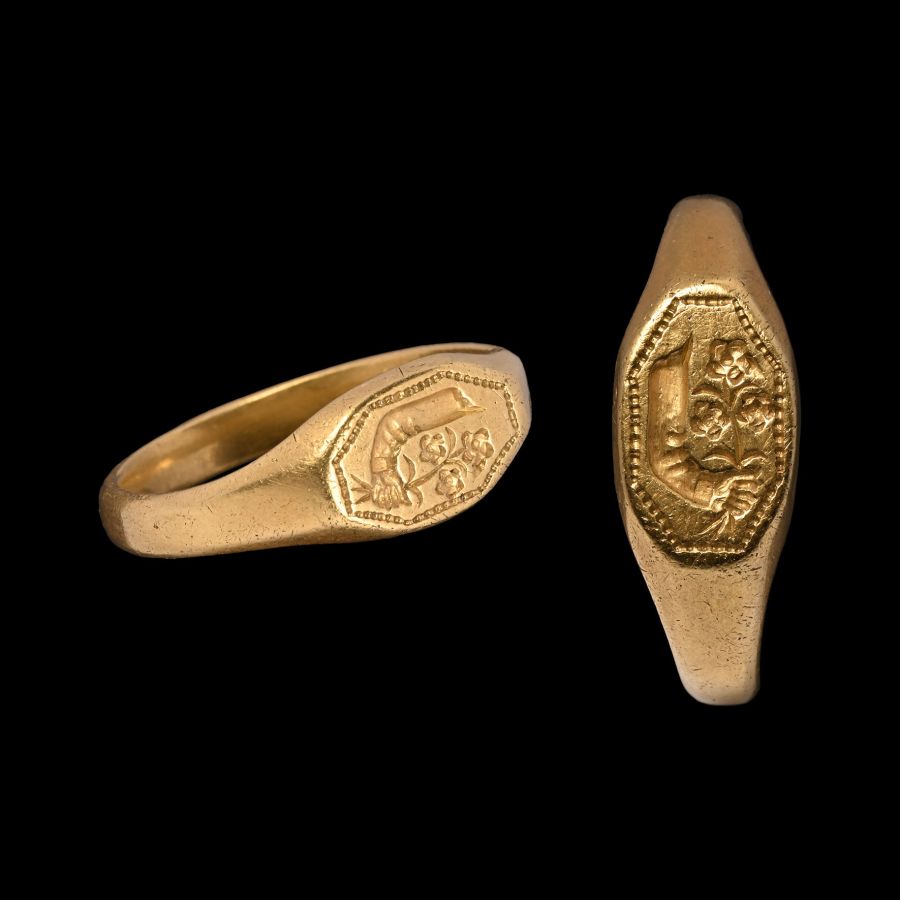
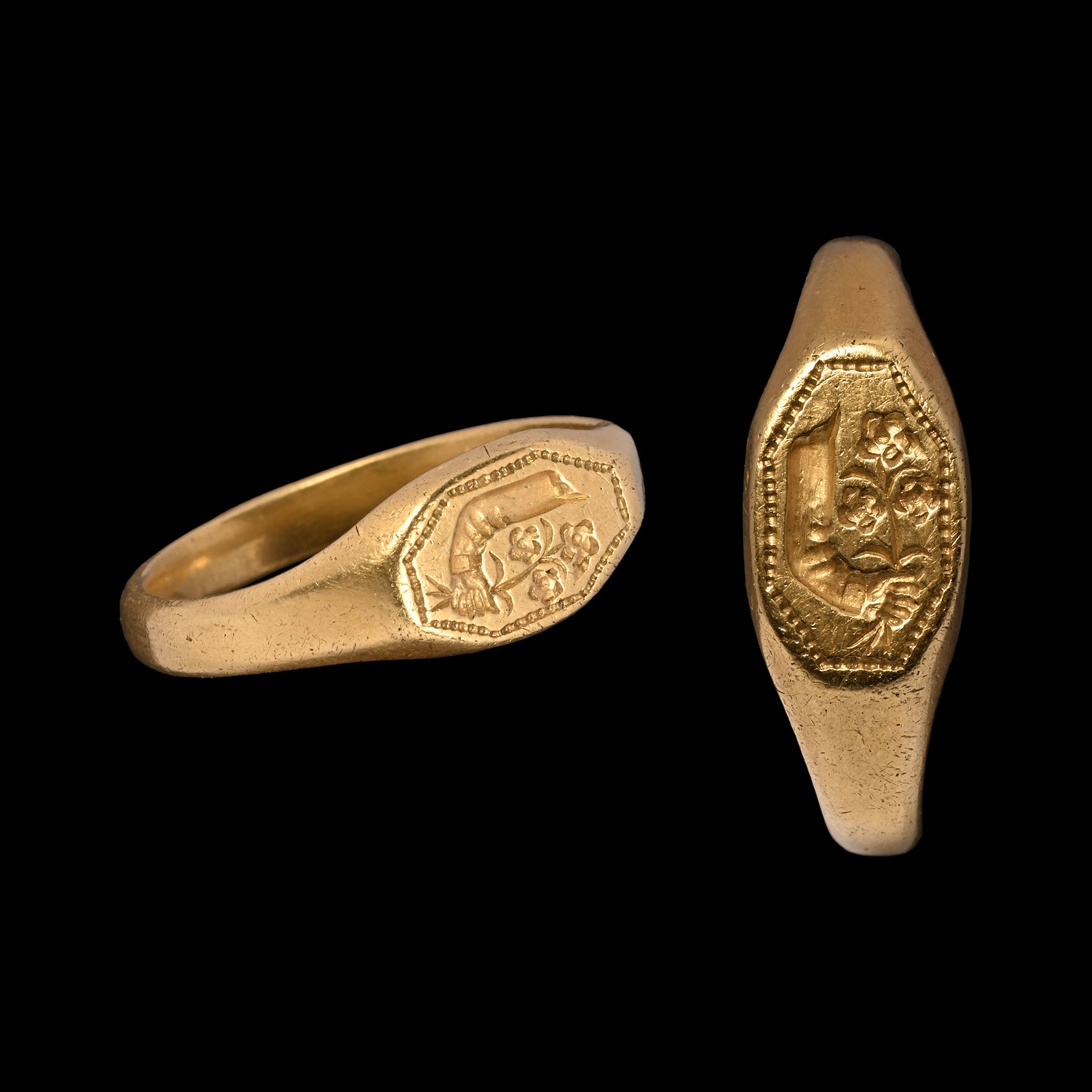
Stuart Period Large Gold Signet Ring with Arm and Floral Spray
17TH CENTURY A.D.
1 in. (9.78 grams, 24.40 mm overall, 20.51 mm internal diameter (approximate size British V, USA 10 1/2, Europe 23.77, Japan 22)).
A gold signet ring composed of a D-section hoop and facetted oval bezel, engraved with crest depicting a forearm and hand oriented right, holding a floral spray composed of three five-petalled flowers and four leaves, set within a beaded octagonal border.
ProvenanceAcquired in the 1980s.
Property of a London gentleman.
This lot has been checked against the Interpol Database of stolen works of art and is accompanied by search certificate no.11663-197588.
Signet rings were jewellery items serving practical functions, and were pressed into hot wax to seal letters and packets. Personal seals or secreta acted as a legal safeguard, since they were used to witness wills, loans, commercial, personal and other documents. Such rings were often engraved with a coat of arms, initials, merchant's mark or some other personal symbol. Painted portraits of this period portray the wearer with the signet ring on the thumb or forefinger, allowing for practical use.
CONDITIONTimeLine Auctions follows a vetting process to ensure the authenticity and legality of all items, reinforcing our commitment to integrity and responsible trading. Each antiquity, antique, and coin lot undergoes thorough examination by a vetting committee of at least ten external specialists, professional trade association members, scientists, and archaeologists: Our Vetting Process
AUCTIONS:
TimeLine is a leading auction house specialising in antiquities, ancient art, collectables, natural history, coins, medals, and books. Our auctions offer museums, collectors, historians, and enthusiasts the opportunity to acquire unique and historically significant pieces.
LOT 0335
Stuart Period Large Gold Signet Ring with Arm and Floral Spray
Sold for (Inc. bp): £13,000
-
Bronze Statue of an Etruscan Warrior
20th century A.D.Estimate: £3,000 - 4,000 (+bp*)
Opening Bid: £1,500
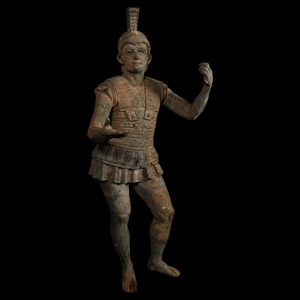
A hollow-formed bronze copy of the Mars of Todi, a figure of an Etruscan warrior wearing segmented armour to the chest and shoulders, crested helmet, short tunic; the hands in animated pose with left hand open to accept a weapon; holes beneath feet for mounting. 7.6 kg, 61.5 cm high
French collection, 1960s-early 2000s. From an important Paris gallery, France. with Galerie Athena, Brussels, 9 May 2019, lot 393. This lot has been checked against the Interpol Database of stolen works of art and is accompanied by search certificate number no.11691-199344.
The "Mars of Todi" figure is a large, almost life-sized bronze statue of a warrior in armour. It dates from the late 5th - early 4th century B.C., and is believed to have been produced by an Etruscan workman for an Umbrian patron. The figure was probably a votive offering for a religious sanctuary, perhaps sacred to Laran, the Etruscan god of war. It had been buried ritually and left undisturbed until its modern discovery in 1835. It lacks a helmet, and the hands are empty; possibly a patera plate was originally in the open right hand, and a spear gripped in the clenched left hand. The sculptor of the figure followed the Greek contrapposto posture accentuating the carefully modelled lamellar plate armour. The statue bears a short inscription in Umbrian "Ahal Trutitis dunum dede" (Ahal Trutitis gave this gift). -

Half Life-Size Post Medieval Wooden Painted St George and Mount Statue
18th century A.D.Sold for (Inc. bp): £8,450
A dynamic horse and mounted St George figure in wood; the helmetted rider with billowing cloak; gesso and polychrome; approximately half life-size; mounted on an elaborate custom-made display stand; repaired. 76 kg, 1.77 m high including stand
English private collection. This lot has been checked against the Interpol Database of stolen works of art and is accompanied by search certificate no.11672-199837.
Likely derived from a religious scene. The timber shows some old insect flight holes and we are advised that this piece has been recently treated with Permethrin, as a precaution. -
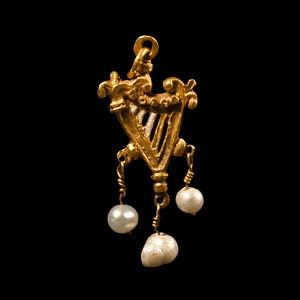
Elizabethan Gold Harp Pendant with Pearl Drops
16th-early 17th century A.D.Estimate: £800 - 1,000 (+bp*)
Opening Bid: £400
A gold pendant formed as a frame-harp with scrolls to the angles and openwork 'strings'; three pearl drops to the lower body, suspension loop above. 3.55 grams, 32 mm
Acquired 1960s-1990s. Late Alison Barker collection, a retired London barrister.
