Loading, please wait...
Details
LOT 0342
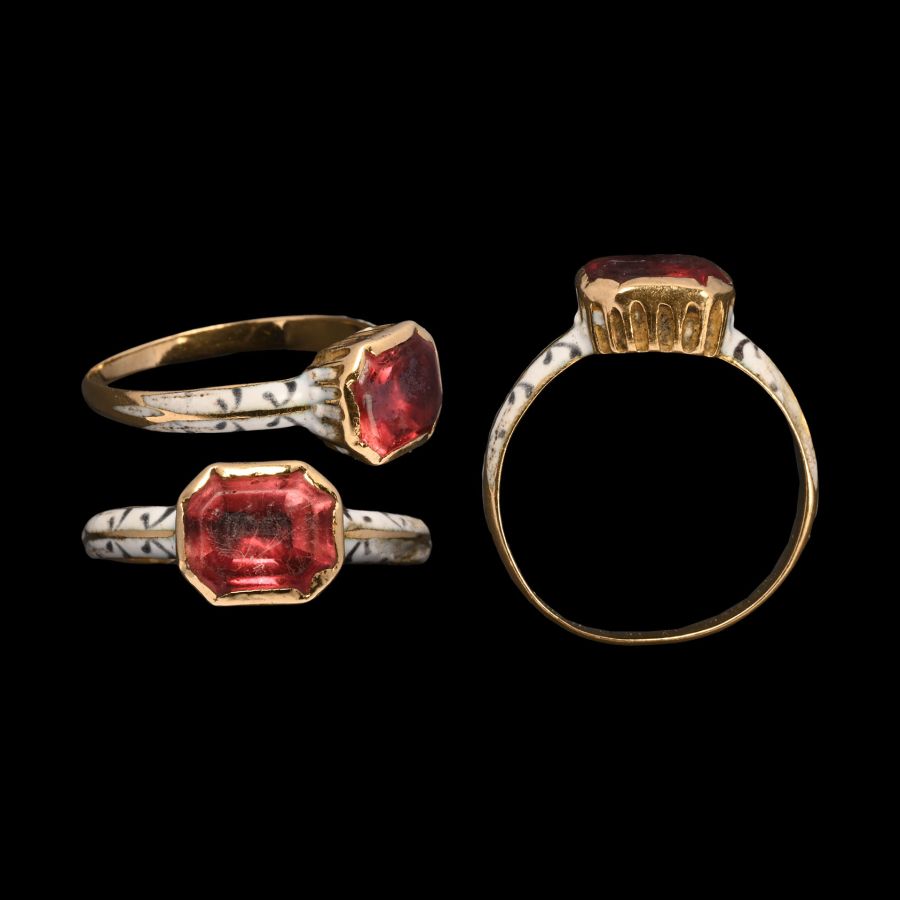
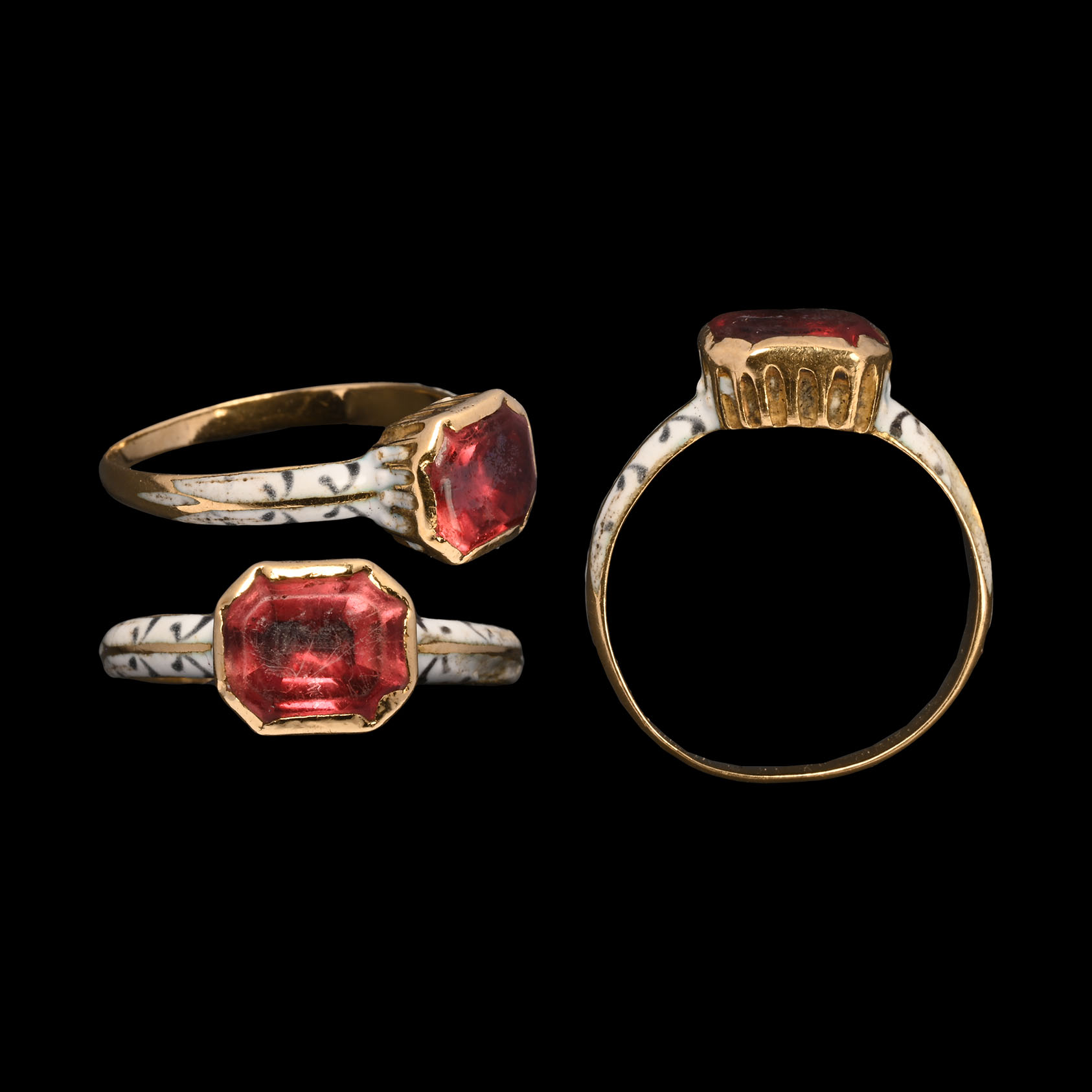
Stuart Period Gold, Rock Crystal and White Enamel Ring
17TH CENTURY A.D.
3/4 in. (1.89 grams, 21.50 mm overall, 16.63 mm internal diameter (approximate size British L 1/2, USA 6, Europe 11.87, Japan 11)).
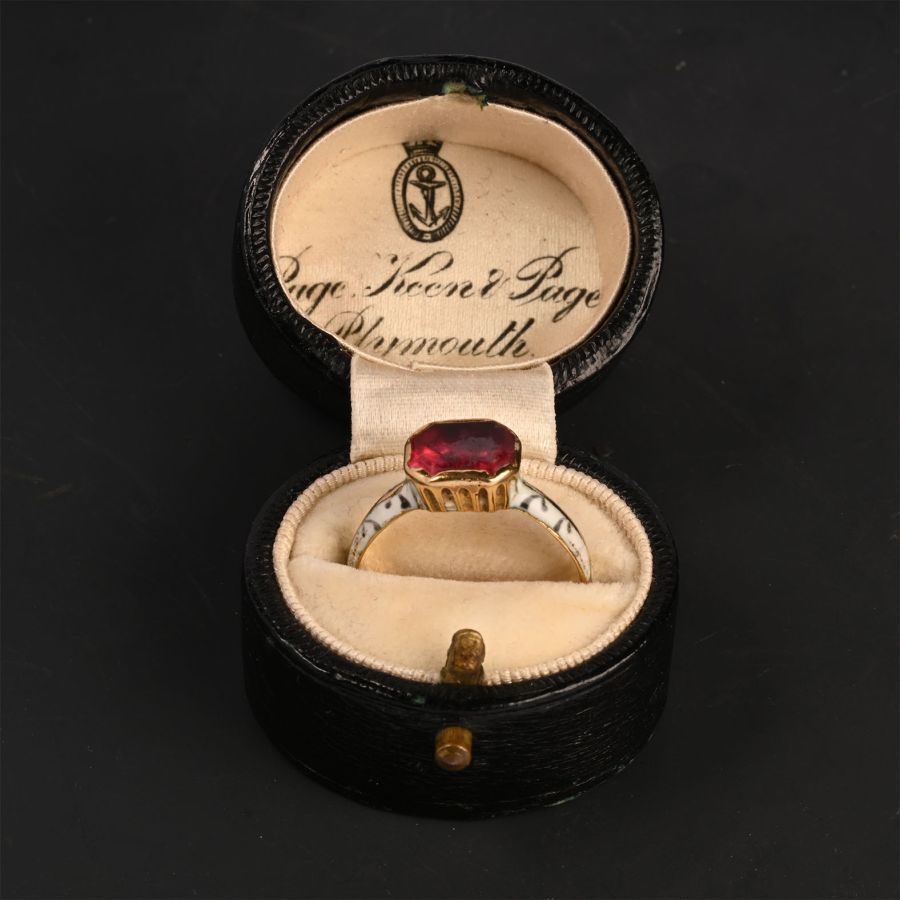
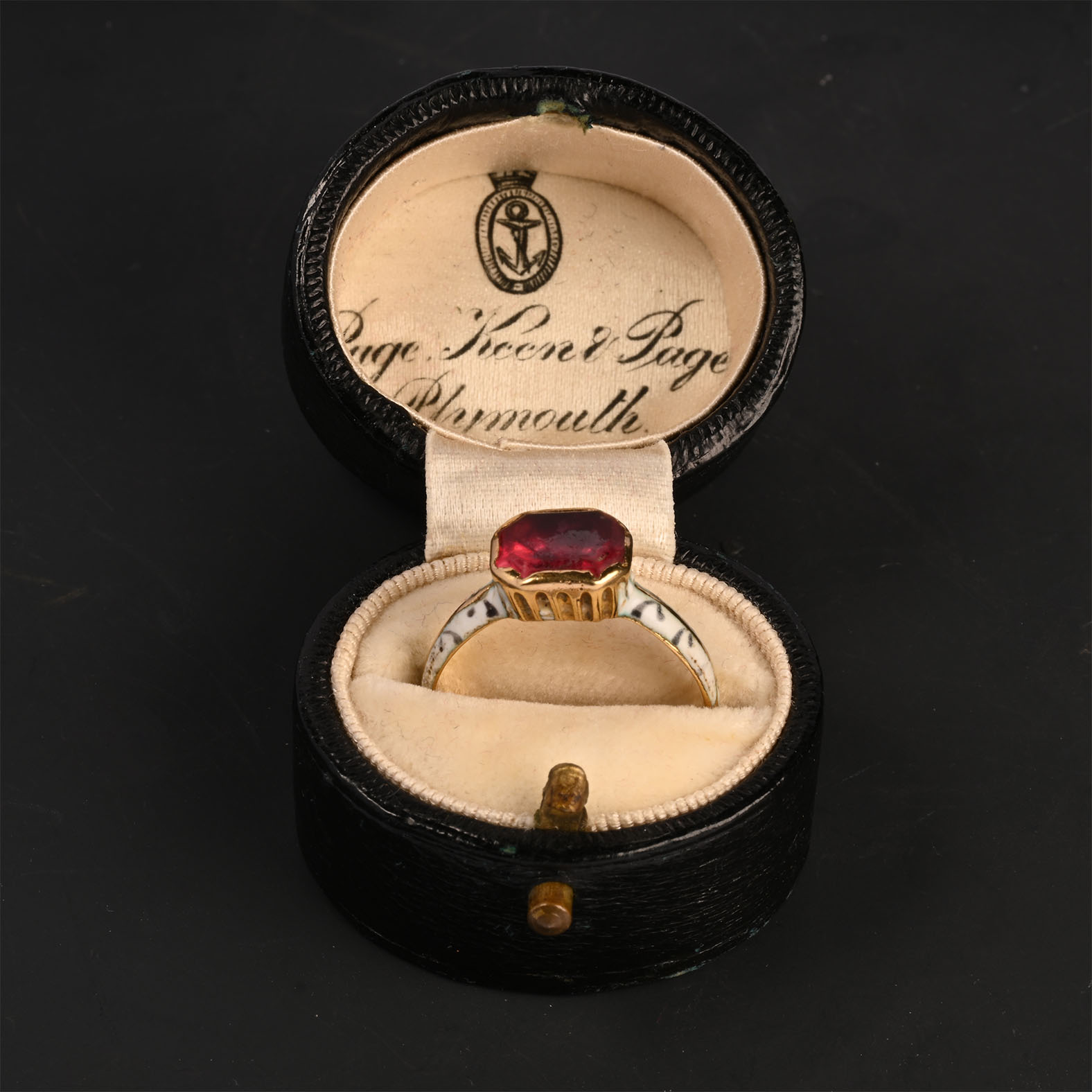
A gold ring composed of a slender hoop embellished with tapering, white enamelled shoulders with black enamelled flourishes, fluted box collet setting, set with a pink foil back and table-cut rock crystal; accompanied by a vintage ring box.
Provenance
Valued by Bentley & Skinner, Piccadilly, London W1, 2016.
Property of an East Sussex collector.
Accompanied by a copy of the Bentley & Skinner insurance valuation.
This lot has been checked against the Interpol Database of stolen works of art and is accompanied by search certificate no.11669-197584.
Literature
Cf. The V&A Museum, accession number 1112-1864, for a similar ring; cf. Oman, C., British Rings 800-1914, London, 1974, pl. 3, for similar rings; cf. Chadour, A.B., Rings. The Alice and Louis Koch Collection, Vol.1, Leeds, 1994, items 757-758, for similar; cf. Oman, C., British Rings 800-1914, London, 1974, pl. III, for a similar ring.
Footnotes
The V & A Museum explains that during the '...Renaissance, the ring developed from the simple forms of the medieval period into a miniature work of art, combining the skills of the chaser, engraver and enameller as well as the stone cutter.
CONDITIONVETTING:
TimeLine Auctions follows a vetting process to ensure the authenticity and legality of all items, reinforcing our commitment to integrity and responsible trading. Each antiquity, antique, and coin lot undergoes thorough examination by a vetting committee of at least ten external specialists, professional trade association members, scientists, and archaeologists: Our Vetting Process
AUCTIONS:
TimeLine is a leading auction house specialising in antiquities, ancient art, collectables, natural history, coins, medals, and books. Our auctions offer museums, collectors, historians, and enthusiasts the opportunity to acquire unique and historically significant pieces.
LOT 0342
Stuart Period Gold, Rock Crystal and White Enamel Ring
Sold for (Inc. bp): £4,420
RELATED LOTS
-
Venus of Milo Statue
19th century A.D.Estimate: £1,200 - 1,700 (+bp*)
Opening Bid: £600
A white marble copy of the famous Venus of Milo, naturalistically portrayed with her garment having fallen from her shoulders, hanging loose at her waist and exposing her breasts. 34.8 kg, 77 cm high
French collection, 1960s-early 2000s. From an important Paris gallery, France.
Aphrodite of Milos, better known as the Venus of Milo, is an ancient Greek statue and one of the most famous works of ancient Greek sculpture known today, created between 130-100 years B.C. The original is currently displayed at the Louvre in Paris. -
'The Hursley' Tudor Gold 'Hope Is Mi Holde Till Hap Shall Helpe' Buckle Posy Ring
Circa 16th century A.D.Estimate: £15,000 - 20,000 (+bp*)
Opening Bid: £5,556
A gold posy ring with rectangular-section hoop in the form of a buckled belt with looped end tie and chape with double-bowed and pinned buckle, the outer face inscribed '+HOPE * IS * MI HOLDE' in Roman capitals, continuing 'TILL * HAP * SHALL * HELPE' around the interior; accompanied by a vintage ring box. 2.76 grams, 19.17 mm overall, 16.63 mm internal diameter (approximate size British M, USA 6 1/4, Europe 12.34, Japan 12)
Found whilst searching with a metal detector near Hursley, Hampshire, UK, on Sunday 26th August 2012. Acquired from Berganza, Hatton Garden, London, 2017. Property of an East Sussex collector. Disclaimed under the Treasure Act with reference no.2012 T805. Accompanied by a copy of the British Museum's Portable Antiquities Scheme report no.HAMP-62C152. Accompanied by a copy of the Berganza invoice. This lot has been checked against the Interpol Database of stolen works of art and is accompanied by search certificate no.11667-197581.
The inscription is somewhat enigmatic and does not seem to have been previously recorded for a posy ring; the form of the buckle and the knopped chape are typical of examples seen, often in base metal, from the late medieval period to the 16th century A.D. The name of this genre of ring is derived from the 'poesy' or motto usually engraved around the hoop. In medieval examples the posy is mostly engraved around the outside of the hoop but later examples find it on the inner surface. Rings with amatory inscriptions have their origins in the 14th century A.D., when they served as love gifts, betrothal and wedding rings, as attested by surviving documentary evidence. Posy rings were also given to friends or used to mark significant occasions. -
Large Veneto-Cretan Icon of Virgin and Child
17th century A.D. or laterEstimate: £5,000 - 7,000 (+bp*)
Opening Bid: £2,250
A large icon depicting the Virgin holding the Christ on her lap on a gilt background, both nimbate, the haloes with punched foliate decoration; the Virgin wearing a carmine red maphorion embellished with golden embroidery and fringes, elaborate cuffs and neckline to the himation; the Christ seated on the lap, holding his right arm out and making the blessing sign with his hand, left hand holding an open scroll inscribed in Greek πνευμα κυριου επ εμε ου ενεκεν εχρισεν με ευαγγελιζεσθαι πτωχοις απεσταλκεν με for 'The Spirit of the Lord is on me, because he has anointed me to proclaim good news to the poor' (Luke 4:18-21), the green chiton and orange himation embellished with red folds; Greek inscription 'ΜΡ ΘΥ' for 'Mother of God' flanking the Virgin's halo, 'IC XC' for 'Jesus Christ' to the right of the Child and inside his nimbus 'O Ѿ N' for 'The Only One who always exists'; some restoration. 4.3 kg, 60 x 42.5 cm
very good condition; tempera on wood panel; vertical crack minimally restored.
Property of a London lady, part of her family's collection. Accompanied by an academic report by Dr Raffaele D’Amato. This lot has been checked against the Interpol Database of stolen works of art and is accompanied by searcher certificate no.11572-198599.
In the Orthodox church, the spaces between the columns close to the central doors of the Iconostasis (Holy Doors) are occupied by two proskynesis icons, representing Christ giving his blessings to the right and to the left the Virgin Mary, with or without the infant, or in interceding position known as Virgin Chalkoprateia type.