
Loading, please wait...
_900x900.jpg "Stuart Period Gold Memento Mori Ring with Skull and Crossed Bones for Ian Shepherd")
_200x200.jpg "Stuart Period Gold Memento Mori Ring with Skull and Crossed Bones for Ian Shepherd")
_900x900.jpg "Stuart Period Gold Memento Mori Ring with Skull and Crossed Bones for Ian Shepherd")
_200x200.jpg "Stuart Period Gold Memento Mori Ring with Skull and Crossed Bones for Ian Shepherd")
.jpg "Stuart Period Gold Memento Mori Ring with Skull and Crossed Bones for Ian Shepherd")
.jpg "Stuart Period Gold Memento Mori Ring with Skull and Crossed Bones for Ian Shepherd")
LOT 0366
Stuart Period Gold Memento Mori Ring with Skull and Crossed Bones for Ian Shepherd
DATED 1724 A.D.
7/8 in. (4.60 grams, 22.48 mm overall, 18.44 mm internal diameter (approximate size British Q 1/2, USA 8 1/4, Europe 18.12, Japan 17)).
Comprising a D-shaped hoop with foliate and floral decoration, rectangular bezel set with a facetted rock crystal(?) gemstone with a skull and crossed bones beneath the gem; engraved to the inner face 'In˚ Shepherd Obt 20 Jan 1724 æt 62' and a worn maker's mark.
ProvenanceAcquired from a London, UK, auction house.
From a private Bristol, UK, collection.
This lot has been checked against the Interpol Database of stolen works of art and is accompanied by search certificate number no.13213-249807.
Cf. The British Museum, museum number 1961,1202.385, for a similar pattern.
FootnotesThe memento mori jewellery of the 16th-18th centuries served as wearable ‘reminders of mortality’. Typical motifs within this genre included skulls, skeletons, crossbones, hourglasses, coffins, the gravedigger’s pick and shovel, and various other emblems of death and decay.
CONDITIONTimeLine Auctions follows a vetting process to ensure the authenticity and legality of all items, reinforcing our commitment to integrity and responsible trading. Each antiquity, antique, and coin lot undergoes thorough examination by a vetting committee of at least ten external specialists, professional trade association members, scientists, and archaeologists: Our Vetting Process
AUCTIONS:
TimeLine is a leading auction house specialising in antiquities, ancient art, collectables, natural history, coins, medals, and books. Our auctions offer museums, collectors, historians, and enthusiasts the opportunity to acquire unique and historically significant pieces.
LOT 0366
Stuart Period Gold Memento Mori Ring with Skull and Crossed Bones for Ian Shepherd
Sold for (Inc. bp): £3,900
-
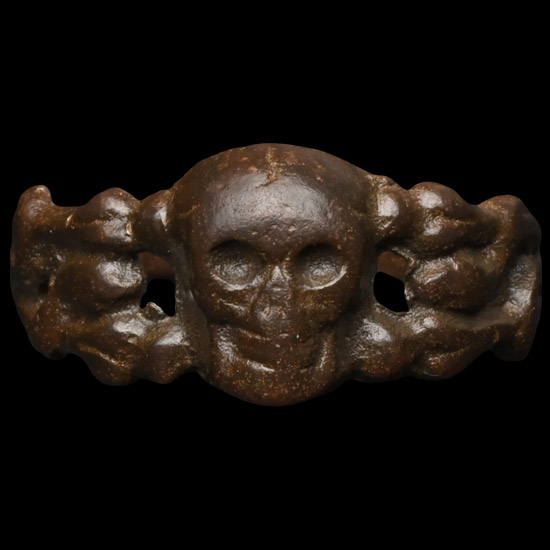
Post Medieval Bronze Skull Ring
Circa 19th century A.D.Sold for (Inc. bp): £59
Slender hoop formed as a pair of long bones with a snake curled around the shafts at the shoulders, the bezel a skull with recessed eye sockets. 3.44 grams, 22.68 mm overall, 18.29 mm internal diameter (approximate size British O 1/2, USA 7 1/4, Europe 15.61, Japan 15)
Ex German art market, 2000s. Acquired from an EU collector living in London. From the collection of a Surrey, UK, gentleman. -
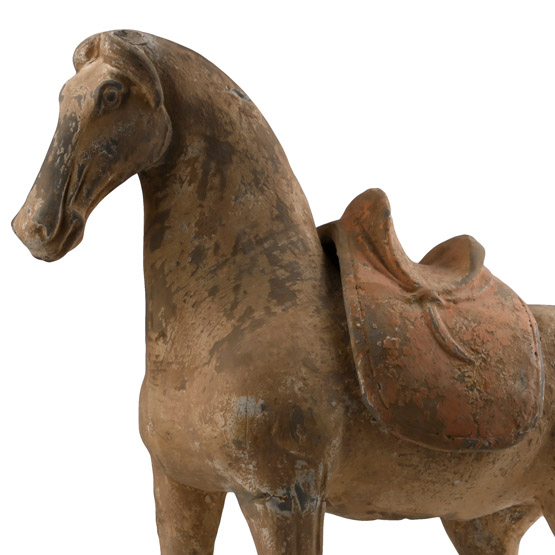
Chinese Tang Style Terracotta Horse
20th century A.D.Sold for (Inc. bp): £13
Hollow-formed, standing erect with mane swept back from the brow; separate saddle and blanket with traces of pigment; tail extended to rear, repaired. 3.95 kg, 40.7 cm high
Acquired on the UK art market. -
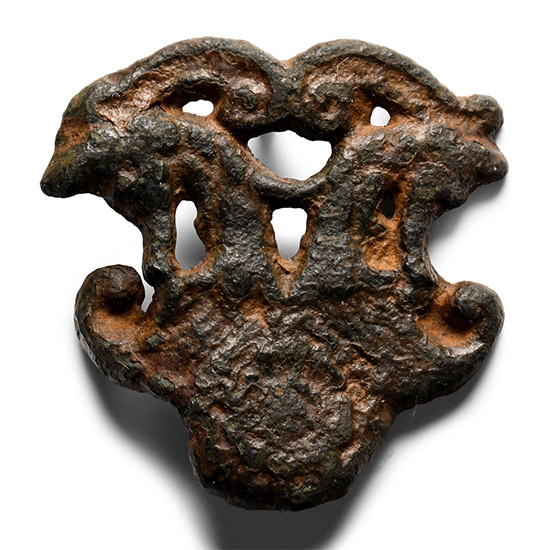
Post-Medieval Bronze Pilgrim's Badge
Circa 16th-17th century A.D.Sold for (Inc. bp): £7
Openwork plaque with rosette supported on scrolled leaves and stems, scrolled band beneath; baroque style. 9.15 grams, 33 mm
From a retired Lincolnshire, UK, gentleman's collection, a long time member of the Pewter Society.
