
Loading, please wait...


LOT 1712
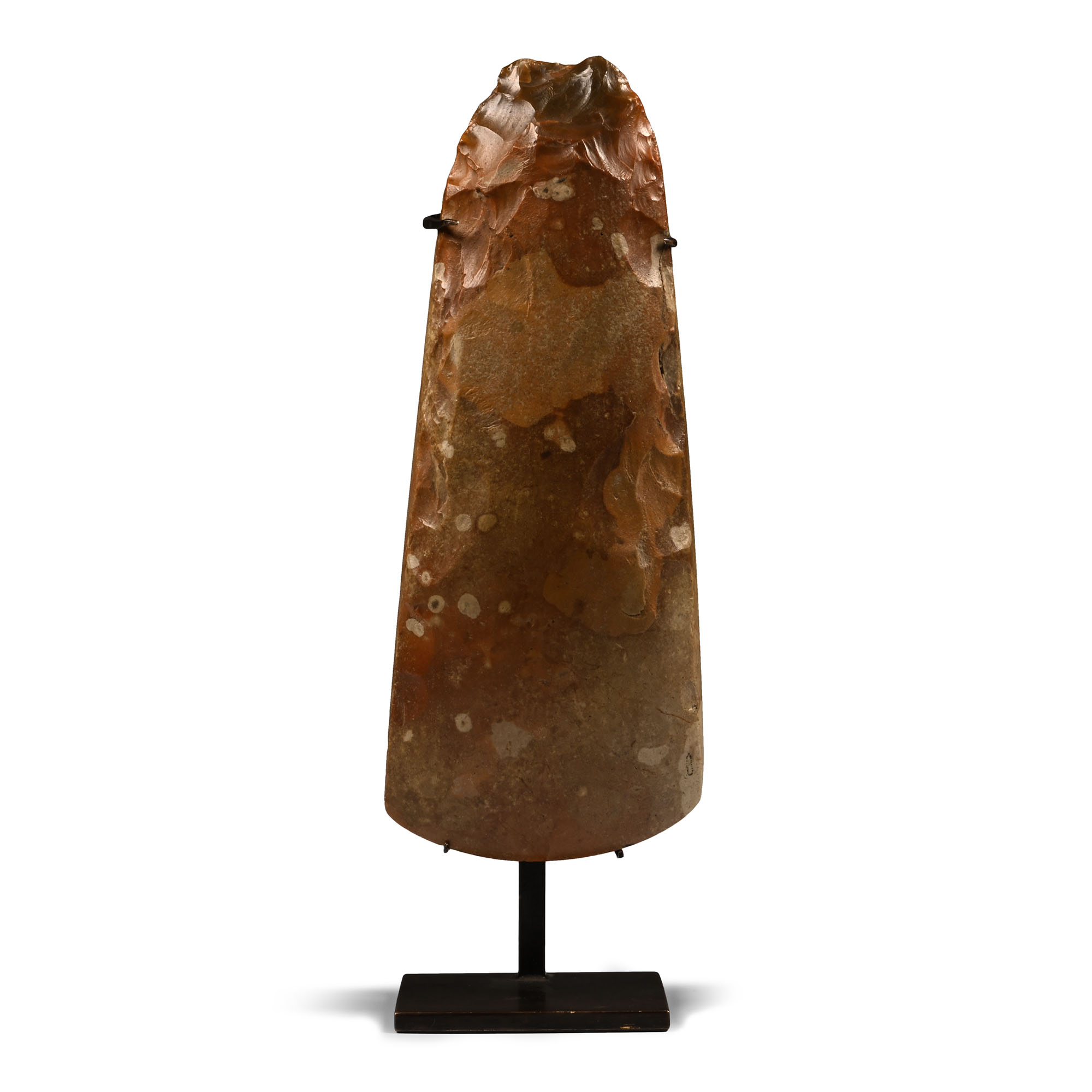
Stone Age Polished Thin-Butted Handaxe
RüGEN (NORTHERN GERMANY), NORDIC NEOLITHIC PERIOD, CIRCA 4000-2000 B.P.
6 7/8 in. (8 in.) (493 grams total, 17.5 cm (640 grams total, 20.2 cm including stand)).
Knapped and polished in fine honey-coloured flint, trapezoidal in profile and rectangular in section; with rounded butt and slightly convex edge; mounted on a custom-made stand.
ProvenanceFrom the old German private collection Von Korff family, Germany; inherited by Julian von Korff before 1980, Germany.
with Athena Münzen der Antike, München, prior 2004.
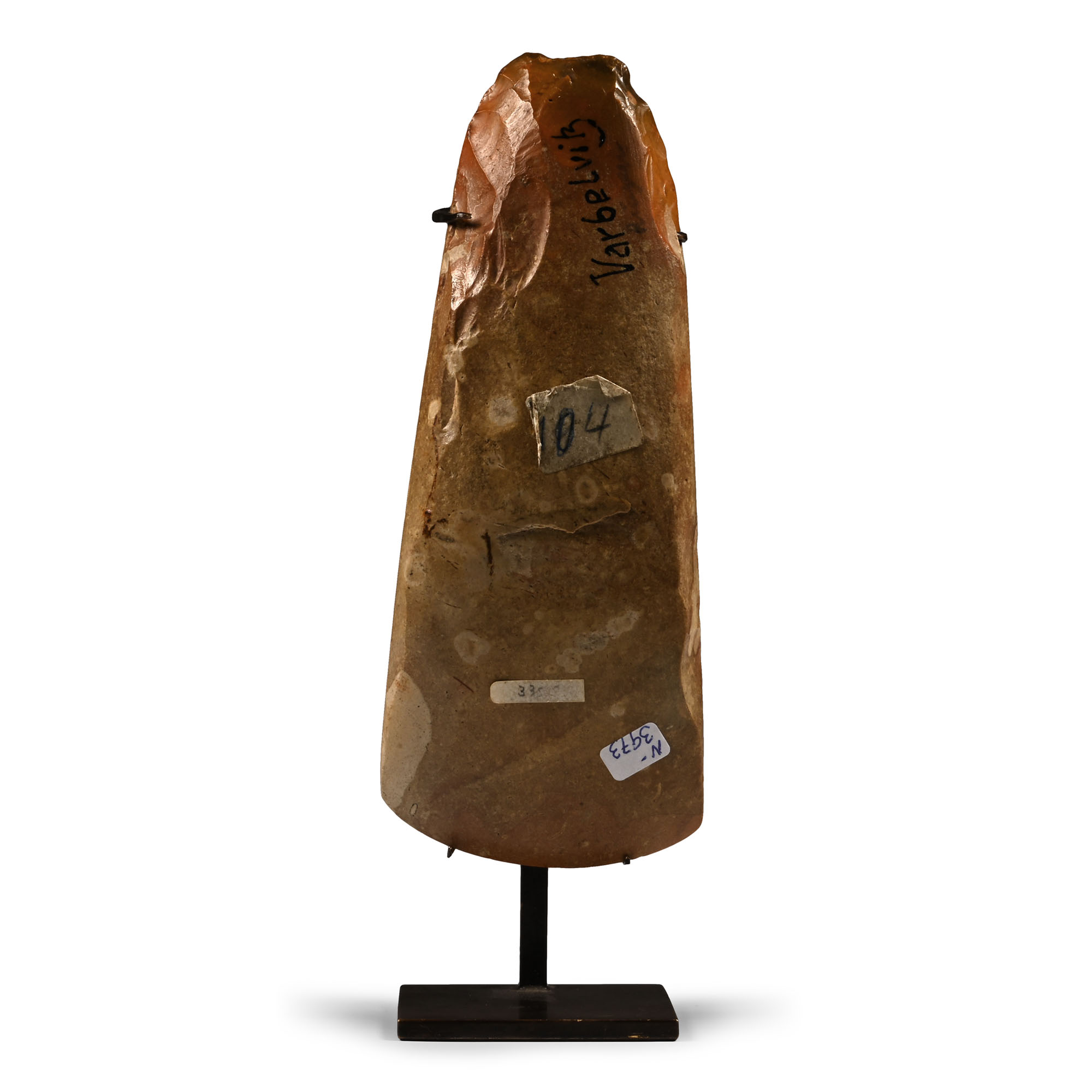
Inscription on object: "Varbelvitz Rügen"; inscription on label: "104"; inscription on label: "335".
This lot is accompanied by an illustrated lot declaration signed by the Head of the Antiquities Department, Dr Raffaele D’Amato.
Cf. MacGregor, A. (ed.), Antiquities from Europe and the Near East in the Collection of Lord McAlpine of West Green, Oxford, 1987, item 4.85, for type.
CONDITIONTimeLine Auctions follows a vetting process to ensure the authenticity and legality of all items, reinforcing our commitment to integrity and responsible trading. Each antiquity, antique, and coin lot undergoes thorough examination by a vetting committee of at least ten external specialists, professional trade association members, scientists, and archaeologists: Our Vetting Process
AUCTIONS:
TimeLine is a leading auction house specialising in antiquities, ancient art, collectables, natural history, coins, medals, and books. Our auctions offer museums, collectors, historians, and enthusiasts the opportunity to acquire unique and historically significant pieces.
-
Stone Age British Knapped Flint Tranchet Axe
Mesolithic Period, circa 6,000 B.P.Sold for (Inc. bp): £46
Plano-convex in section with irregular pointed edge; cortex to butt and sides' inked legend 'Southeast England'. 175 grams, 10.7 cm
Found Southeast England. From a Leicestershire, UK, collection. This lot is accompanied by an illustrated lot declaration signed by the Head of the Antiquities Department, Dr Raffaele D’Amato. -
Very Large Stone Age 'Livre de Beurre' from Le Grand Pressigny
Neolithic Period, 5500-2400 B.P.Estimate: £1,000 - 1,400 (‡+bp*)
Opening Bid: £495
A substantial flint core or so-called 'Livre de Beurre' with vertical traces of blows on the work side, including one pronounced blade negative extending half way along the stone’s length; cortex remains and core preparation traces on other side; proximal end with impact surface, distal end with rounded point; two bifacial wave to chevron-shaped core edges; flat-prismatic cross-section; raw material for blade production, beige stone (silex) with yellow undertone, cream-colored patches and spots, slightly shiny surface (origin: Le Grand Pressigny, Dép. Indre-et-Loire, France); old collector's label 'N13310'; supplied with a custom-made stand. 2.62 kg, 30.5 cm (3.79 kg total, 37.5 cm including stand)
Private collection, B.G., Southwest France. Accompanied by a copy of an Art Loss Register certificate no.S00127506. This lot is accompanied by an illustrated lot declaration signed by the Head of the Antiquities Department, Dr Raffaele D’Amato. -
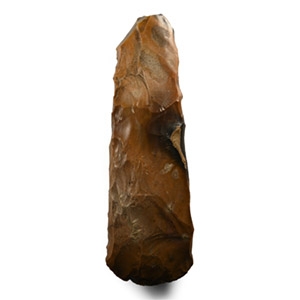
Stone Age Danish Flaked Thin-Butted Flint Axe
Late Passage Grave-Early Dolmen Period, 3900-3000 B.P.Sold for (Inc. bp): £312
Rectangular in section with asymmetrical rounded butt, worked rounded edge. 629 grams, 20.5 cm
Acquired from a Swedish auction house. From the collection of a South West London, UK, specialist Stone Age collector. Accompanied by a copy of the Swedish Cultural Heritage Board export licence. This lot is accompanied by an illustrated lot declaration signed by the Head of the Antiquities Department, Dr Raffaele D’Amato.
