
Loading, please wait...
_900x900.jpg "Stone Age Obsidian Knife Core")
_200x200.jpg "Stone Age Obsidian Knife Core")
.jpg "Stone Age Obsidian Knife Core")
LOT 1124
Stone Age Obsidian Knife Core
NEOLITHIC PERIOD, 6TH-4TH MILLENNIUM B.C.
3 in. (92 grams, 76 mm).
A tongue-shaped obsidian core with vertical fluting where blades have been knapped from the surface.
ProvenanceEx UK art market, 1970s.
Property of a London gentleman.
TimeLine Auctions follows a vetting process to ensure the authenticity and legality of all items, reinforcing our commitment to integrity and responsible trading. Each antiquity, antique, and coin lot undergoes thorough examination by a vetting committee of at least ten external specialists, professional trade association members, scientists, and archaeologists: Our Vetting Process
AUCTIONS:
TimeLine is a leading auction house specialising in antiquities, ancient art, collectables, natural history, coins, medals, and books. Our auctions offer museums, collectors, historians, and enthusiasts the opportunity to acquire unique and historically significant pieces.
LOT 1124
Stone Age Obsidian Knife Core
Estimate £200 - 300€230 - 350 (for guidance only)$270 - 410 (for guidance only)
-
.jpg)
Stone Age Obsidian Knife Core
Neolithic Period, 6th-4th millennium B.C.Estimate: £200 - 300 (+bp*)
Opening Bid: £100
A tongue-shaped obsidian core with vertical fluting where blades have been knapped from the surface. 92 grams, 76 mm
Fine condition.
Ex UK art market, 1970s. Property of a London gentleman. -
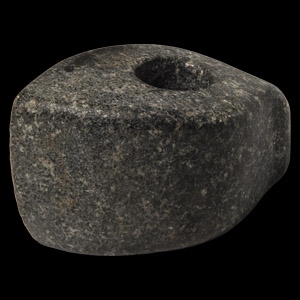
Stone Age Boat-Shaped Axehead
Neolithic Period, circa 3rd millennium B.C.Sold for (Inc. bp): £156
A diorite axe-hammer, with rounded butt chamfered at the edge and with convex sides, sub-rectangular in section, dark green fine-grained stone. 635 grams, 10 cm
Acquired 1971-1972. From the collection of the vendor's father. Property of a London, UK, collector.
During Neolithic period, while objects for everyday use, such as knife blades, arrows and lance tips were often only knapped - albeit with very fine retouching - and people soon learnt how to polish selected tools and equipment with sand for a smooth surface. Rotating tubular bone and sand made it possible to fit axes and hammers with a pierced 'eye' for the handle. This eye socket is the preliminary stage of the Bronze Age socket. -
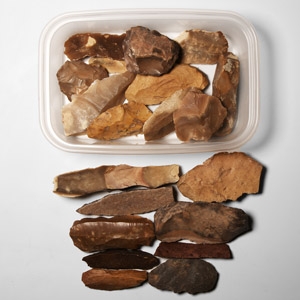
Stone Age Tenerian Stone Tool Group
Neolithic Period, circa 7500-5300 B.C.Sold for (Inc. bp): £33
A group of 20 Tenerian Culture tools including, knives, scrapers, cores and awls. 643 grams total, 3.9-10.5 cm
From an exposed site, Tenera Region, of The Green Sahara, South Central Sahara. Acquired 1960s-1970s. From a private French collection.
