
Loading, please wait...
LOT 1626
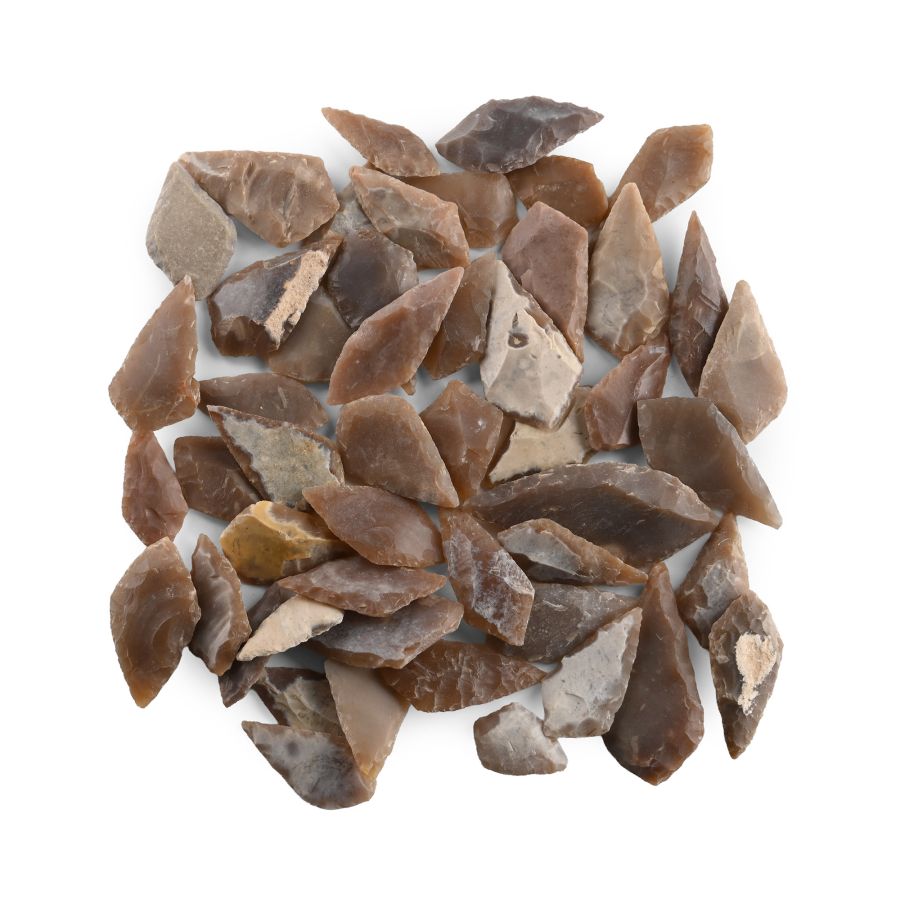
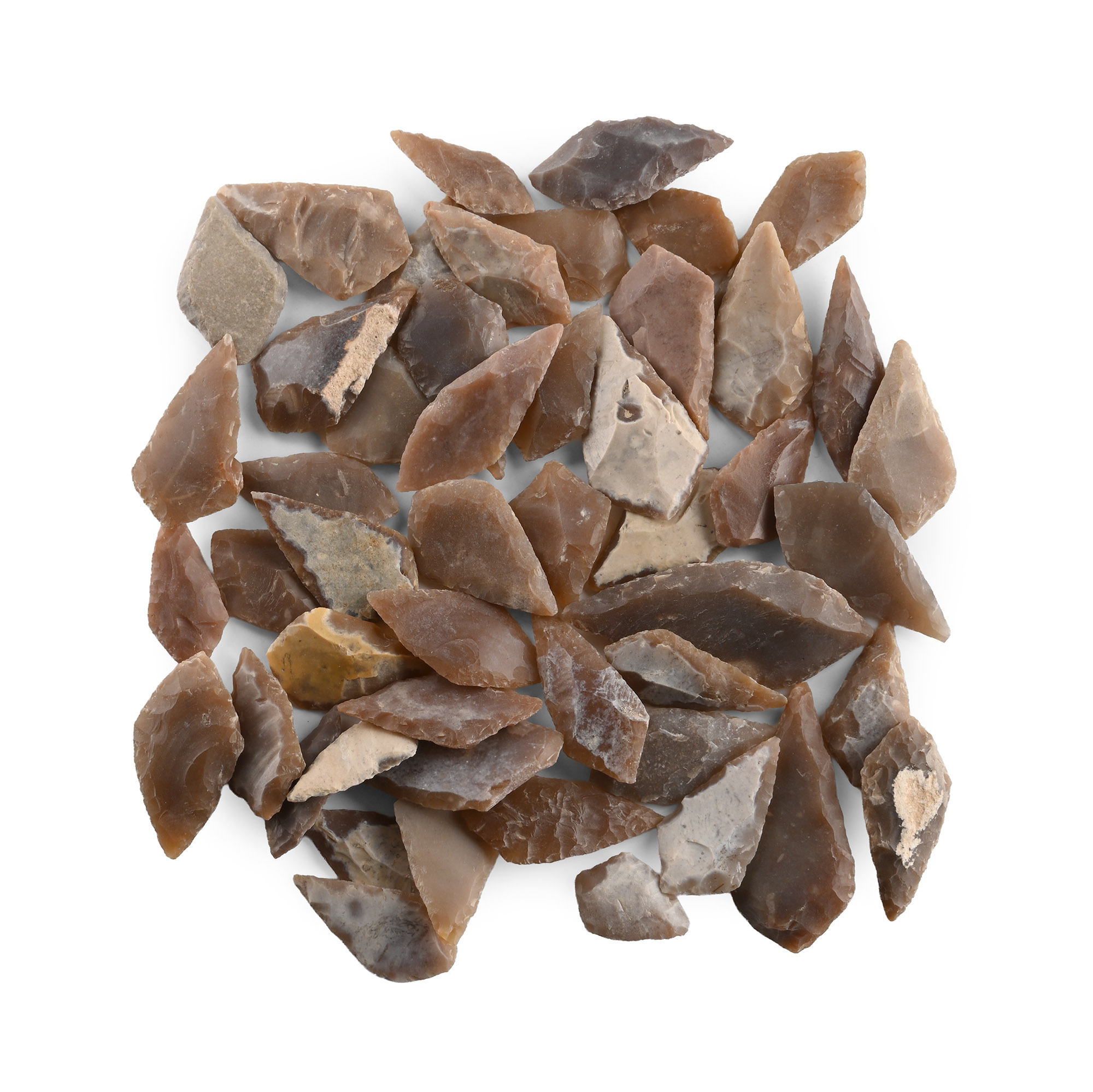
Stone Age Lozenge-Shaped Arrowhead Collection
NEOLITHIC PERIOD, 6TH-4TH MILLENNIUM B.C.
5/8 - 1 5/8 in. (76 grams total, 16-42 mm).
Comprising mostly bifacial and uniface lozenge-shaped and piriform flint and chert arrowheads; probably from the Sahara region of North Africa. [50, No Reserve]
ProvenanceUK gallery, early 2000s.
LiteratureSee Greenwell, D.F., Artefacts of North Africa, privately published, 2005, for much information.
FootnotesSimilar specimens of arrowheads have been found in the Eastern Sahara Region of Abu Tartur Plateau. Most of the arrowheads came from the El Jarar Neolithic, c. 7700-7300 B.P. (c.6500-6100 B.C.). Other parallels occur in the region of Kharga Oasis.
CONDITIONTimeLine Auctions follows a vetting process to ensure the authenticity and legality of all items, reinforcing our commitment to integrity and responsible trading. Each antiquity, antique, and coin lot undergoes thorough examination by a vetting committee of at least ten external specialists, professional trade association members, scientists, and archaeologists: Our Vetting Process
AUCTIONS:
TimeLine is a leading auction house specialising in antiquities, ancient art, collectables, natural history, coins, medals, and books. Our auctions offer museums, collectors, historians, and enthusiasts the opportunity to acquire unique and historically significant pieces.
-
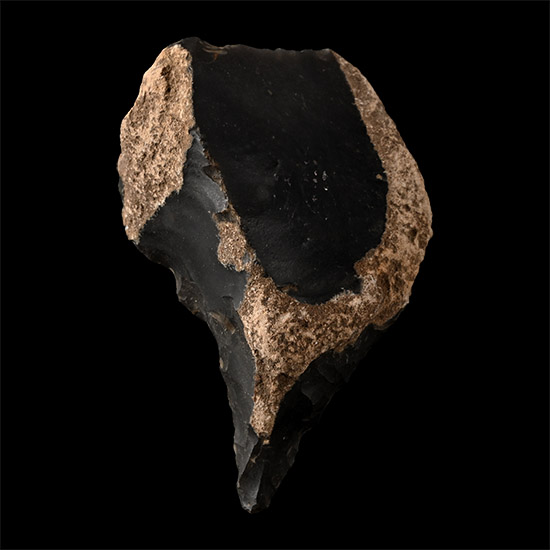
British Stone Age Flint Awl from Farnham
Neolithic Period, circa 6,000 B.P.Sold for (Inc. bp): £208
Comprising a thick flat-faced shank and thin lateral spike; some cortex remaining. 36.3 grams, 63 mm
Found Farnham, Surrey, UK, in 1901. From the collection of Captain Streatfield who helped to fund the archaeology excavations at Farnham, Kent.
After Captain Streatfield passed away in the 1940s, his collection was sold at auction to a gentleman in Kent. The collection was then sold again in the 2020’s via a UK auction house. -

Stone Age Grease Lamp
Upper Palaeolithic Period, circa 40,000-15,000 B.P.Sold for (Inc. bp): £234
Formed from a natural river cobble, modified by accentuating a large recess in one broad face and extending it to the edge, thus forming a nozzle or ledge on which to rest a wick. 225 grams, 97 mm
Found Dordogne, France. Acquired in the 1970s-1990s. From the collection of the famous UK musician and amateur archaeologist, Victor Brox (1941-2023). Acquired on the UK art market at auction after being sold by Mr Brox’s family. From the private collection of an East Anglian, UK, specialist collector. -
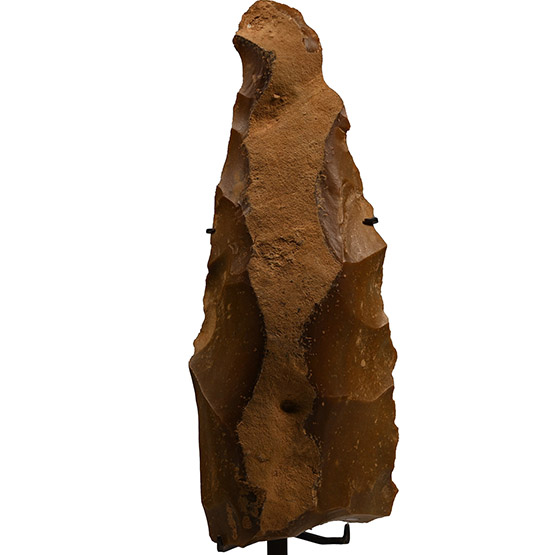
Very Large Stone Age 'Livre de Beurre' from Le Grand Pressigny
Neolithic Period, 5500-2400 B.P.Estimate: £700 - 900 (‡+bp*)
Opening Bid: £360
A substantial flint core or so-called 'Livre de Beurre' with vertical traces of blows on the work side, including one pronounced blade negative extending half way along the stone’s length; cortex remains and core preparation traces on other side; proximal end with impact surface, distal end with rounded point; two bifacial wave to chevron-shaped core edges; flat-prismatic cross-section; raw material for blade production, beige stone (silex) with yellow undertone, cream-coloured patches and spots, slightly shiny surface (origin: Le Grand Pressigny, Dép. Indre-et-Loire, France); old collector's label 'N13310'; supplied with a custom-made stand. 2.62 kg, 30.5 cm (3.79 kg total, 37.5 cm including stand)
Private collection, B.G., Southwest France. Accompanied by a copy of an Art Loss Register certificate no.S00127506.
