
Loading, please wait...
_900x900.jpg "Stone Age Knapped Flint Adze with Blue-Grey Patina")
_200x200.jpg "Stone Age Knapped Flint Adze with Blue-Grey Patina")
_900x900.jpg "Stone Age Knapped Flint Adze with Blue-Grey Patina")
_200x200.jpg "Stone Age Knapped Flint Adze with Blue-Grey Patina")
.jpg "Stone Age Knapped Flint Adze with Blue-Grey Patina")
.jpg "Stone Age Knapped Flint Adze with Blue-Grey Patina")
LOT 1946
Stone Age Knapped Flint Adze with Blue-Grey Patina
LATE MESOLITHIC-EARLY NEOLITHIC PERIOD, CIRCA 7550-3650 B.Р.
5 1/4 in. (378 grams, 13.5 cm).
Lentoid in section with rounded edge and base; cortex still remaining on part of the tool; inked findspot 'Salisbury'. [No Reserve]
ProvenanceFrom the private collection of Mr P.M. Wiltshire, UK.
Found by the collector whilst field walking in the Salisbury area during the early 2000s.
TimeLine Auctions follows a vetting process to ensure the authenticity and legality of all items, reinforcing our commitment to integrity and responsible trading. Each antiquity, antique, and coin lot undergoes thorough examination by a vetting committee of at least ten external specialists, professional trade association members, scientists, and archaeologists: Our Vetting Process
AUCTIONS:
TimeLine is a leading auction house specialising in antiquities, ancient art, collectables, natural history, coins, medals, and books. Our auctions offer museums, collectors, historians, and enthusiasts the opportunity to acquire unique and historically significant pieces.
-
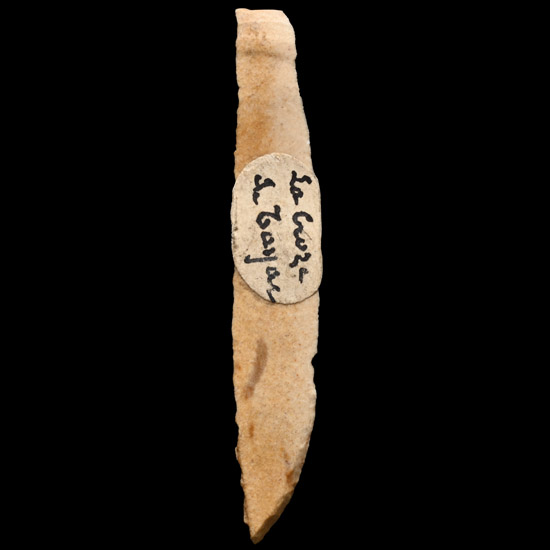
French Stone Age Knapped Flint Point
Gravettian Period, circa 33,000-21,000 B.P.Sold for (Inc. bp): £312
Triangular in section with old collector's label 'La Groze du Tayac'. 1.00 grams, 46.69 mm
From Le Groze - Du Tay. Acquired in the 1970s-1990s. From the collection of the famous UK musician and amateur archaeologist, Victor Brox (1941-2023). Acquired on the UK art market at auction after being sold by Mr Brox’s family. From the private collection of an East Anglian, UK, specialist collector.
The Gravettian point (or Gravette point) is a small, narrow stone tool with a straight, blunted end, characteristic of the Gravettian culture. Serving as a key diagnostic artefact, these points were primarily used as weapon tips or armatures for hunting large Ice Age game -
.jpg)
Acheulean Stone Age Hand Axe
Lower Palaeolithic, circa 700,000-300,000 B.P.Sold for (Inc. bp): £143
Ovate in profile, broad butt with some cortex. 550 grams, 15.1 cm
Montesson, Île-de-France, May 1987. Collection of Jean-Claude Debenne (1936-2020), formed between the 1950s and 1990s. Accompanied by a French Ministry of Culture export licence no.CBC 242815. -
.jpg)
Acheulean Stone Age Dark Red Quartzite Handaxe Made by Homo Erectus
Lower Palaeolithic Period, circa 1,000,000-500,000 B.P.Sold for (Inc. bp): £156
Lentoid in section with facetted base. 388 grams, 11 cm
From Northern Sahara, North Africa. From a collection formed during the seventies and eighties and acquired on the British art market. By descent to the current owner in 1998.
