
Loading, please wait...
LOT 0375
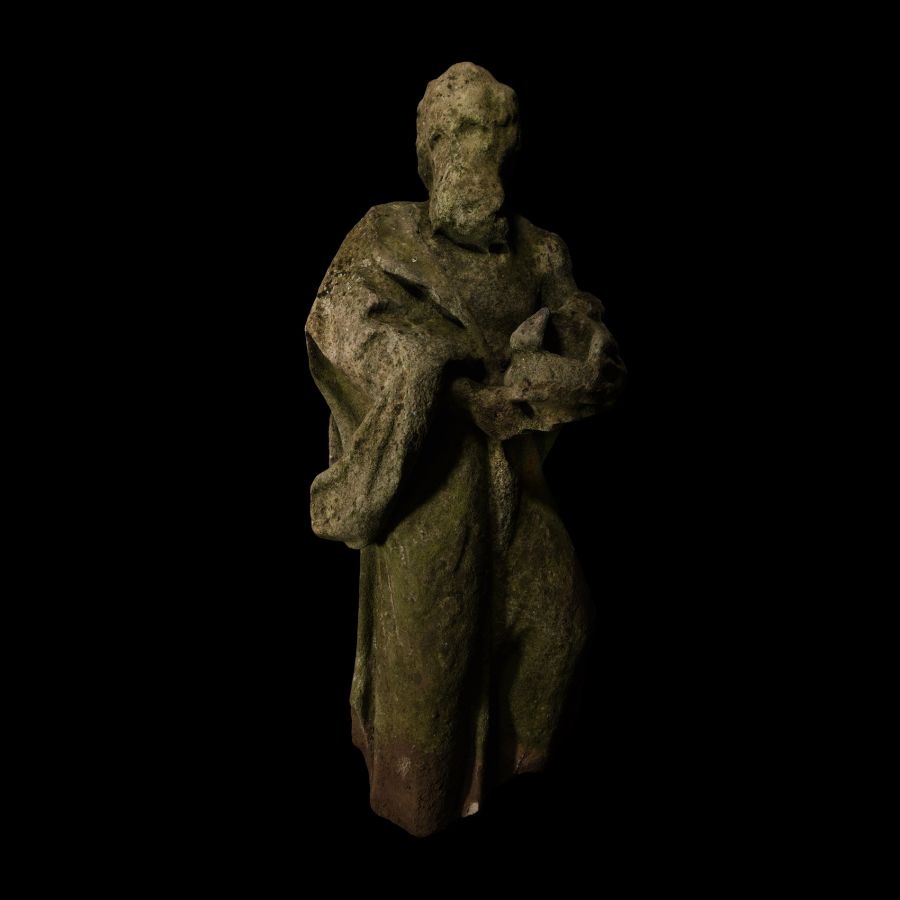
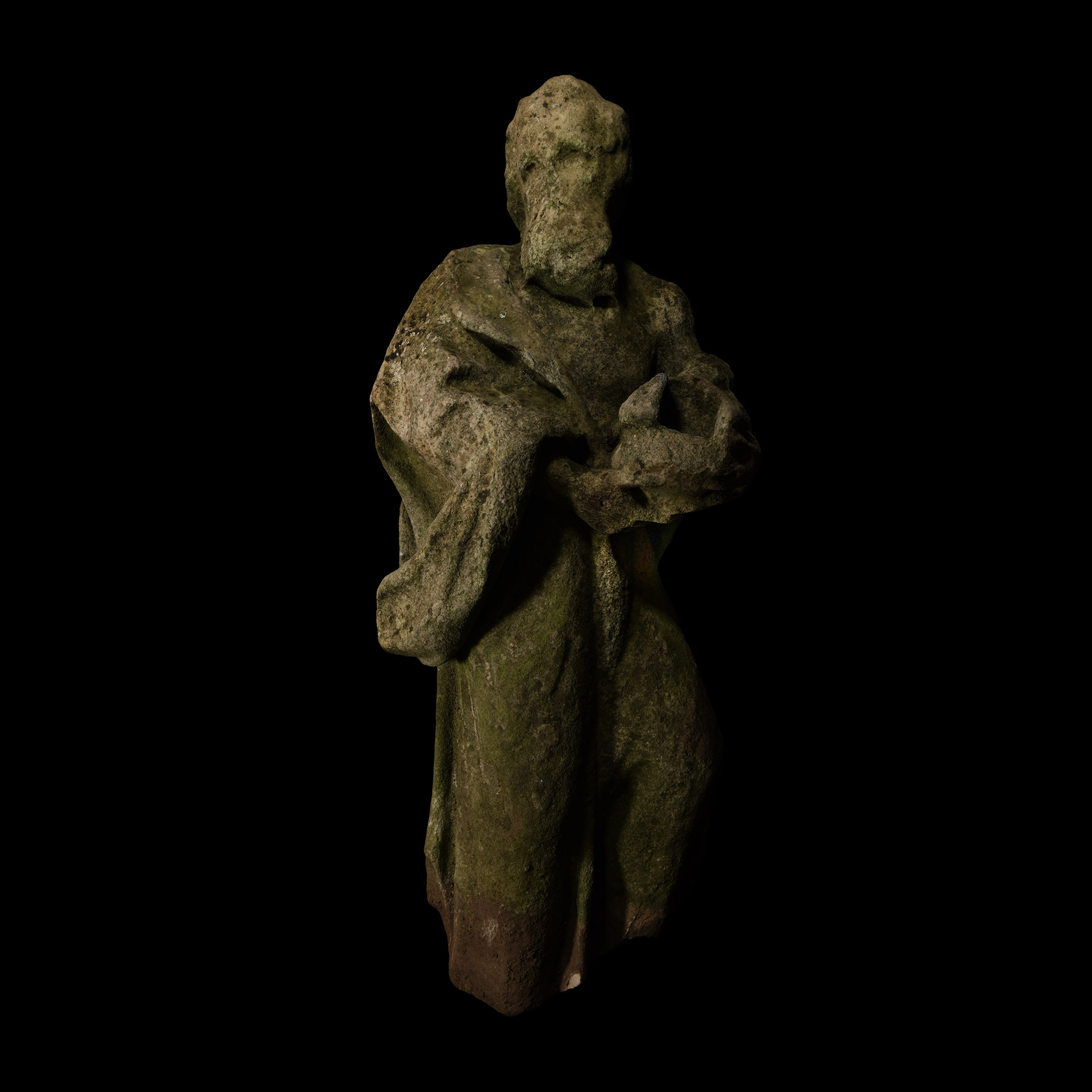
Statue of a Saint or Apostle
CIRCA 17TH CENTURY A.D.
38 5/8 in. (93 kg, 98 cm high).
A marble statue of a saint or apostle modelled in the round, standing, wearing a floor-length simple robe draped over his right shoulder and open to his left elbow; his head held erect and slightly turned, long bead resting on his chest; in his hands, a chalice or cup from which to pour the baptismal water.
ProvenanceAcquired between the 1970s and 1980s.
From the private collection of John Watson, Cambridge, UK, who worked for the Anthropology and Archaeology Museum, Downing Street, Cambridge.
Situated in his garden for at least 30 years.
TimeLine Auctions follows a vetting process to ensure the authenticity and legality of all items, reinforcing our commitment to integrity and responsible trading. Each antiquity, antique, and coin lot undergoes thorough examination by a vetting committee of at least ten external specialists, professional trade association members, scientists, and archaeologists: Our Vetting Process
AUCTIONS:
TimeLine is a leading auction house specialising in antiquities, ancient art, collectables, natural history, coins, medals, and books. Our auctions offer museums, collectors, historians, and enthusiasts the opportunity to acquire unique and historically significant pieces.
LOT 0375
Statue of a Saint or Apostle
Estimate £1,200 - 1,700€1,390 - 1,970 (for guidance only)$1,620 - 2,300 (for guidance only)
-
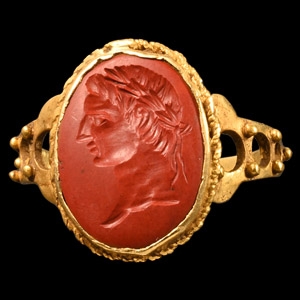
Post Medieval Gold Ring with Gemstone
19th-20th century A.D. or earlierSold for (Inc. bp): £1,170
A gold finger ring with openwork and granulation to the shoulders, ellipsoid bezel with inset jasper cloison, intaglio profile male bust wearing a wreath. 5.02 grams, 25.02 mm overall, 20.60 mm internal diameter (approximate size British V, USA 10 1/2, Europe 23.77, Japan 22)
Ex private Swiss collection. English private collection. -
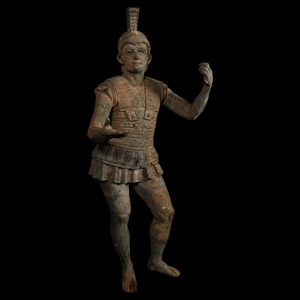
Bronze Statue of an Etruscan Warrior
20th century A.D.Estimate: £3,000 - 4,000 (+bp*)
Opening Bid: £1,500
A hollow-formed bronze copy of the Mars of Todi, a figure of an Etruscan warrior wearing segmented armour to the chest and shoulders, crested helmet, short tunic; the hands in animated pose with left hand open to accept a weapon; holes beneath feet for mounting. 7.6 kg, 61.5 cm high
French collection, 1960s-early 2000s. From an important Paris gallery, France. with Galerie Athena, Brussels, 9 May 2019, lot 393. This lot has been checked against the Interpol Database of stolen works of art and is accompanied by search certificate number no.11691-199344.
The "Mars of Todi" figure is a large, almost life-sized bronze statue of a warrior in armour. It dates from the late 5th - early 4th century B.C., and is believed to have been produced by an Etruscan workman for an Umbrian patron. The figure was probably a votive offering for a religious sanctuary, perhaps sacred to Laran, the Etruscan god of war. It had been buried ritually and left undisturbed until its modern discovery in 1835. It lacks a helmet, and the hands are empty; possibly a patera plate was originally in the open right hand, and a spear gripped in the clenched left hand. The sculptor of the figure followed the Greek contrapposto posture accentuating the carefully modelled lamellar plate armour. The statue bears a short inscription in Umbrian "Ahal Trutitis dunum dede" (Ahal Trutitis gave this gift). -
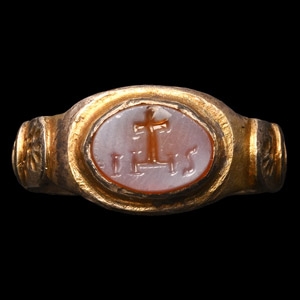
Post Byzantine Gilt Silver Ring with Cross Gemstone
17th century A.D. or earlierEstimate: £400 - 600 (+bp*)
Opening Bid: £200
A silver-gilt finger ring with tiered scales to the hoop, ellipsoid bezel with inset ellipsoid carnelian intaglio of a cross over 'IHS' Christogram. 4.26 grams, 21.70 mm overall, 18.96 mm internal diameter (approximate size British O, USA 7, Europe 14.98, Japan 14)
From a collection formed between 1990-2000. Ex East London collection. English private collection.
