
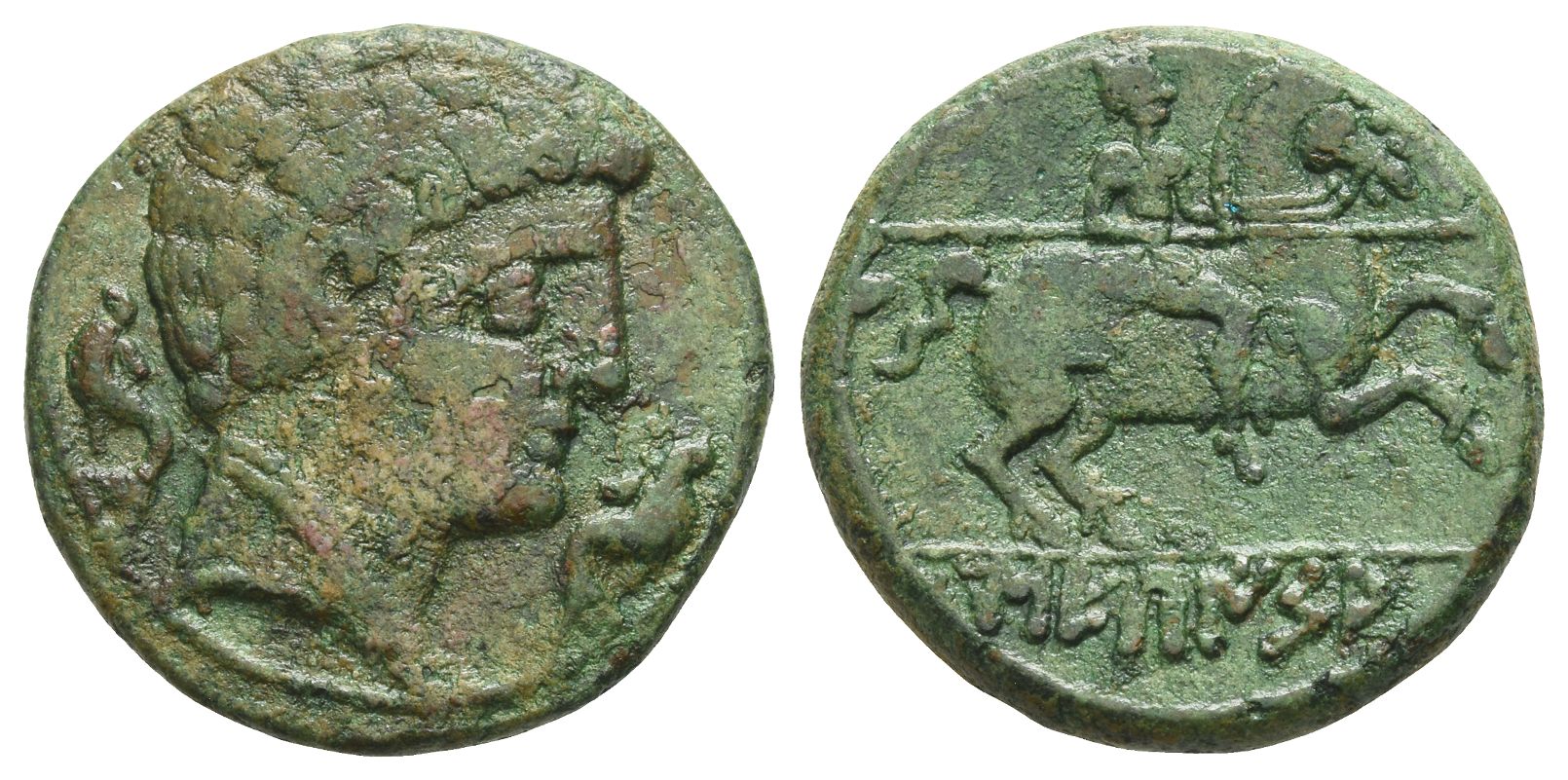
LOT 3056
Spain, Secaisa AE Unit. Circa 100-50 BC.
Male head right, dolphin in front and behind / Horseman right, holding spear, Iberic SECaISA legend below. Vill 236.40; Burgos 2131 (text); Calico 1124-26. Good Very Fine. Bold dolphins, great rider, gorgeous green patina.(8.39gr, 23mm, 6h.).
ProvenanceEx Chris Rudd, 130, lot 2, ref. no.16576.
From the private collection of John Meredith, acquired since the 1990s; thence by descent.
Celtiberian Secaisa was in the region of Aragon, northern Spain.
TimeLine Auctions follows a vetting process to ensure the authenticity and legality of all items, reinforcing our commitment to integrity and responsible trading. Each antiquity, antique, and coin lot undergoes thorough examination by a vetting committee of at least ten external specialists, professional trade association members, scientists, and archaeologists: Our Vetting Process
AUCTIONS:
TimeLine is a leading auction house specialising in antiquities, ancient art, collectables, natural history, coins, medals, and books. Our auctions offer museums, collectors, historians, and enthusiasts the opportunity to acquire unique and historically significant pieces.
-
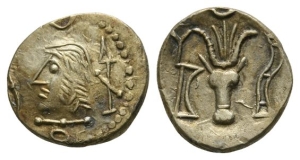
South Arabia, Himyar AR Unit. 2nd-3rd century AD. 'Bucranium Series'.
Sold for (Inc. bp): £72
Diademed male head to left; curved symbol of Almaqah to left, symbol of Athtar to right; disc-crescent of Dhat-Hamim above; 'ayin' letter below / Head of antelope facing; monogram to left, curved symbol of Almaqah to right; disc-crescent of Dhat-Hamim above. Cf. Huth 309. 2.13gr, 16mm, 5h.
Very Fine.
Private Collection, acquired 1980–1985. -
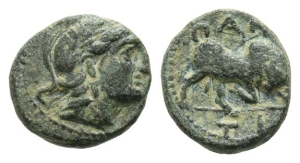
Seleukid Empire, Uncertain Ruler in the name of Antiochos I Soter(?) AE 12mm. 3rd century BC. Uncertain Western mint.
Sold for (Inc. bp): £143
Male head to right, wearing laureate and crested Attic helmet / AN-TI, bull butting to right. Cf. SC 354 (Apollo; perhaps Antioch on the Orontes); Roma Numismatics, e-Sale 112, 529 (hammer: 850 GBP); otherwise unpublished. 1.56gr, 12mm, 10h.
Good Very Fine. Nice green patina. Exceedingly Rare; the second known example and of considerable numismatic importance.
Acquired at European coin market. Property of a Kent, UK, gentleman.
The closest example to our coin is this of SC 354 (=SNG Spaer 216). Although the obverse is described as Apollo, it is nevertheless very worn. Upon closer examination one could see that the two coins share the same type. According to SC 354 note 'The Kritt specimen shows an apparent helmet crest behind Apollo's head, perhaps evidence for overstriking on an earlier variety featuring Athena'. SC's suggestion of Antioch as a possible mint is repeated from SNG Spaer. The reverse is similar to those from Seleukeia ad Tigrim but the fabric is quite different (cf. Brian Kritt, From Aï Khanoum to Samarqand. Seleucid Coins in Central Asia, pl. 8). Our coin is more reminiscent of western mints, but the identification of a specific mint is still impracticable. The most interesting feature, however, is the mysterious face depicted on the obverse, whose parallel example cannot be found in the references. -
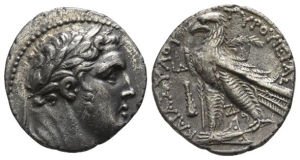
Phoenicia, Tyre AR Shekel. Dated CY 4 (123/2 BC).
Sold for (Inc. bp): £1,235
Bust of Melkart to right, wearing laurel wreath, [lion skin around neck] / ΤΥPΟΥ ΙΕΡΑΣ ΚΑΙ ΑΣΥΛΟΥ, eagle standing to left on prow; palm frond in background; to left, L Δ (date) above club; monogram of ZB and Phoenician B between legs. DCA-Tyre 10; Rouvier 1957; DCA 919; BMC 51; Hunt II 606; HGC 10, 357. 13.91gr, 27mm, 12h.
Good Very Fine. Toned.
From the collection of a gentleman, acquired on the London art market in the 1990s.
