
Loading, please wait...
LOT 0101
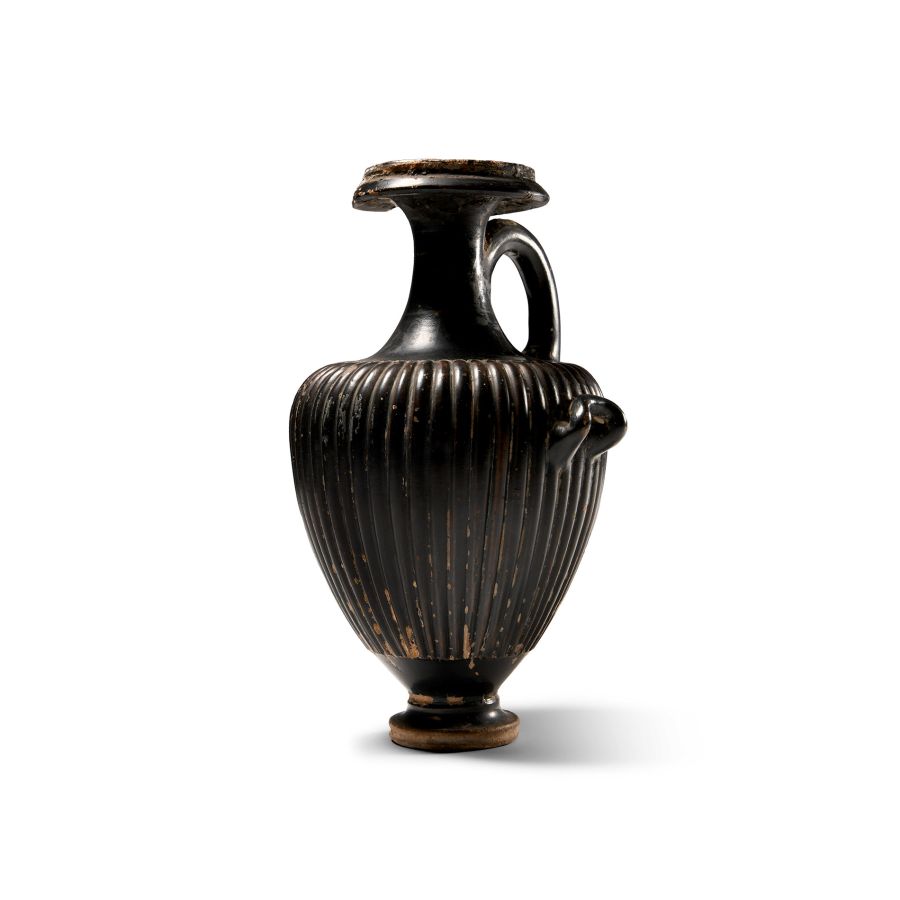
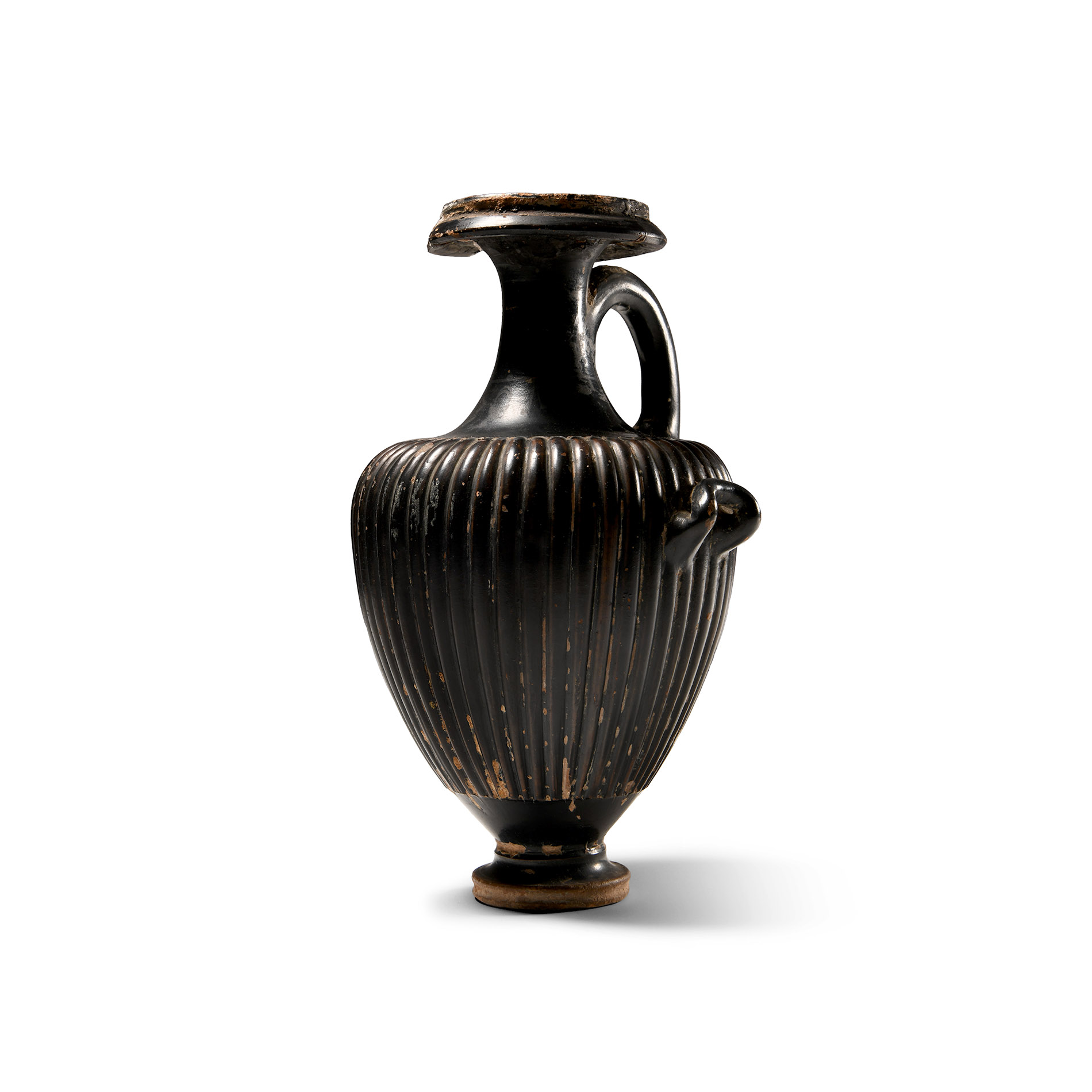
South Italian Black-Glazed Miniature Hydria
4TH CENTURY B.C.
6 1/2 in. (232 grams, 16.5 cm high).
Decorated with ribbed fluting around the body and broad shoulder, slender neck with stepped and everted rim and mouth, two handles to the equator, a carry handle between neck and shoulder to the rear, discoid foot; repaired.
ProvenancePrivate collection.
Anonymous sale, Eve Auctions, Paris, December 11, 2013, lot 11.
Cf. The Metropolitan Museum, New York, accession number 01.8.10, for similar.
CONDITIONTimeLine Auctions follows a vetting process to ensure the authenticity and legality of all items, reinforcing our commitment to integrity and responsible trading. Each antiquity, antique, and coin lot undergoes thorough examination by a vetting committee of at least ten external specialists, professional trade association members, scientists, and archaeologists: Our Vetting Process
AUCTIONS:
TimeLine is a leading auction house specialising in antiquities, ancient art, collectables, natural history, coins, medals, and books. Our auctions offer museums, collectors, historians, and enthusiasts the opportunity to acquire unique and historically significant pieces.
LOT 0101
South Italian Black-Glazed Miniature Hydria
Estimate £2,000 - 3,000€2,320 - 3,480 (for guidance only)$2,700 - 4,050 (for guidance only)
-
.jpg)
Greek Red-Figure Fragment with Athletes Attributed to the Euaion Painter
Circa 460 B.C.Sold for (Inc. bp): £3,900
From a kylix, the inside painted with two young naked athletes within a medallion, conversing and cleaning their bodies with a strigil, the edge of the medallion decorated with a series of meanders and four crosses; the outside with two naked athletes and other figures, divided by foliage ornaments and volutes. 121 grams, 15.2 cm
Acquired in before 2005. Private collection, Europe. This lot has been checked against the Interpol Database of stolen works of art and is accompanied by search certificate no.11805-206818.
The Euaion painter was a prolific artist of about 460 B.C. His painting - already in the manneristic period of the Attic red figures vases - was more nearly classical in style, although the ancestry of his small-headed, slim figures, is very evident. He introduced a high, sometimes patterned ground line for an upright two-figure group, and preferred the old elaborately patterned borders for tondos and the ground lines outside cups. -
Greek Corinthian Ceramic Alabastron with Geometric Design
Circa 6th century B.C.Sold for (Inc. bp): £221
The piriform bottle with broad everted rim and strap handle, polychrome painted dashes and concentric bands to the upper body and rim; accompanied by a custom-made display stand. 36 grams total, 77 mm high including stand
Acquired 1980s-1990s. From the H.N. collection, Milton Keynes, Bedfordshire, UK.
The alabastron takes its name from the material (alabaster) from which it was originally produced by the people who inhabited Mediterranean Africa from where it spread in the classical world. From an archaeological point of view, our specimen belongs to the first type of alabastrons, a conventional form of Corinthian origin, widespread throughout Greece from the second half of the 7th century BC. to the mid-6th century B.C., characterised by an elongated body with a maximum diameter towards the base, and continuous profile. It seems to be an Etrusco-Corinthian variant. -
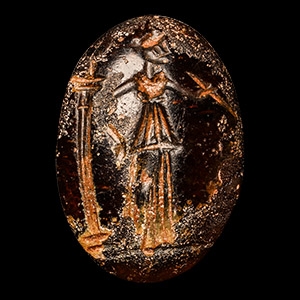
Hellenistic Glass Gem with Goddess
3rd-2nd century B.C.Estimate: £600 - 800 (+bp*)
Opening Bid: £333
Engraved with a goddess (Aphrodite?), facing right, peplos around her hips, her left elbow resting on a column and her left hand behind her body; the right hand outstretched and holding a sceptre; a snake(?) before. 2.52 grams, 22 mm
Acquired in the late 1980s-early 1990s. Important North West London collection.
In the famous Greek myth of the Gorgon, Aphrodite, jealous of their beauty, placed a curse on Medusa and her sisters, transforming their hair into snakes and making their gaze turn anyone into stone.
