
Loading, please wait...
LOT 2221
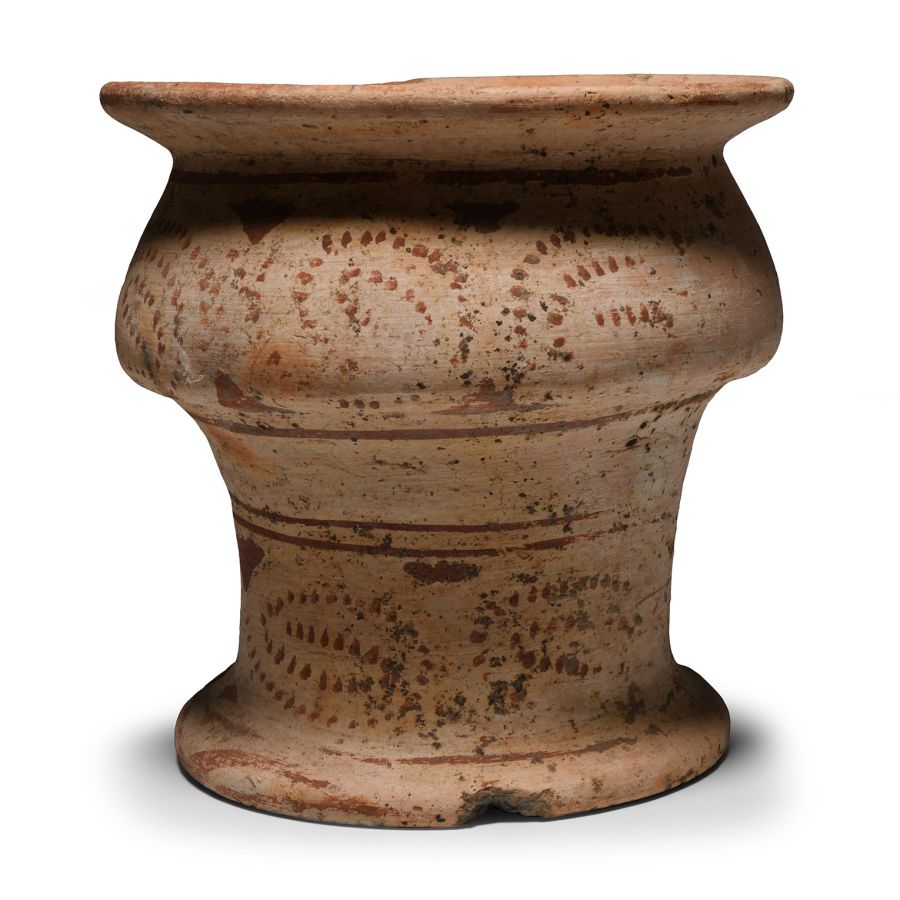
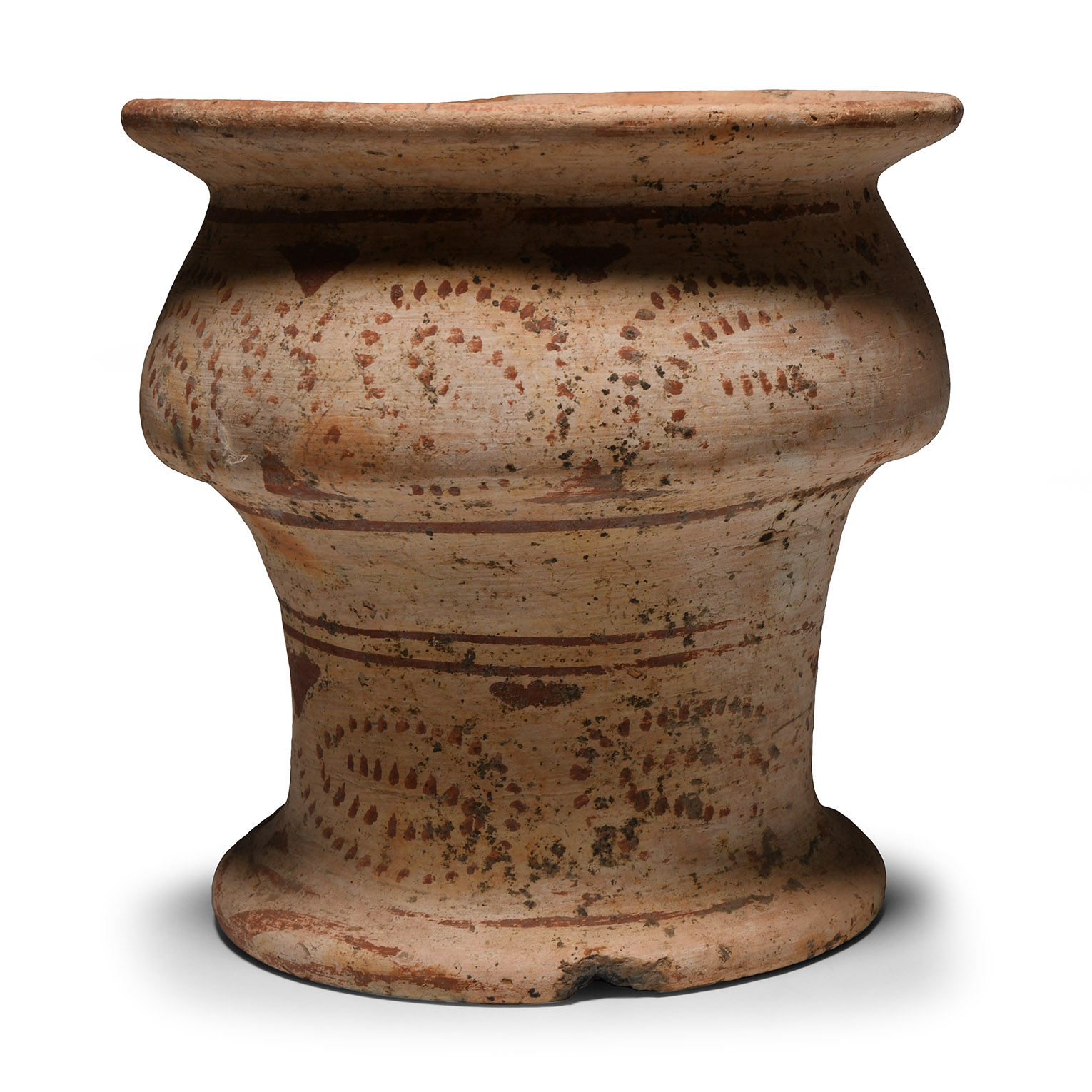
South East Asian Ban Chiang Period Painted Chalice
MIDDLE PERIOD, 900-300 B.C.
6 1/2 in. (879 grams, 16.5 cm high).
Squat carinated bowl with flared neck and rim atop a trumpet-shaped base, remains of painted interlocking spiral motifs; foot repaired. [No Reserve]
ProvenanceFrom a collection acquired on the UK art market from various auction houses and collections mostly before 2000.
From an important Cambridgeshire estate; thence by descent.
See, Labbe, A., Prehistoric Thai Ceramics: Ban Chiang in Regional Cultural Perspective, Bangkok, 2002, p.50, no.74, pl.74, for type.
FootnotesIn Ban Chiang pottery the most common body shape is an ellipsoid form with a rounded bottom covered by a low outflaring pedestal base. The neck variations include a low straight-sided neck and a higher outflaring neck. Body-pedestal juncture and body-neck juncture may be either angular or curved. The same neck variations occur on a globular body, in addition to a composite concave-convex neck form not occurring on the ellipsoid bodies. Again, all examples have low outflaring pedestal bases.
CONDITIONTimeLine Auctions follows a vetting process to ensure the authenticity and legality of all items, reinforcing our commitment to integrity and responsible trading. Each antiquity, antique, and coin lot undergoes thorough examination by a vetting committee of at least ten external specialists, professional trade association members, scientists, and archaeologists: Our Vetting Process
AUCTIONS:
TimeLine is a leading auction house specialising in antiquities, ancient art, collectables, natural history, coins, medals, and books. Our auctions offer museums, collectors, historians, and enthusiasts the opportunity to acquire unique and historically significant pieces.
-
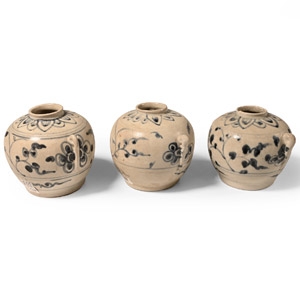
Hoi An Cargo Shipwreck Glazed Blue and White Jarlet Group
15th century A.D.Sold for (Inc. bp): £104
Each a squat jar with broad shoulder and low rim to the mouth, applied scroll handle, painted rosette and tendril motifs to the shoulder and sidewall. 573 grams total, 89-95 mm
Ex Butterfield and Butterfield auction with official Hoi An Hoard labels. Accompanied by an illustrated information sheet about the Hoi An shipwreck.
In the mid 15th century a freighting junk loaded with fine Vietnamese pottery sank in an area of the South China Sea called the 'Dragon’s Embrace.' This vessel is part of the shipwreck cargo recovered off the coast of Vietnam at Hoi An. The ceramics themselves were probably made in the area of Chu Dau. -
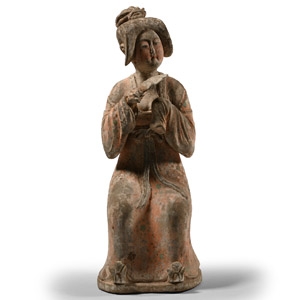
Chinese Tang Terracotta Courtly Lady
Tang Dynasty, 618-907 A.D.Sold for (Inc. bp): £2,080
Seated on a low folding chair, with elaborately dressed hair and blusher on her cheeks, dressed in a draped robe, cloud slippers emerging from beneath the hem; arms raised within the sleeves exposing one delicate hand holding a scallop-shaped fan. 1.4 kg, 29 cm
From a West Country, UK, collection, 1990s. Accompanied by a thermoluminescence analysis report no.C122k21 from Oxford Authentication. This lot has been checked against the Interpol Database of stolen works of art and is accompanied by a search certificate number no.12448-226142. -
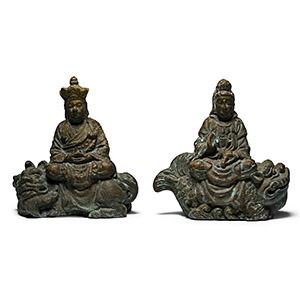
Chinese Bronze Guardian Figures
17th century A.D.Estimate: £2,000 - 4,000 (+bp*)
Opening Bid: £1,000
Each hollow-formed and wearing long robes and a tall headdress; one depicting Buddha sitting on a Buddhistic lion, the other the goddess Quan Yin sitting on a mythical fish. 335 grams total, 70 mm each
Acquired on the German art market, 1989-1995. with The Museum Gallery, 19 Bury Place, London, WC1, UK, 1998-2003. Property of a London based academic, 2003-present. This lot has been checked against the Interpol Database of stolen works of art and is accompanied by a search certificate number no.12456-226029.
