
Loading, please wait...
_900x900.jpg "Smith and Wesson Old Model No 2 Revolver")
_200x200.jpg "Smith and Wesson Old Model No 2 Revolver")
_900x900.jpg "Smith and Wesson Old Model No 2 Revolver")
_200x200.jpg "Smith and Wesson Old Model No 2 Revolver")
.jpg "Smith and Wesson Old Model No 2 Revolver")
.jpg "Smith and Wesson Old Model No 2 Revolver")
LOT 1408
Smith and Wesson Old Model No 2 Revolver
1861-1874 A.D.
10 5/8 in. (690 grams, 27 cm).
Also known as 'Model No 2 Army' with hinged frame, six shot .32 calibre rimfire cylinder with 'PATENTED APRIL 3 1855 JULY 5 1859 & DEC 18 1860' and 15cm (6") octagonal barrel marked 'SMITH & WESSON SPRINGFIELD MASS' to top with fixed extractor pin and spur trigger; serial number 47946 to butt strap with plain wood grip scales; action working.
ProvenanceAcquired from Bolk Antique Arms, Netherlands, 2016.
Ex Kusmirek Collection, UK.
Accompanied by an original Bolk invoice (1,075.00 Euros).
See Flayderman, N., Guide to Antique American Firearms, 9th edition, 2007, pp.220-221, for details.
FootnotesSold as an exempt item under Section 58 (2) of the Firearms Act, 1968, to be held as a curiosity or ornament. No license required but buyer must be over 18 years of age. Overseas bidders should note that, due to UK regulations governing export of all firearms, overseas buyers will need to make arrangements for shipping this lot out of the UK directly, by air freight, with a specialist company or agent.
CONDITIONTimeLine Auctions follows a vetting process to ensure the authenticity and legality of all items, reinforcing our commitment to integrity and responsible trading. Each antiquity, antique, and coin lot undergoes thorough examination by a vetting committee of at least ten external specialists, professional trade association members, scientists, and archaeologists: Our Vetting Process
AUCTIONS:
TimeLine is a leading auction house specialising in antiquities, ancient art, collectables, natural history, coins, medals, and books. Our auctions offer museums, collectors, historians, and enthusiasts the opportunity to acquire unique and historically significant pieces.
-
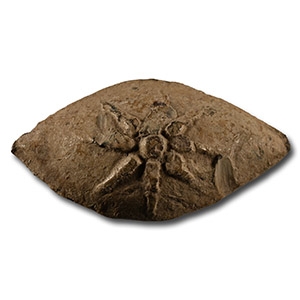
Greek Macedonian Lead Sling Shot
4th-3rd century B.C.Sold for (Inc. bp): £143
Scaphoid in plan and lentoid in section with reserved starburst motif to one face. 18.7 grams, 34 mm
Acquired in the 1980s. From the collection of a London antiquarian. -
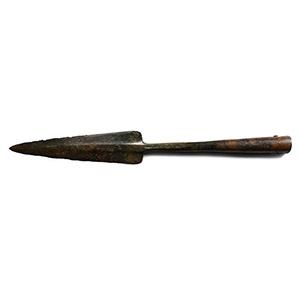
Luristan Bronze Spearhead
13th-7th century B.C.Estimate: £250 - 350 (+bp*)
Opening Bid: £130
Composed of a leaf-shaped blade with tapering socket. 355 grams, 44 cm
Acquired 1980-2015. Ex Abelita family collection. -
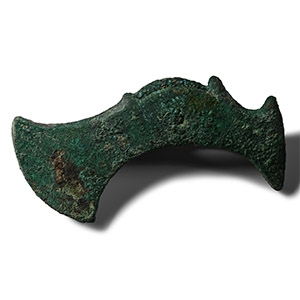
Bactrian Bronze Axehead
3rd-2nd millennium B.C.Estimate: £500 - 700 (‡+bp*)
Opening Bid: £250
With curved flaring cutting edge, characteristic curving shape and narrow socket, blade end squaring off, shaft hole pierced on both sides. 227 grams, 10.6 cm
Acquired in the mid 1980s-1990s. Private collection, Switzerland, thence by descent. Private collection, since the late 1990s.
These collared axes have the specific feature of being equipped with variously shaped rear extensions. The provenance of this typology is clearer than others: these axes came from Margiana and southern Bactria. Gonur Depe and Susa yielded a rather atypical and probably imported example. P. Amiet suggests that they were an adoption of Elamite material, from conceptual and institutional models. They would have developed from the end of the 3rd and the beginning of the 2nd millennium B.C.
