
Loading, please wait...
LOT 1518
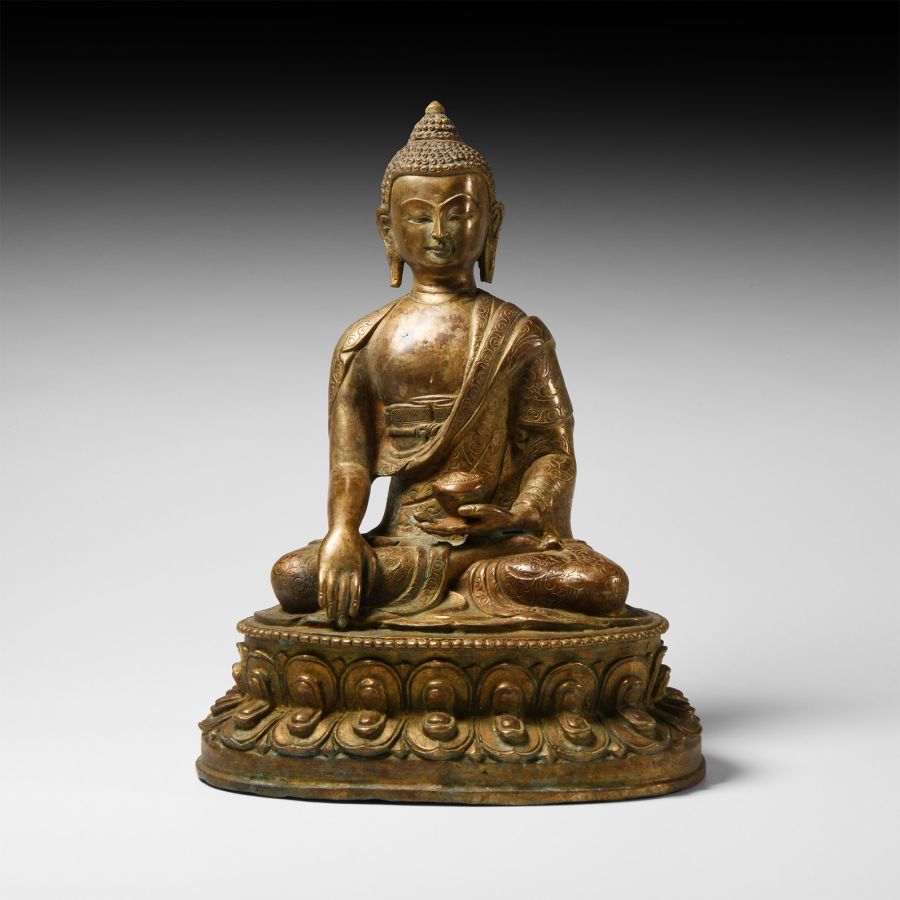
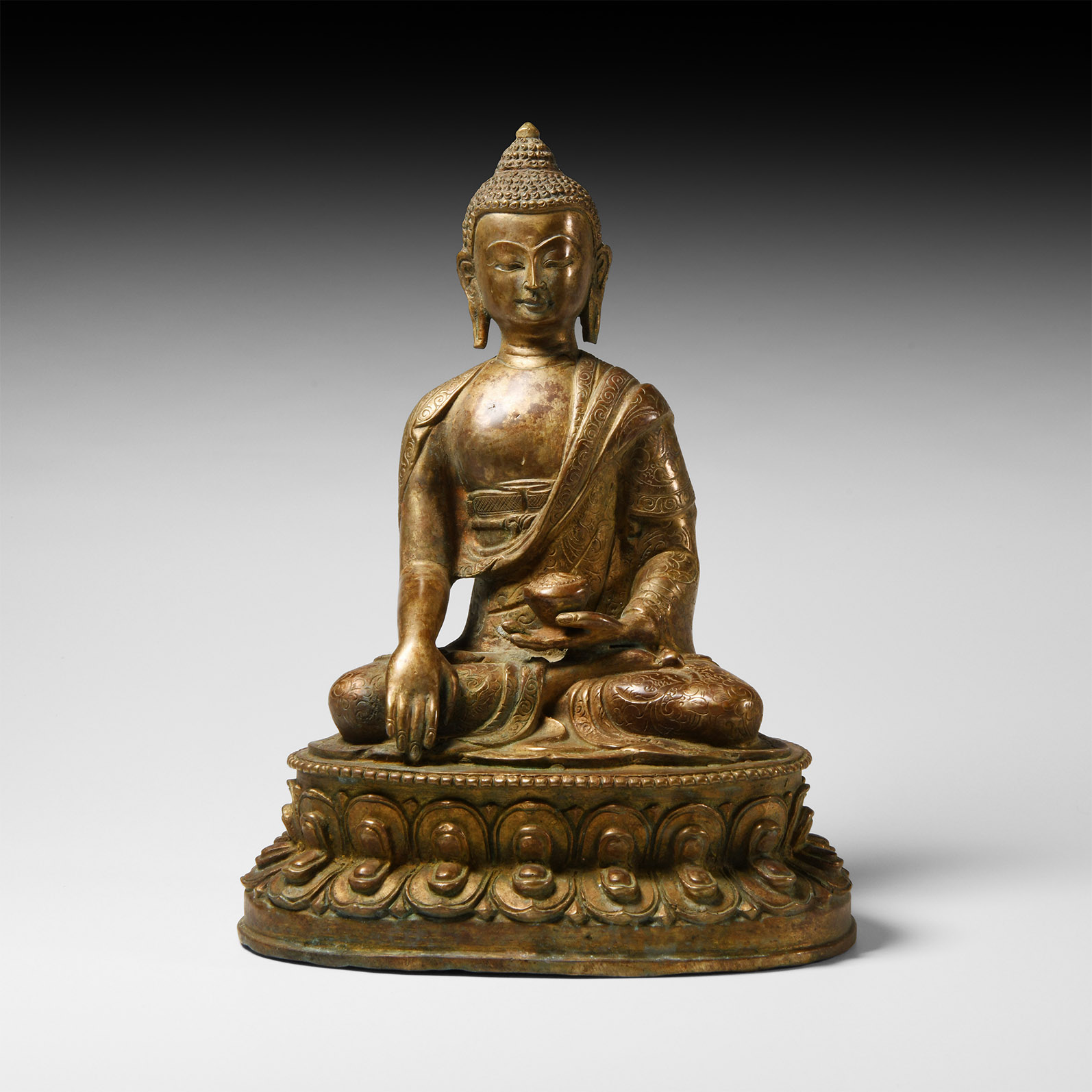
Sino-Tibetan Gilt Buddha Figure
19TH-EARLY 20TH CENTURY A.D.
8 5/8 in. (1.5 kg, 22 cm high).
A hollow-formed gilt-bronze figure of Buddha sitting cross-legged on a lotus-flower dais, cradling a vessel in his left hand and touching the earth with his right hand in the Bhumisparsha mudra at the instant of his enlightenment.
ProvenanceAcquired 1980-2015.
Ex Abelita family collection.
See Lutz, A. et al, The Return of the Buddha. The Qingzhou Discoveries, London, 2002, for discussion.
CONDITIONTimeLine Auctions follows a vetting process to ensure the authenticity and legality of all items, reinforcing our commitment to integrity and responsible trading. Each antiquity, antique, and coin lot undergoes thorough examination by a vetting committee of at least ten external specialists, professional trade association members, scientists, and archaeologists: Our Vetting Process
AUCTIONS:
TimeLine is a leading auction house specialising in antiquities, ancient art, collectables, natural history, coins, medals, and books. Our auctions offer museums, collectors, historians, and enthusiasts the opportunity to acquire unique and historically significant pieces.
LOT 1518
Sino-Tibetan Gilt Buddha Figure
Estimate £400 - 600€460 - 700 (for guidance only)$540 - 810 (for guidance only)
-
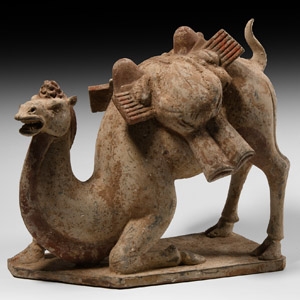
Chinese Tang Kneeling Camel
Tang Dynasty, 618-907 A.D.Estimate: £2,500 - 3,500 (+bp*)
Opening Bid: £1,250
A ceramic Bactrian camel modelled in the round in a dynamic pose, kneeling on a polygonal base and possibly in the act of standing up; saddle bags heavily laden with goods, semi-naturalistic anatomical and facial detailing, short tail held aloft; remains of polychrome painted pigment. 4 kg, 31 cm
Ex Hong Kong collection. London Mayfair gallery, UK. Accompanied by a thermoluminescence analysis report no.C122k20 from Oxford Authentication. This lot has been checked against the Interpol Database of stolen works of art and is accompanied by search certificate number no.11700-199213. -
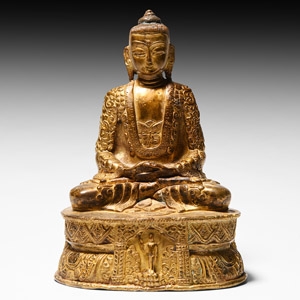
Sino-Tibetan Gilt Buddha Figure
19th-20th century A.D.Estimate: £350 - 450 (+bp*)
Opening Bid: £194
A gilt-bronze statuette of Buddha sitting cross-legged on a lotus flower dais; both hands placed palm-upwards in the lap; the D-shaped base with a lotus detailing to the outer face and icons of Buddha in various poses, hollow with panel to the underside. 1.9 kg, 17 cm high
Fine condition.
Acquired 1970s-2000s. From a Japanese collection of Buddhist art. -
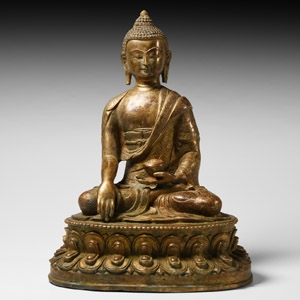
Sino-Tibetan Gilt Buddha Figure
19th-early 20th century A.D.Estimate: £400 - 600 (+bp*)
Opening Bid: £200
A hollow-formed gilt-bronze figure of Buddha sitting cross-legged on a lotus-flower dais, cradling a vessel in his left hand and touching the earth with his right hand in the Bhumisparsha mudra at the instant of his enlightenment. 1.5 kg, 22 cm high
Acquired 1980-2015. Ex Abelita family collection.
