
Loading, please wait...
_900x900.jpg "Silver Ring with Facetted Gem")
_200x200.jpg "Silver Ring with Facetted Gem")
.jpg "Silver Ring with Facetted Gem")
LOT 2179
Silver Ring with Facetted Gem
CIRCA 18TH CENTURY A.D.
1 in. (3.84 grams, 26.69 mm overall, 17.88 mm internal diameter (approximate size British O 1/2, USA 7 1/4, Europe 15.61, Japan 15)).
Comprising a wide hoop with moulded ropework, tall bezel set with red glass. [No Reserve]
ProvenanceFrom an English collection formed before 2000.
This lot is accompanied by an illustrated lot declaration signed by the Head of the Antiquities Department, Dr Raffaele D’Amato.
TimeLine Auctions follows a vetting process to ensure the authenticity and legality of all items, reinforcing our commitment to integrity and responsible trading. Each antiquity, antique, and coin lot undergoes thorough examination by a vetting committee of at least ten external specialists, professional trade association members, scientists, and archaeologists: Our Vetting Process
AUCTIONS:
TimeLine is a leading auction house specialising in antiquities, ancient art, collectables, natural history, coins, medals, and books. Our auctions offer museums, collectors, historians, and enthusiasts the opportunity to acquire unique and historically significant pieces.
-
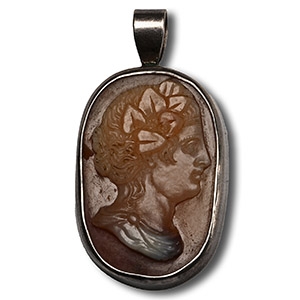
Georgian Cameo in a later Silver Pendant
18th century A.D.Estimate: £400 - 600 (+bp*)
Opening Bid: £200
Set in a silver frame with suspension loop, cameo with profile bust facing right, wearing a flower wreath, narrow band on the forehead, hair gathered in a loose chignon with a short curl falling on the side of the neck. 6.47 grams, 34 mm
Mr F.D. collection, acquired on the European art market, 1975 to present. This lot is accompanied by an illustrated lot declaration signed by the Head of the Antiquities Department, Dr Raffaele D’Amato. -
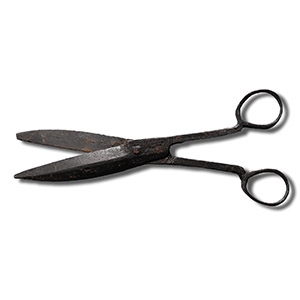
Georgian 'Thames' Iron Scissors
Mid 18th century A.D.Sold for (Inc. bp): £59
Pointillé decoration to the body, keeled blades and small loop handles, mechanism still working. 54.1 grams, 17 cm
Found on the Thames foreshore in the 1980s. Property of an Essex collector. This lot is accompanied by an illustrated lot declaration signed by the Head of the Antiquities Department, Dr Raffaele D’Amato. -
.jpg)
Bactrian Style Lapis Lazuli Bead Necklace String
20th century A.D.Sold for (Inc. bp): £78
With tabular and annular lapis lazuli beads, gilt beaded collars. 47 grams, 65 cm long
Acquired 1980-2015. Ex Abelita family collection. This lot is accompanied by an illustrated lot declaration signed by the Head of the Antiquities Department, Dr Raffaele D’Amato.
