
Loading, please wait...
LOT 0405
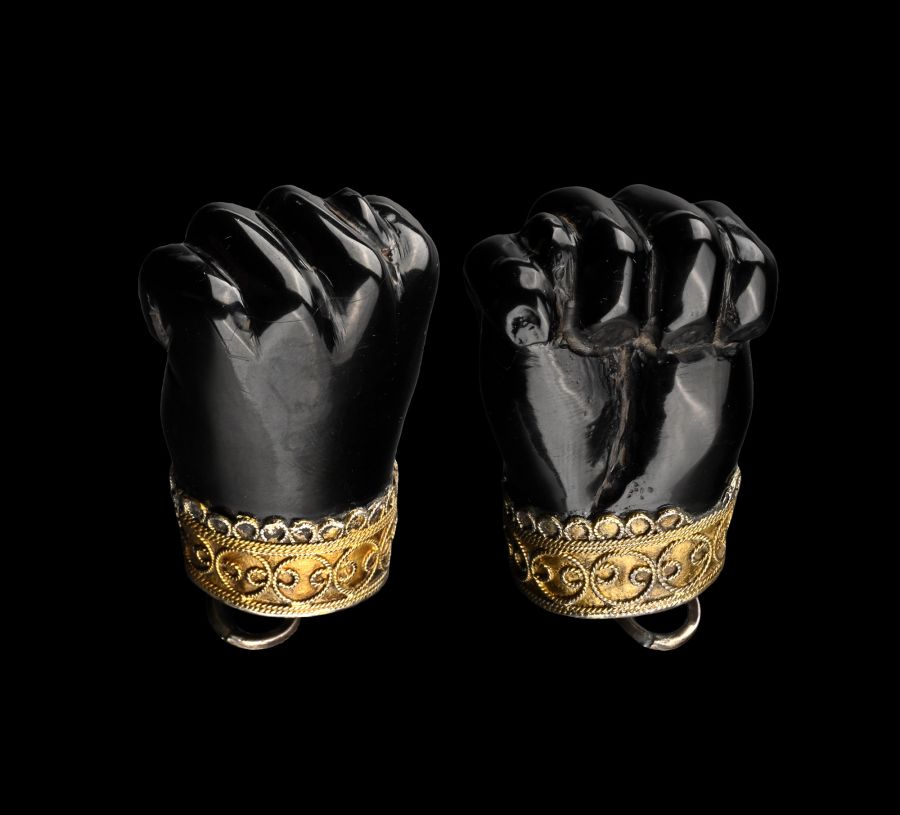
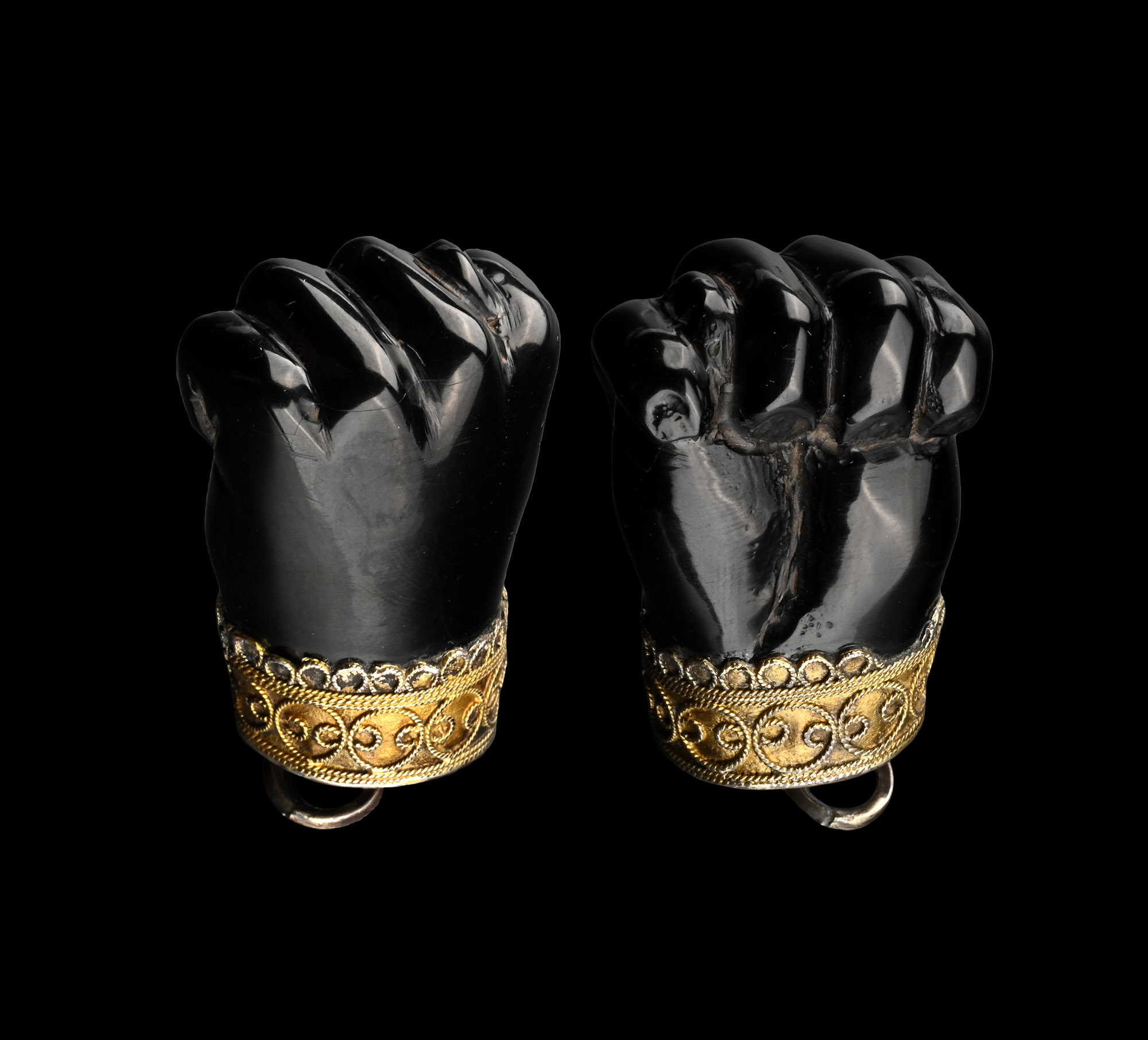
Silver-Gilt Mounted Jet 'Figa' Amulet
SPAIN, 17TH CENTURY A.D.
2 1/4 in. (19.6 grams, 56 mm).
Formed as a hand showing figa gesture, silver mount with applied twisted wires; attachment loop and ring to the top.
ProvenancePrivate collection, Europe.
Acquired on the English art market.
Mano Fico, as protective amulets have been used since the ancient world, it was believed to protect from the evil eye and other dark and magical forces and to promote fertility. In ancient Rome, the fig sign, or mano fico, was made by the pater familias (father of the family) to ward off the evil spirits of the dead as a part of the Lemuria ritual. The ancient Greeks wore amulets of the gesture around the neck to protect from the evil eye, and also used the gesture in artwork. What they considered an overtly sexual gesture was expected to distract evil spirits from causing harm. The pendant would have been worn from a belt or from a chatelaine containing other protective talismans. This carving would have served as a token representing a person's pilgrimage to Santiago de Compostela, one of the very few places in which jet can be found and mined since at least the Middle Ages.
CONDITIONTimeLine Auctions follows a vetting process to ensure the authenticity and legality of all items, reinforcing our commitment to integrity and responsible trading. Each antiquity, antique, and coin lot undergoes thorough examination by a vetting committee of at least ten external specialists, professional trade association members, scientists, and archaeologists: Our Vetting Process
AUCTIONS:
TimeLine is a leading auction house specialising in antiquities, ancient art, collectables, natural history, coins, medals, and books. Our auctions offer museums, collectors, historians, and enthusiasts the opportunity to acquire unique and historically significant pieces.
LOT 0405
Silver-Gilt Mounted Jet 'Figa' Amulet
Estimate £700 - 900€810 - 1,040 (for guidance only)$950 - 1,220 (for guidance only)
-
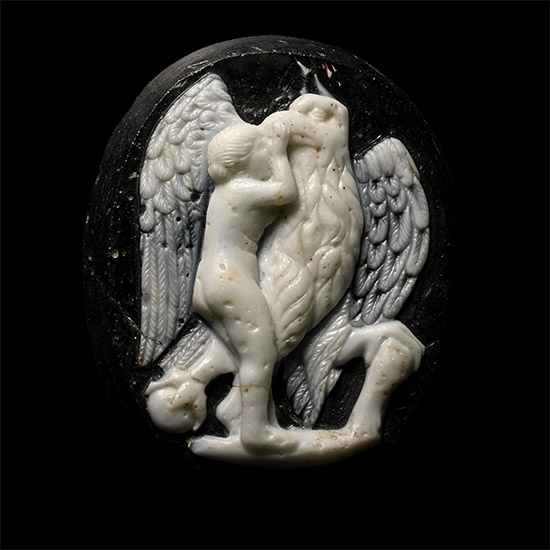
Large Post-Classical Glass Paste Cameo of a Female Figure with Eagle
20th century A.D.Estimate: £2,000 - 3,000 (+bp*)
Opening Bid: £1,000
A cameo scene comprising a standing female figure with hair tied in a chignon, approaching a perching eagle with wings spread and clutching a sphere in one claw; the woman drawing the bird's beak close to her forehead; the eagle with claws extended leaning on a branch; exergue below. 118 grams, 87 mm
Private collection, England. This lot has been checked against the Interpol Database of stolen works of art and is accompanied by search certificate number no.13172-249567.
The eagle is probably a metamorphosed personification of Jupiter, and the globe is a symbol of domain and military power. The scene is an interesting allegorical composition with possible references to the metamorphosis and Jupiter's love affairs, considering the presence of the naked female figure. The peculiar superimposition of the limbs is inspired by ancient models. The scene is engraved on the white layer of the glass paste, characterised by a dark violet second layer (seen with a powerful light from the back). On the back, traces of the glass dough melting. The evident presence of clear engraving marks and the cut glass bubbles confirms the fact that this work is an intaglio (not a cast). A work with a personality, showing undercuts. -
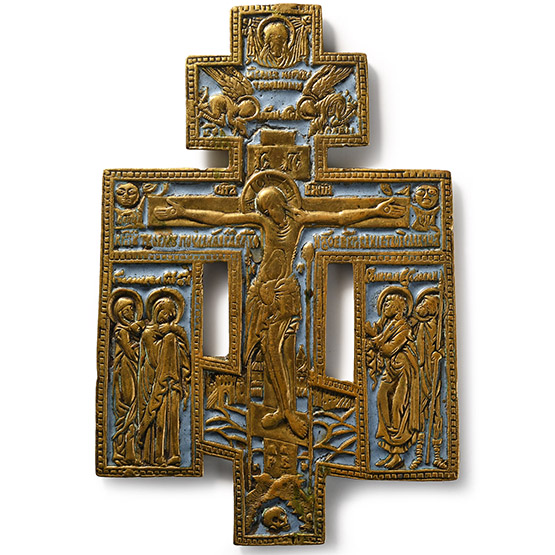
Russian Orthodox Enamelled Bronze Travel Icon with Christ Flanked by Mary, Maria, and Saint John
19th century A.D.Estimate: £250 - 350 (+bp*)
Opening Bid: £135
Representing the Saviour on the cross, the titulum inscribed with the letters 'ΙC ΧΡ' (Jesus Christ); Cyrillic inscriptions over the sun (Солнце) and the moon (Луна), flanking Jesus and above the heads of the figures: Mary of Magdala (Мария Магдала), the Mother of God ('ΜΡ ϴΥ'), Saint John the Theologian (Св Иоанн) and Saint Longinus (Св Лонгин); on the background the symbols of the Passion (sponge on reed, spear and a skull set on stones marking the site as Golgotha, twisted cords or wire, skan) and the city of Jerusalem; on the upper part of the cross the Archangels Michael and Gabriel with cloth-covered hands, the Mandylion above them. 270 grams, 16.6 cm
Acquired from Chris Martin-Zakheim, Iconastas, 5 Piccadilly Arcade, London SW1. From the private collection of a West London, UK, gentleman, formed since the early 2000s.
Orthodox travel icons were used by the faithful to carry a sacred representation with them during their journeys, offering protection and a constant spiritual connection. The icon features meticulous craftsmanship with intricate details of the Passion and Death of the Saviour, according to the Byzantine iconography. -
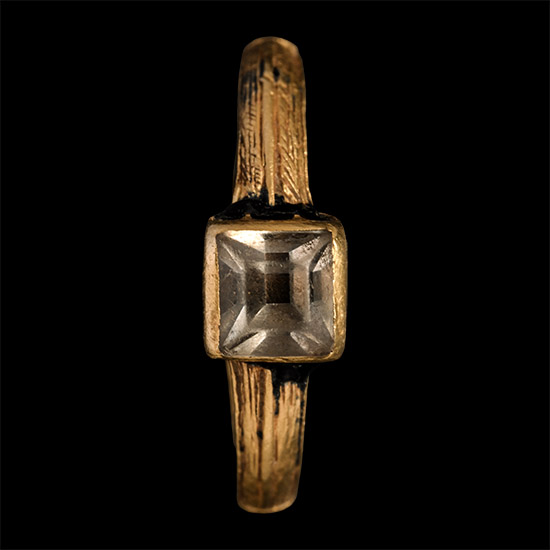
Post Medieval Enamelled Gold Ring with Table-Cut Rock Crystal Gemstone
Netherlands, 17th century A.D.Sold for (Inc. bp): £1,560
D-section hoop with carinated profile, ribbing to the shoulders, square bezel with arcade detailing to the base, and inset table-cut crystal. 3.10 grams, 23.84 mm overall, 17.41 mm internal diameter (approximate size British N 1/2, USA 6 3/4, Europe 14.35, Japan 13)
By repute from Maastricht, Netherlands. Acquired on the European art market.
