
Loading, please wait...
_900x900.jpg "Siamese 'Wild Tigers Corps' Type 62 Pattern 1907 Bayonet and Scabbard")
_200x200.jpg "Siamese 'Wild Tigers Corps' Type 62 Pattern 1907 Bayonet and Scabbard")
.jpg "Siamese 'Wild Tigers Corps' Type 62 Pattern 1907 Bayonet and Scabbard")
LOT 1069
Siamese 'Wild Tigers Corps' Type 62 Pattern 1907 Bayonet and Scabbard
DATED 1919 A.D.
23 in. (726 grams, 58.5 cm).
Stamped 2642 in Thai numerals at top of blade with 'tiger mask' mark for Siam, together with original British marks, fitted with wood grip scales and spring release button; the scabbard with original throat and chape, modified in Thailand to replace the original leather main section. [No Reserve]
ProvenanceProperty of a Luton, UK gentleman, by inheritance.
LiteratureSee Capwell, T., Knives, Daggers and Bayonets, Lorenz, 2009, p.190, for general type and details.
FootnotesThe Type 62 is a re-badged British Pattern 1907 bayonet. Siam purchased 10,000 SMLE rifles and Pattern 1907 bayonets from Britain in 1919 to equip the 'Wild Tiger Corps', royal bodyguard of Vajiravudh, King Rama VI (reigned 1910–1925). The tiger figural on the ricasso is representative of the Wild Tiger Corps. Year 2462 on the Buddhist Calendar corresponds to 1919. SMLE rifles and Pattern 1907 bayonets were taken from British stocks, refurbished by Birmingham Small Arms (BSA), and remarked with Siamese markings. The bayonets were shipped with standard steel-mounted leather scabbards. However, the leather rapidly deteriorated in the tropical climate, so the Siamese made a replacement steel scabbard body to which the original steel mounts were brazed.
CONDITIONTimeLine Auctions follows a vetting process to ensure the authenticity and legality of all items, reinforcing our commitment to integrity and responsible trading. Each antiquity, antique, and coin lot undergoes thorough examination by a vetting committee of at least ten external specialists, professional trade association members, scientists, and archaeologists: Our Vetting Process
AUCTIONS:
TimeLine is a leading auction house specialising in antiquities, ancient art, collectables, natural history, coins, medals, and books. Our auctions offer museums, collectors, historians, and enthusiasts the opportunity to acquire unique and historically significant pieces.
LOT 1069
Siamese 'Wild Tigers Corps' Type 62 Pattern 1907 Bayonet and Scabbard
Sold for (Inc. bp): £65
-
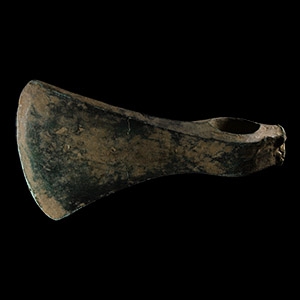
Large Western Asiatic Socketted Bronze Axehead
Late 2nd millennium B.C.Sold for (Inc. bp): £234
Composed of flared cheeks, convex cutting edge and lentoid-shaped socket with raised circumferential rib and butt, with a vertical rib to the rear. 1.16 kg, 19.2 cm
Acquired 1980-2015. Ex Abelita family collection.
In the 2nd millennium B.C., in the Caucasus area, variants of axes with a curved horizontal blade and a tubular eye developed. The simplest variants of these types were borrowed through the north of Ciscaucasia by the inhabitants of the Eurasian steppes. In the steppes, war axes became, around the middle of the 2nd millennium B.C., the most powerful bronze weapons, spreading far to the east. -
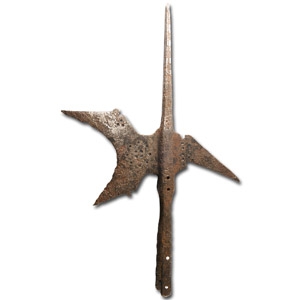
German Socketted Iron Halberd
15th-16th century A.D.Sold for (Inc. bp): £390
With square-section body and tapering spike, lateral languets pierced for attachment to the haft, hook to the rear and thick blade with crescent recess, pierced. 756 grams, 45 cm
Ex California, USA, collection formed since the late 1960s. European art market before the late 1990s. -
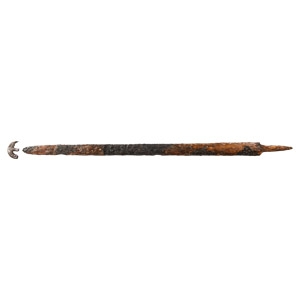
Roman Iron Spatha with Remains of Scabbard and Chape
4th century A.D.Sold for (Inc. bp): £3,900
With a double-edged blade of Illerup-Wyhl Type, narrow parallel cutting edges tapering towards the point; remains of wooden scabbard on the blade and remains of wooden grip on the hilt; accompanied by a crescent-shaped iron chape. 1.02 kg total, 6.5-94.5 cm
From the private collection of a London gentleman, from his grandfather's collection formed before the early 1970s. Accompanied by an academic report by Dr Raffaele D’Amato. This lot has been checked against the Interpol Database of stolen works of art and is accompanied by search certificate no.11924-209661.
The iconographic sources indicate that Roman swords changed in the later 2nd and 3rd centuries A.D. Longer swords, which were more popular within Germanic and Celtic cultures and more useful for fighting on horseback, were soon widespread among infantry units and mass-produced in the Roman workshops. They were brought home by foreigners after mercenary or auxiliary service in the Roman army. This, together the possibility of war booty, may explain why a great number of these swords have been found in the distant areas such as Nydam Mose, Eisbøl and Illerup Adal, all in modern Denmark.
