
Loading, please wait...
_900x900.jpg "Seal Matrix Casting Group")
_200x200.jpg "Seal Matrix Casting Group")
.jpg "Seal Matrix Casting Group")
LOT 2330
Seal Matrix Casting Group
19TH CENTURY A.D.
1 3/8 - 3 1/8 in. (165 grams total, 34-79 mm).
Comprising: two castings from moulds taken from a medieval seal, possibly of Edward I, set in plaster in a wooden frame: the smaller with a facing mask in a boat surmounted by a cross, the larger with a seated figure holding orb and sceptre within a lancet arch with a heater shield below. [2, No Reserve]
ProvenanceFrom the collection of a West London, UK, collector.
CONDITIONTimeLine Auctions follows a vetting process to ensure the authenticity and legality of all items, reinforcing our commitment to integrity and responsible trading. Each antiquity, antique, and coin lot undergoes thorough examination by a vetting committee of at least ten external specialists, professional trade association members, scientists, and archaeologists: Our Vetting Process
AUCTIONS:
TimeLine is a leading auction house specialising in antiquities, ancient art, collectables, natural history, coins, medals, and books. Our auctions offer museums, collectors, historians, and enthusiasts the opportunity to acquire unique and historically significant pieces.
-
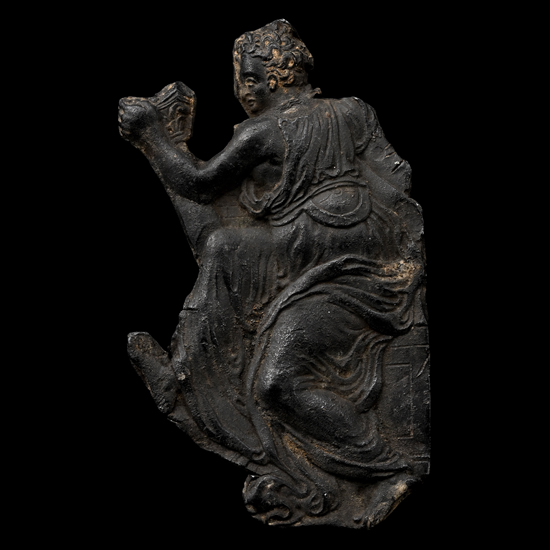
Renaissance Lead Fragment of a Draped Female
16th century A.D.Sold for (Inc. bp): £20
Appliqué fragment with a figure in a loosely draped palla turning to hold a cup in one hand. 11.04 grams, 55 mm
From the private collection of a European gentleman (1942-2024), formed since the 1970s. -
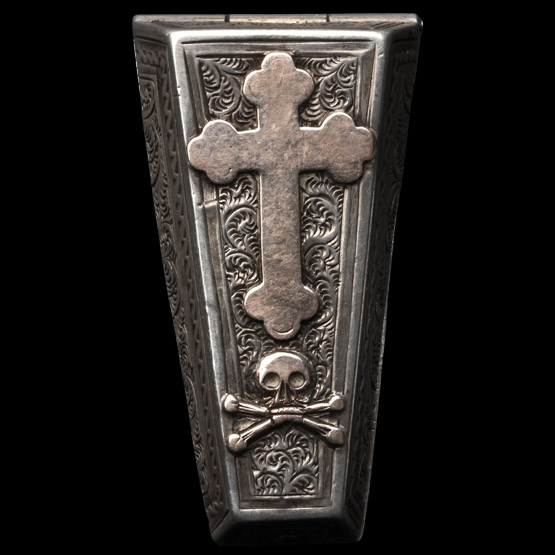
Victorian Silver Memento Mori Lidded Coffin-Shaped Casket with Skull and Crossed Bones
Late 19th-early 20th century A.D.Sold for (Inc. bp): £312
Trapezoidal in plan with hinged lid, panels of scrolled foliage within undulating borders to each face; applied rose-gold cross bottony to lid above a skull and crossed longbones; inside, glazed panel to accept a lock of hair (absent); pierced lug at foot aligning with hole in the lid to secure it. 21.9 grams, 45 mm
Previously from the house sale of a late English collector. Ex USA private collection, 1970s-1980s. -
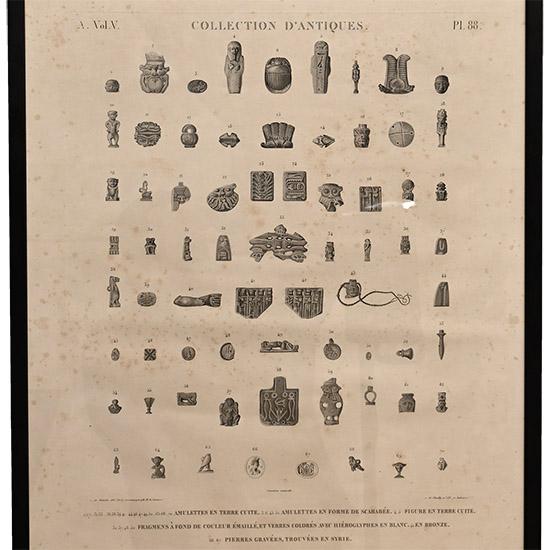
Large Framed Book Plate with Egyptian Amulets
19th century A.D.Sold for (Inc. bp): £33
Large-format engraved plate illustrating amulets of various types (figures of Bes and Pataikos, multiple wedjat, Taweret with dorsal pillar, etc.), from the book series La Description de l'Egypte published after the French army's Egyptian campaign (1798-1801), Book A, Volume V, plate 88; mounted in a modern glazed frame. 3 kg total, 70.6 x 53 cm including frame
Private collection, London, UK.
Produced between February 1802 and 1830 on the orders of Napoleon Bonaparte; published between 1809 and 1828. Just 1,000 copies were distributed to various institutions, printed on laid paper with an 'Égypte ancienne et moderne' watermark. The book is subtitled Recueil des observations et des recherches qui ont été faites en Égypte pendant l’expédition de l’Armée française, publié par les ordres de Sa Majesté l’Empereur Napoléon le Grand (Gathering of observations and discoveries which were made in Egypt during the expedition of the French army, published on the orders of His Majesty the Emperor Napoleon the Great). It was the world's first encyclopedia devoted exclusively to the remains of ancient Egypt.
