
Loading, please wait...
LOT 0299
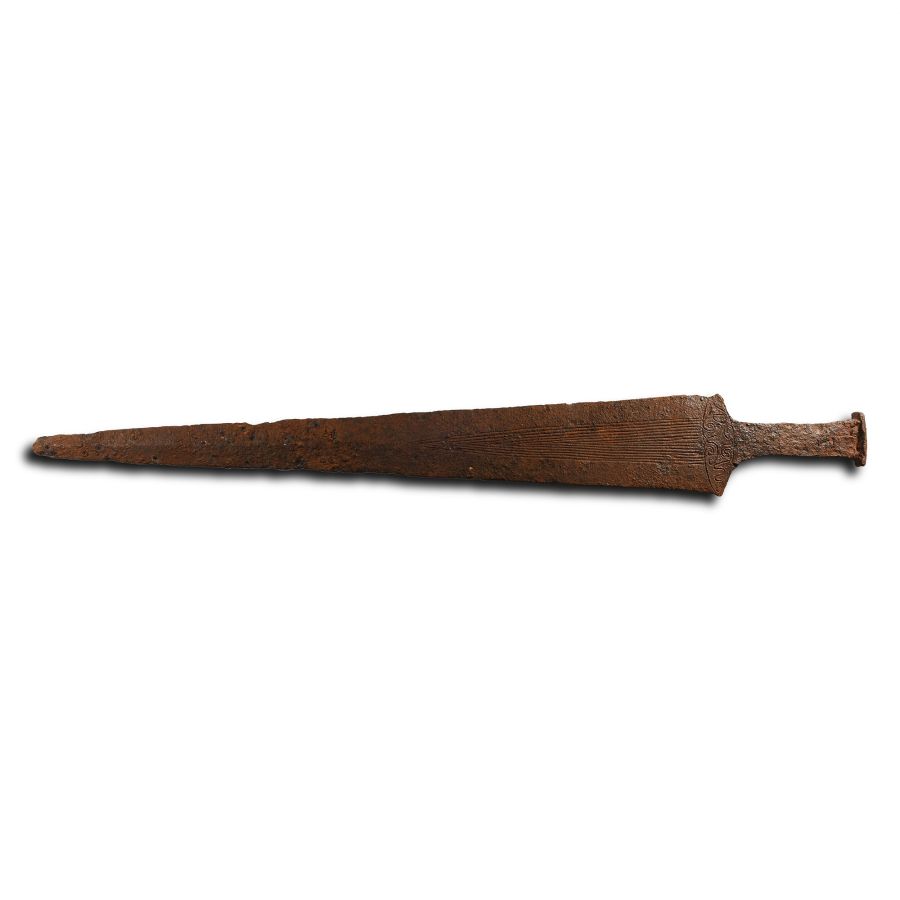
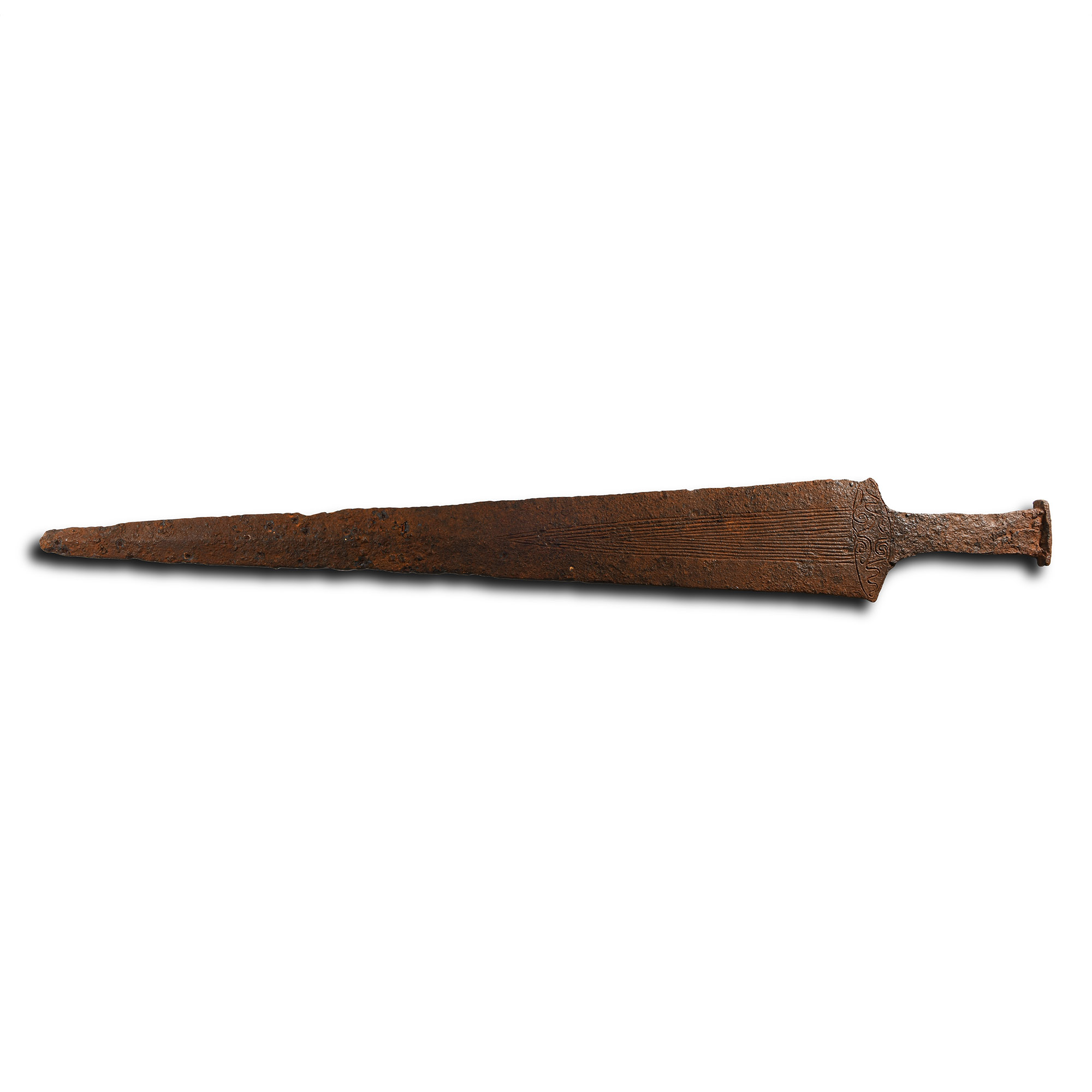
Scythian Iron Akinakes Sword with Decorations
4TH CENTURY B.C.
23 in. (481 grams, 58.5 cm).
Of Central Asian typology, strong hilt and narrow ogival guard with Steppe style ornamentation, tipped hilt, triangular tapering blade fitted with a central triangular blood channel with sixteen grooves.
ProvenanceEx private collection of Mr M.B., Mainz, Germany, since the 1980s.
Acquired from the above, 2004.
See Gorelik, M., Weapons of Ancient East, IV millennium BC-IV century BC, Saint Petersburg, 2003, in Russian, see pl.VIII, no.53, for a similar sword; cf. Meliukova, A.I., Vooruzhenie skifov. Moskva: Nauka Svod arheologicheskih istochnikov, Moscow, 1964, pl.18,10, for a near identical sword from Sofievska.
FootnotesThe akinakes was a characteristic Scythian type of weaponry, which was used throughout their history (7th-3rd centuries B.C.). With the departure of the Scythians from the steppe in the 3rd century B.C., and the appearance of the Sarmatian tribes in the Northern Black Sea region in the 2nd-1st centuries B.C., Sarmatian types of bladed weapons spread in the region. This particular shape of akinakes belongs to the nomadic cultures of Central Asia.
CONDITIONTimeLine Auctions follows a vetting process to ensure the authenticity and legality of all items, reinforcing our commitment to integrity and responsible trading. Each antiquity, antique, and coin lot undergoes thorough examination by a vetting committee of at least ten external specialists, professional trade association members, scientists, and archaeologists: Our Vetting Process
AUCTIONS:
TimeLine is a leading auction house specialising in antiquities, ancient art, collectables, natural history, coins, medals, and books. Our auctions offer museums, collectors, historians, and enthusiasts the opportunity to acquire unique and historically significant pieces.
LOT 0299
Scythian Iron Akinakes Sword with Decorations
Estimate £1,500 - 2,000€1,740 - 2,320 (for guidance only)$2,030 - 2,700 (for guidance only)
-
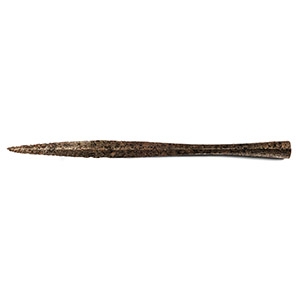
Viking Age Iron Socketted Spearhead
11th-12th century A.D.Sold for (Inc. bp): £234
Type N leaf-shaped slender blade, with flattened transition area between blade and socket, continuing far up onto the blade. 255 grams, 39 cm
Ex private collection of Mr M.B., Mainz, Germany, since the 1980s. Acquired from the above, 2004.
The spearheads of type N were a minor group in the Viking spearheads, found throughout the whole of the 10th century A.D. They make up circa 10% of the Viking Age spears. -
.jpg)
Siamese 'Wild Tigers Corps' Type 62 Pattern 1907 Bayonet and Scabbard
Dated 1919 A.D.Sold for (Inc. bp): £65
Stamped 2642 in Thai numerals at top of blade with 'tiger mask' mark for Siam, together with original British marks, fitted with wood grip scales and spring release button; the scabbard with original throat and chape, modified in Thailand to replace the original leather main section. 726 grams, 58.5 cm
Property of a Luton, UK gentleman, by inheritance.
The Type 62 is a re-badged British Pattern 1907 bayonet. Siam purchased 10,000 SMLE rifles and Pattern 1907 bayonets from Britain in 1919 to equip the 'Wild Tiger Corps', royal bodyguard of Vajiravudh, King Rama VI (reigned 1910–1925). The tiger figural on the ricasso is representative of the Wild Tiger Corps. Year 2462 on the Buddhist Calendar corresponds to 1919. SMLE rifles and Pattern 1907 bayonets were taken from British stocks, refurbished by Birmingham Small Arms (BSA), and remarked with Siamese markings. The bayonets were shipped with standard steel-mounted leather scabbards. However, the leather rapidly deteriorated in the tropical climate, so the Siamese made a replacement steel scabbard body to which the original steel mounts were brazed. -
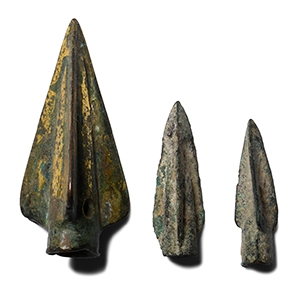
Chinese and Greek Bronze Arrowhead Group
Circa 3rd century B.C.-3rd century A.D.Sold for (Inc. bp): £26
Comprising two triangular-section Greek arrowheads; a gilt triangular-section arrowhead with short tubular socket. 18.9 grams total, 24-40 mm
Acquired in the 1980s-1990s. Property of a Nottinghamshire gentleman.
