
Loading, please wait...


LOT 0103
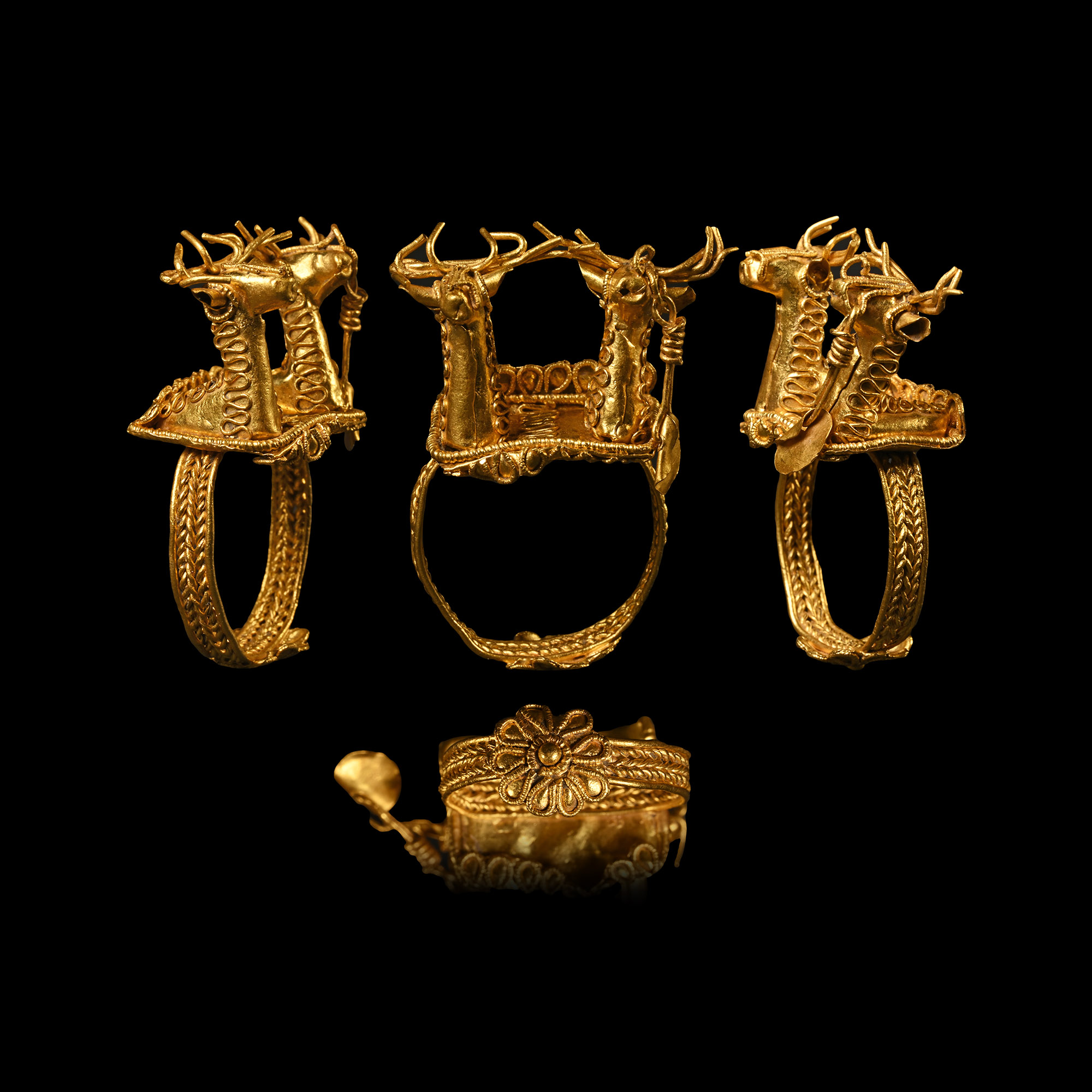
Scythian Gold Ring with Pair of Stags
CIRCA 6TH CENTURY B.C.
1 1/2 in. (7.59 grams, 38.13 mm overall, 18.63 mm internal diameter (approximate size British P 1/2, USA 7 3/4, Europe 16.86, Japan 16)).
Comprising a broad hoop of gold filigree ropework with wire borders, applied filigree rosette to underside; rectangular plaque with band of filigree loops to both long edges, applied filigree meander to centre; two hollow-formed model stags' heads each with applied filigree meander to both sides of the neck and to the spine, filigree and granule facial and other features, filigree antlers; disc dangle and filigree shank and hoop attaching to right stag's head.
ProvenancePrivate collection formed in Europe in the 1980s.
Westminster collection, central London, UK.
Accompanied by an academic report by Dr Raffaele D’Amato.
This lot has been checked against the Interpol Database of stolen works of art and is accompanied by search certificate number no.12355-225025.
Cf. Marshall, F.H., Catalogue of the Jewellery, Greek, Etruscan and Roman, in the Department of Antiquities, British Museum, London, 1911, items 1166, 1228-1230, for type of jewellery with similar rosettes and filigree work; similar forms of rosette and filigree work in gold jewellery of the period in Despini, A., Greek Art. Ancient Gold Jewellery, Athens, 1996, e.g. pl.5, p.52 (earring with identical rosette); see also Castor, A.Q., ‘Archaic Greek Earrings: An interim survey’ in Archäologischer Anzeiger, 2008,1, pp.1-34.
FootnotesThe presence of stags on the ring is a clear reference to the cult of Artemis, the hunting goddess, whose favourite animal was the deer. A particular cult of Artemis was celebrated at Brauron, in Attica. According to some stories, this was the place where Iphigenia, daughter of Agamemnon, was sacrificed to the goddess after Agamemnon offended the goddess by killing one of her sacred stags.
CONDITIONTimeLine Auctions follows a vetting process to ensure the authenticity and legality of all items, reinforcing our commitment to integrity and responsible trading. Each antiquity, antique, and coin lot undergoes thorough examination by a vetting committee of at least ten external specialists, professional trade association members, scientists, and archaeologists: Our Vetting Process
AUCTIONS:
TimeLine is a leading auction house specialising in antiquities, ancient art, collectables, natural history, coins, medals, and books. Our auctions offer museums, collectors, historians, and enthusiasts the opportunity to acquire unique and historically significant pieces.
-
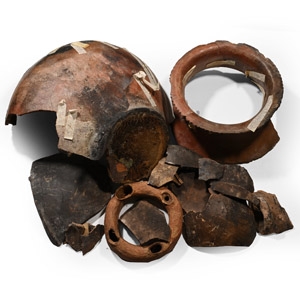
Massive Cypriot Vessel and Other Fragment Group
2nd-1st millennium B.C.Sold for (Inc. bp): £59
Including sherds of a large round-bellied vessel with applied tape for repair, and other items. 14.15 kg total, 5-54 cm
From a collection acquired on the UK art market from various auction houses and collections mostly before 2000. From an important Cambridgeshire estate; thence by descent. -
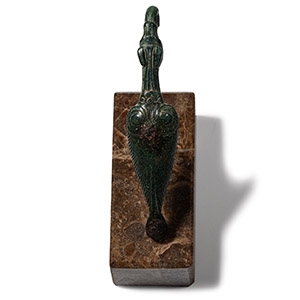
Etruscan Bronze Decorated Belt Mount
5th-3rd century B.C.Sold for (Inc. bp): £338
With domed plaque and ribbed hook; the plaque formed as the pinions and folded wings of a bird of prey, the ribbed neck extending to a dog's head with ears folded back, hook protruding from the mouth; palmette decoration to finial; mounted on a custom-made stand. 149 grams total, 86 mm wide including stand
English private collection. with ArtAncient Ltd, 2013. Private collection, London. -
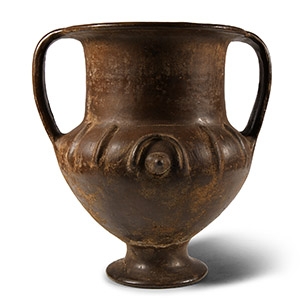
Villanovan Impasto Handled Amphora
Circa 750-700 B.C.Sold for (Inc. bp): £494
Comprising a wide foot beneath a squat stem with a bulbous body, a sloped shoulder beneath a columnar neck, a flared rim, and a pair of applied strap handles arching between rim and shoulder; body decorated with eight slender, vertical ribs surrounded by pecked stippling; two lateral bosses beneath a parabolic arch; surface burnished throughout; foot restored. 1.29 kg, 22.1 cm
From the collection of Eleanor Hilowitz (1913-2007), an abstract expressionist painter and sculptor, New York, USA; acquired between 1956 and 1975. Acquired by Randall Hixenbaugh of Hixenbaugh Ancient Art, New York, USA, in 2007. with Artemis Gallery, 26 September 2019, lot 54 (US$2,000-3,000). Property of a South Australian private collector, with collection reference 20.03. Accompanied by detailed collector's catalogue pages including description and photograph.
