
Loading, please wait...
_900x900.jpg "Scythian Gold Ibex Plaque Pair")
_200x200.jpg "Scythian Gold Ibex Plaque Pair")
.jpg "Scythian Gold Ibex Plaque Pair")
LOT 0109
Scythian Gold Ibex Plaque Pair
CIRCA 7TH CENTURY B.C.
1 1/4 in. (15.6 grams total, 34-34.2 mm).
Each a profile ibex with head reversed, horn returned to attach at the neck, pellet eye, beaded ring-and-dot motif to the shoulder and hip; thick attachment loop to the reverse. [2]
ProvenanceAcquired in the 1980s.
Private collection, London, UK.
Accompanied by an academic report by Dr Raffaele D'Amato.
This lot has been checked against the Interpol Database of stolen works of art and is accompanied by search certificate number no.13253-252971.
Cf. Ledkow, A., Tesori Dei Kurgani Del Causaso Settentrionale, Rome, 1991, no.140, for a similar plaque; Various, Ancient Bronzes from China, Ordos and the Steppes, London, nos.28, 58, for similar plaques; Piotrowskij, B.B., Tesori d’Eurasia, 2000 anni di Storia in 60 anni di archeologia sovietica, Milano, 1987.
FootnotesIt is possible to hypothesise that these two elements were bridle plaques, like the two wolf-shaped bridle plaques, in a similar position and style, found in the Kurgan of Pazyrik (Piotrowskij, 1987, p.107, no.137). Belt plaques with zoomorphic motifs illustrate not only the recognised unity of the zoomorphic art of the Steppes, but also the links between the Scythians and the eastern nomadic groups.
CONDITIONTimeLine Auctions follows a vetting process to ensure the authenticity and legality of all items, reinforcing our commitment to integrity and responsible trading. Each antiquity, antique, and coin lot undergoes thorough examination by a vetting committee of at least ten external specialists, professional trade association members, scientists, and archaeologists: Our Vetting Process
AUCTIONS:
TimeLine is a leading auction house specialising in antiquities, ancient art, collectables, natural history, coins, medals, and books. Our auctions offer museums, collectors, historians, and enthusiasts the opportunity to acquire unique and historically significant pieces.
LOT 0109
Scythian Gold Ibex Plaque Pair
Estimate £7,000 - 9,000€8,120 - 10,440 (for guidance only)$9,450 - 12,150 (for guidance only)
-
.jpg)
Greek Painted Pottery Aryballos
Corinthian, circa 6th century B.C.Estimate: £300 - 400 (‡+bp*)
Opening Bid: £150
With a narrow neck and a broad rim to the mouth, a short strap handle to the rear; painted concentric rings around the mouth. 212 grams, 75 mm
Private collection, acquired in 1994; thence by descent.
From the 8th century B.C., Corinthian pottery vessels were exported to Greek colonies in South Italy and the coast of Asia Minor. They were used to hold perfumed oil, an essential item for the wealthy middle classes of the time. In Italy, especially in Etruria, local workshops produced imitations of Corinthian vessel types for a clientele of Greek settlers and local populations with a taste for Greek fashions. -
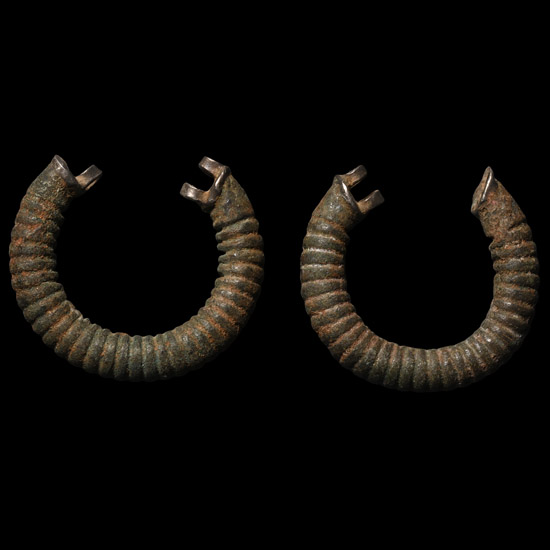
Greek Silver Earring Pair
Circa 4th-2nd century B.C.Sold for (Inc. bp): £59
Matched pair of ribbed crescents with loops. 22.5 grams total, 27-29 mm
From the private collection of a European gentleman (1942-2024), formed since the 1970s. -
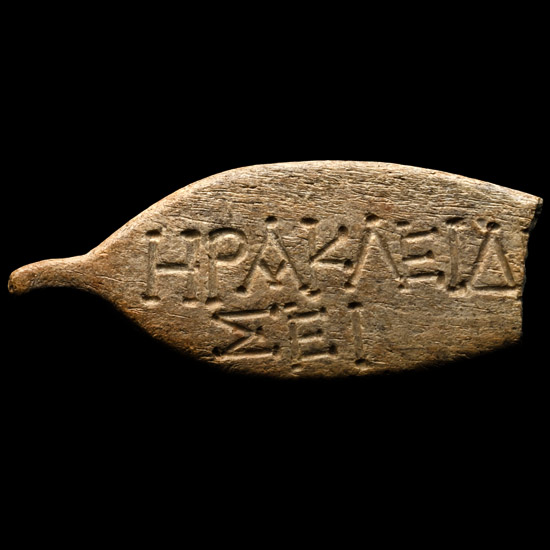
Greek Inscribed Bone Plaque
Late 1st millennium B.C.Sold for (Inc. bp): £65
A leaf-shaped plaque with a Greek inscription 'HPAKΛEIΔ [E] Σ EI' [possibly = of Heracleides]. 3.24 grams, 48 mm
From the collection of a gentleman, acquired on the London art market in the 1990s.
