
Loading, please wait...
LOT 0261
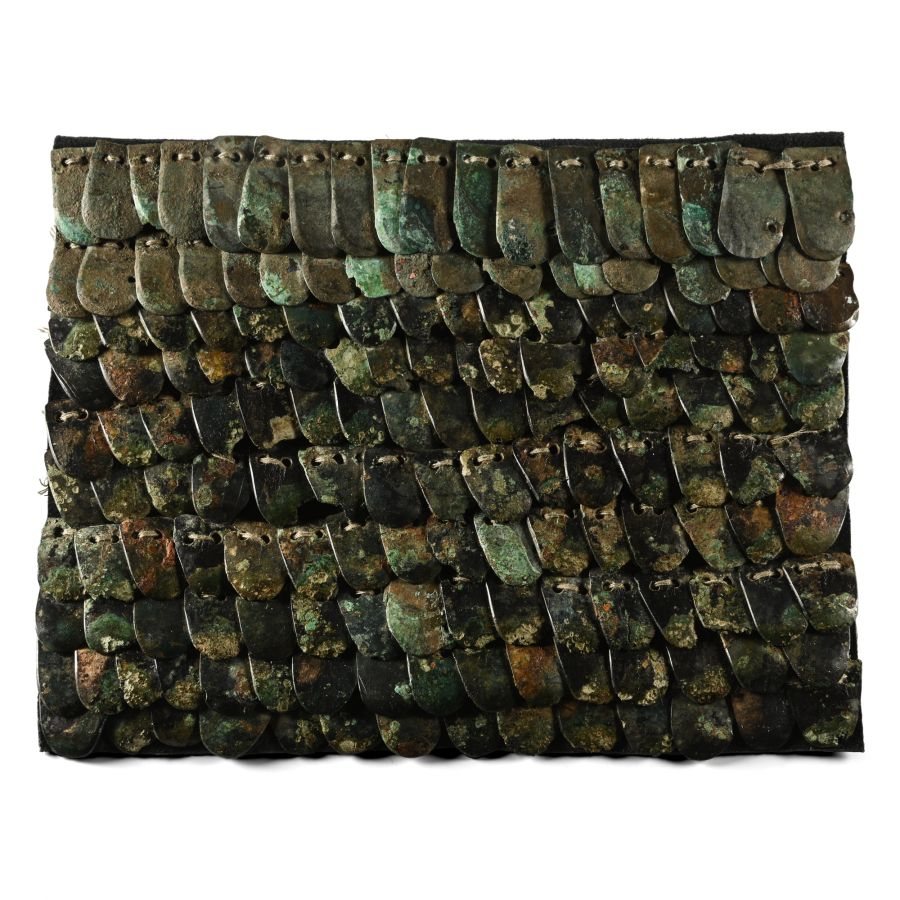
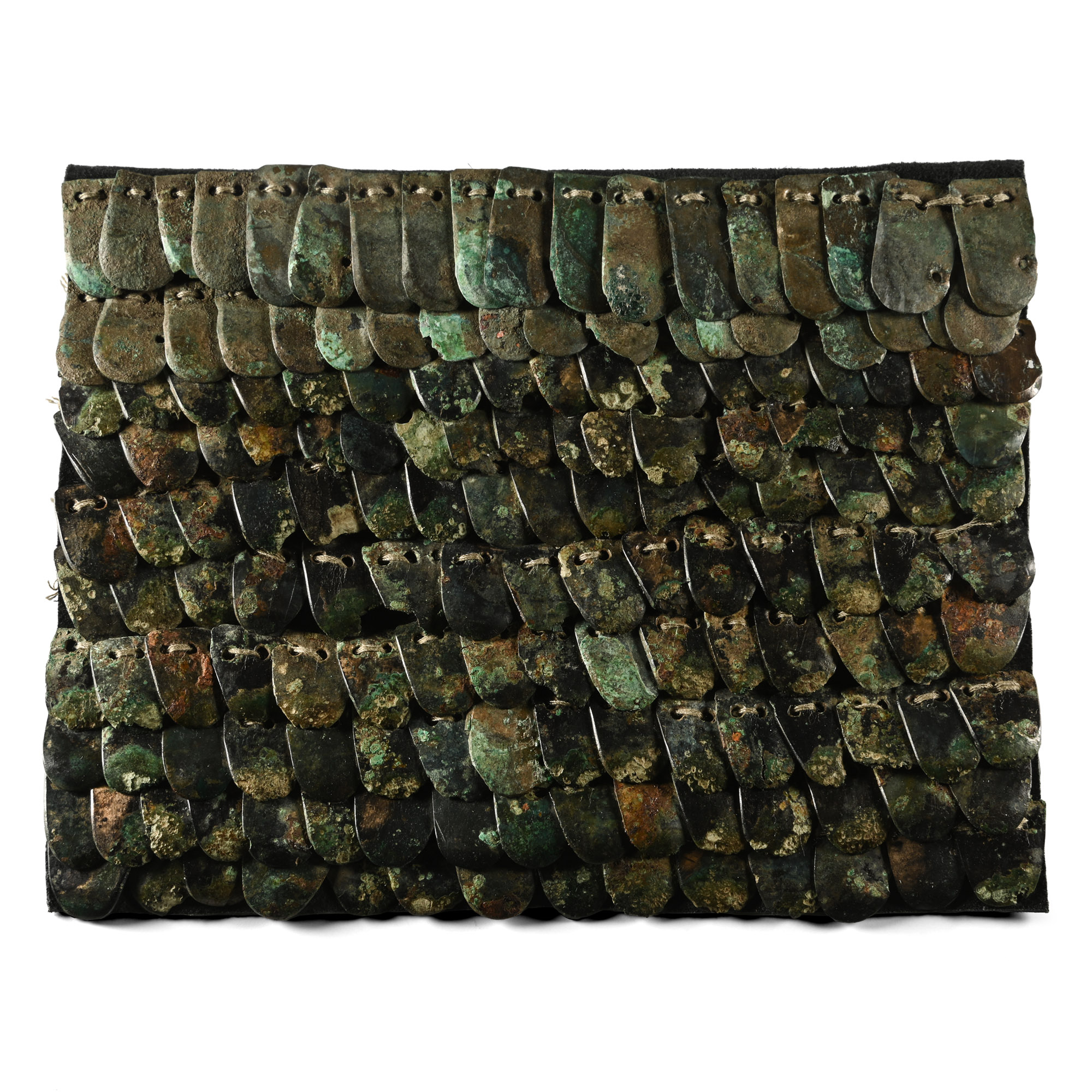
Scythian Bronze Scale Armour Section
6TH-5TH CENTURY B.C.
6 1/4 x 4 3/4 in. (165 grams, 16 x 12 cm).
A section of scale armour coat composed of 162 overlapping tongue-shaped scales mounted onto a cloth panel, each with three holes to the top and some with one or two holes to the right for fastening onto the original leather backing.
ProvenanceFrom the private collection of a London gentleman, from his grandfather's collection formed before the early 1970s.
Accompanied by an academic report by Dr Raffaele D’Amato.
This lot has been checked against the Interpol Database of stolen works of art and is accompanied by search certificate number no.12469-231236.
This lot is accompanied by an illustrated lot declaration signed by the Head of the Antiquities Department, Dr Raffaele D’Amato.
Cf. similar scales from Egypt, dated circa 590 B.C., in the Metropolitan Museum, discovered in the palace of Apries, accession no. 09.183.7a–v; Cernenko, E.V., The Scythians 700-300 BC, Hong Kong, 1998, pp.7ff., pl.D & E; for identical scales see Полин, С.В. & Колтухов, С.Г., ‘A Scythian Burial in a mound near the S.Nadezhda in Crimea’ and Лихачёва, О.С., ‘Elements of Scythian tradition in the complex of armament of the Altai forest-steppes population, in the 6th-3rd centuries B.C.’, in Russian Academy of science, The war and the military in the Scythian-Sarmatian world, Proceedings of International Scientific Conference in tribute to the memory of A.I. Melyukova (Kagal’nik, 26–29 April 2014), pp.119-126, and pp.162-171, pl.3, p.126, fig.2, p.165.
FootnotesThe favourite armour of the Scythian noblemen was composed of scales, usually protecting the torso, sometimes the entire body (kataphraktoi). The Scythians found that the most efficient method was to arrange the overlapping ‘fish-scales’ as a corselet made of a number of bronze and iron plates, which then protected the wearer against sword and spear thrusts. Our scales correspond well to bronze scales found in May 1961 in an accidentally destroyed burial in a barrow, near the village of Nadezhda Sovetsky district. They were discovered together with iron scales, a Greek Corinthian helmet, fragments of an amphora, five arrowheads and fragments of an iron sword. Most of these bronze scales were oblong in shape, with a sub-rectangular upper end and a rounded lower end, but slightly bigger than our scales.
CONDITIONTimeLine Auctions follows a vetting process to ensure the authenticity and legality of all items, reinforcing our commitment to integrity and responsible trading. Each antiquity, antique, and coin lot undergoes thorough examination by a vetting committee of at least ten external specialists, professional trade association members, scientists, and archaeologists: Our Vetting Process
AUCTIONS:
TimeLine is a leading auction house specialising in antiquities, ancient art, collectables, natural history, coins, medals, and books. Our auctions offer museums, collectors, historians, and enthusiasts the opportunity to acquire unique and historically significant pieces.
-
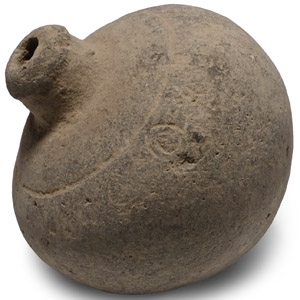
Byzantine 'Greek Fire' Ceramic Fire Bomb or Hand Grenade
9th-11th century A.D.Sold for (Inc. bp): £65
A piriform missile with domed filler-hole, intended to be filled with explosive liquid and wick, used as a hand grenade. 281 grams, 92 mm
From an important specialist collection, London, UK, 1990s onwards. Accompanied by an academic paper by military specialist Dr Raffaele D'Amato, dated 15 July 2019 and titled 'Eastern Roman Empire - Greek Fire Bomb or Hand Grenade (μεσαίον kακάβιον) 9th-11th century AD'. This lot is accompanied by an illustrated lot declaration signed by the Head of the Antiquities Department, Dr Raffaele D’Amato. -
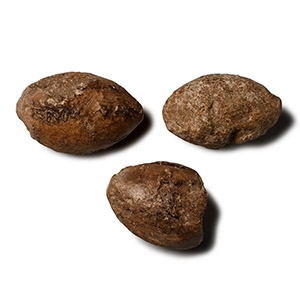
Greek Lead Impacted Slingshot Group
3rd-1st century B.C.Sold for (Inc. bp): £156
Three lentoid-section lead slingshots (glandae), each deformed due to impact, one with the Greek letters 'ΓΕΜ…ΔΑ' (Ghemonidas?). 118 grams total, 25-31 mm
Ex German art market, 2000s. Acquired from an EU collector living in London. From the collection of Surrey, UK, gentleman. This lot is accompanied by an illustrated lot declaration signed by the Head of the Antiquities Department, Dr Raffaele D’Amato.
The use of lead slingshots in battle is attested in Greece as early as the 5th century B.C. Numerous finds were excavated in Olynthus, usually olive or plump-almond-shape. The type continued to be used in the Italian peninsula, and similar specimens, bearing the title ‘Commander of the Units of Slingers’ have been attested from the period of the Punic Wars. -
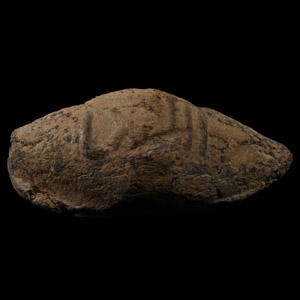
Roman Legion XIII 'Battle of Munda' Lead Slingshot
1st century B.C.Sold for (Inc. bp): £650
Fusiform with reserved legend 'LXIII' (for LEGIO XIII = 13th Legion). 50.3 grams, 41 mm
Acquired on the UK art market. Property of a gentleman collector. This lot is accompanied by an illustrated lot declaration signed by the Head of the Antiquities Department, Dr Raffaele D’Amato.
The shot (Völling type 1C) is marked with the abbreviated name of Legion XIII, and was probably used at the Battle of Monda (or Munda) against Julius Caesar, 17th March 45 B.C., or against the sons of Pompey, because both the generals (Pompey sons and Caesar) had in their army a Legio with the numeral XIII on that day. Interestingly, other glandes of the same typology from the same battlefield bear the name of Pompey, so that it is much possible that the glans belongs to the Legio XIII of Pompey, who was destroyed during the battle and whose survivors were massacred among the 22,000 defenders of Cordoba by the troops of Caesar (D'Amato, 2021, pp.421 and 424). The projectiles were made of different materials: lead (glandes) or in pottery or stone (lapides missiles).
