
Loading, please wait...
LOT 0094
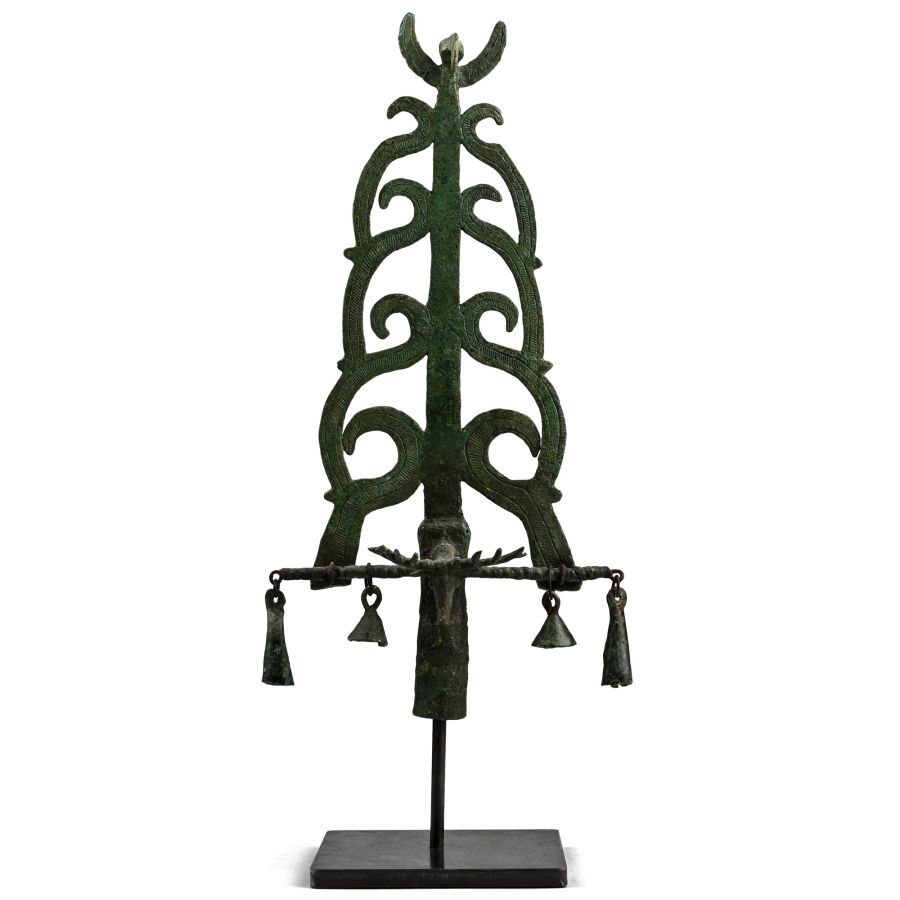
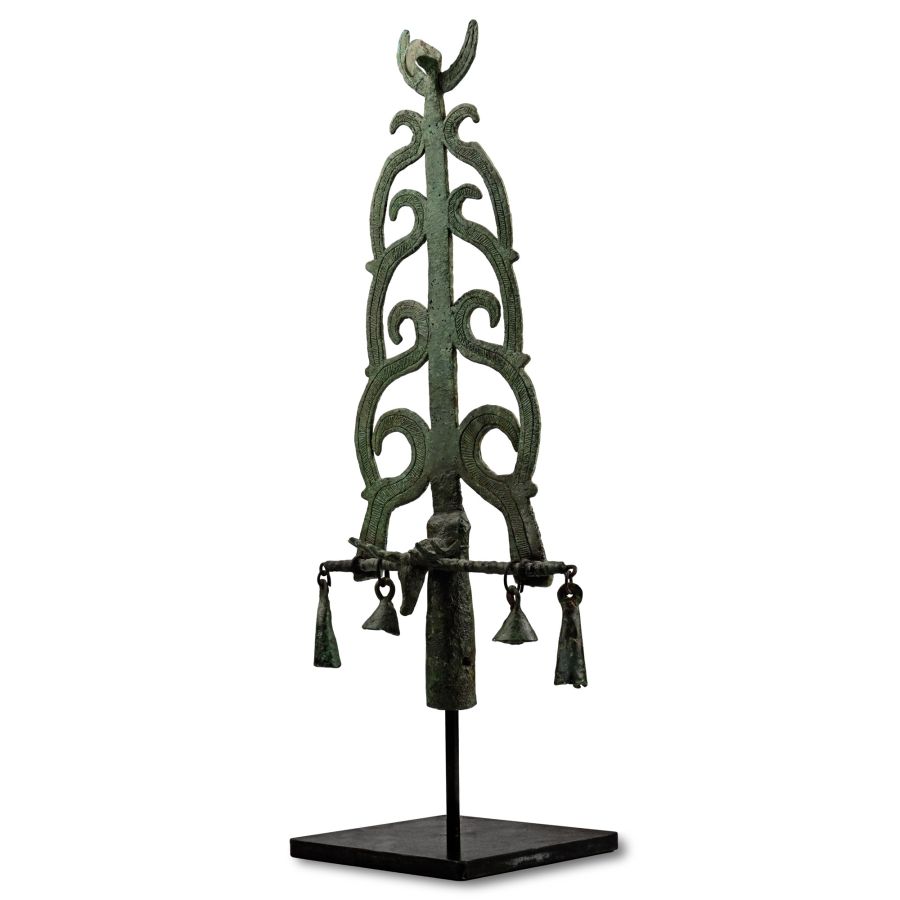
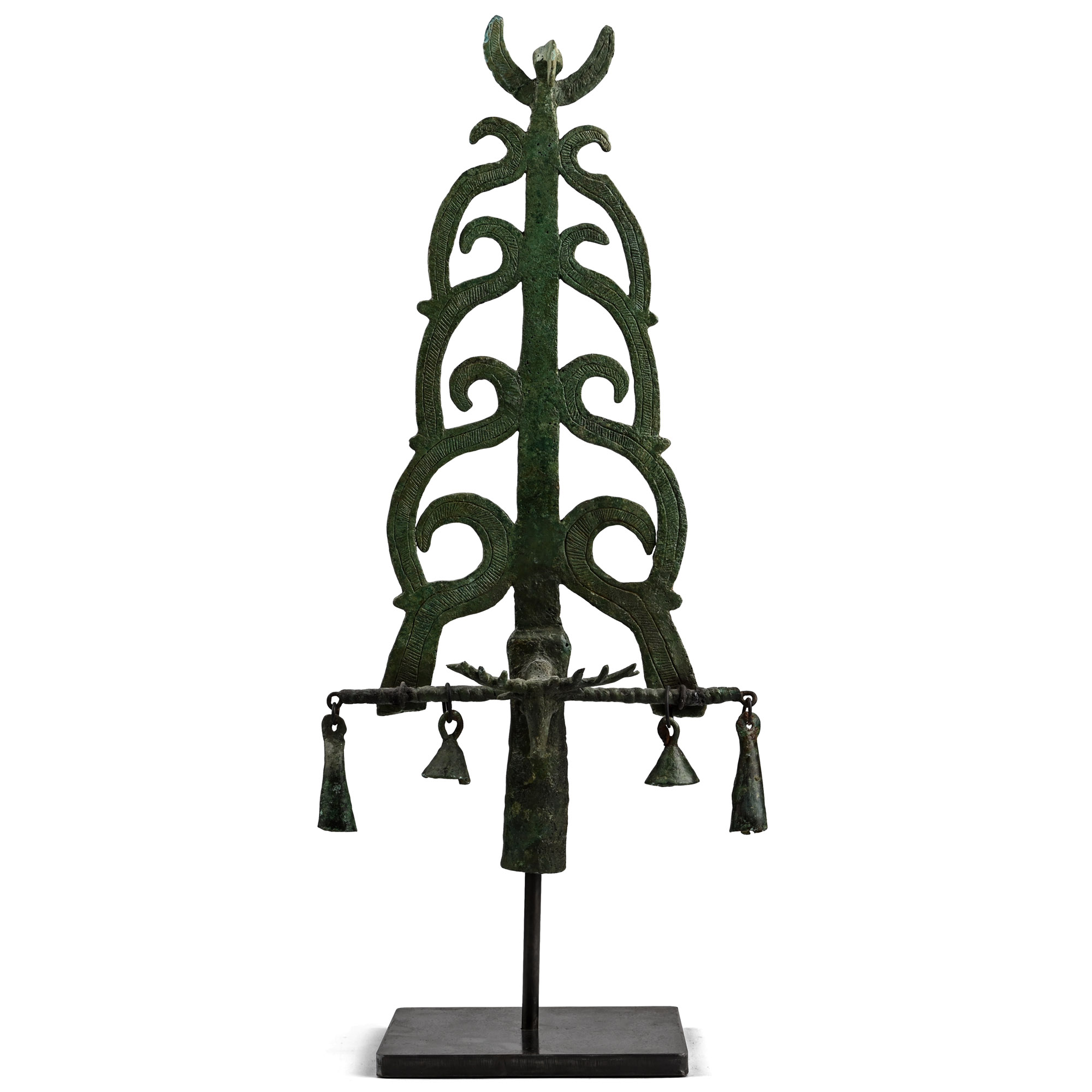
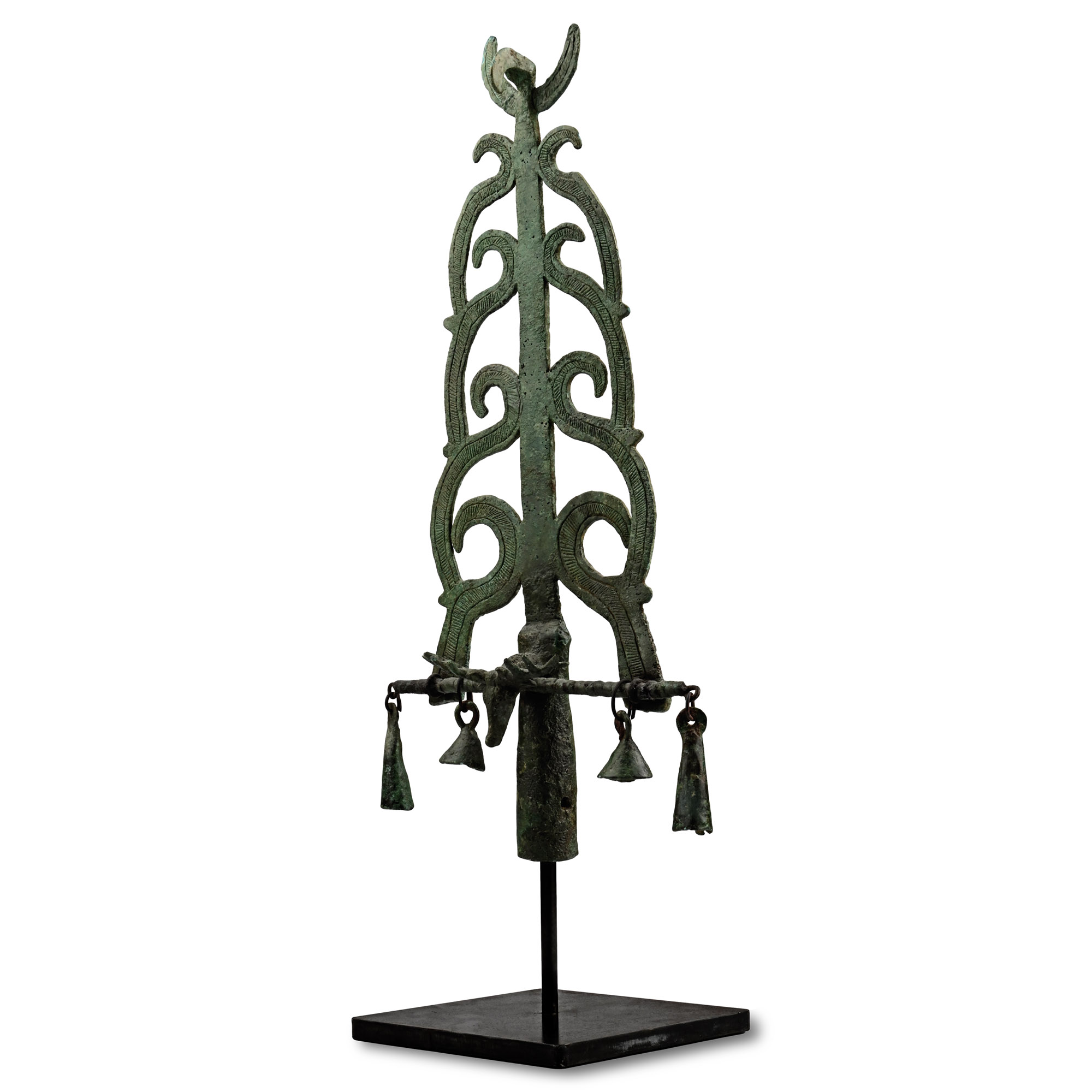
Scythian Bronze Military Standard Finial with Animals
4TH CENTURY B.C.
19 1/4 in. (2.39 kg total, 49 cm including stand).
An elaborate finial, likely from a ceremonial staff or pole, comprising a vertical shaft supporting an openwork plate in the form of stylised stag's antlers; shaft with a sculpted stag’s head with elongated ears and simplified features, extending to antlers with four branches on each side; flat plate above with ornament consisting of four graduated tiers of scrolled 'antlers', each with detailed decorative chasing (incised bands with diagonal lines); above, a crescent (possibly representing wings) flanking a frontal raptor's head with a hooked beak and engraved notching (probably a symbolic addition); a horizontal tube or sleeve passing through the base of the plate, decorated with transverse grooves with bells suspended below and from small loops near the stag’s head; each bell made from thin bronze sheet, conical in shape; accompanied by a custom-made display stand.
ProvenanceFranz Heger (1853–1931), Austrian traveller and ethnographer, acquired in the Caucasus during his 1890 expedition.
Believed to have been gifted circa 1930 to Franz Hancar (1893–1968), noted scholar and expert in ancient Caucasian cultures.
Thence by descent, acquired in the 1950s by Mr R.D., Vienna.
Acquired from the above in 1998 by N.M., former Israeli Ambassador to Austria (1998–2000).
Accompanied by a copy of a nine page examination report number 137/2015 by Dr Habil Mikhail Treister.
This lot has been checked against the Interpol Database of stolen works of art and is accompanied by a search certificate number no.12861-240722.
This lot has been cleared against the Art Loss Register database, and is accompanied by an illustrated lot declaration signed by the Head of the Antiquities Department, Dr Raffaele D'Amato.
See Salmony, A., ‘An unknown Scythian find in Novocherkassk’ in Eurasia Septentrionalis Antiqua, 1936, X, pp.54-60; Loehr, M., ‘The Stag Image in Scythia and the Far East’ in Archives of the Chinese Art Society of America Volume 9, 1955, pp.63-76; Galanina, L.K. & Grach, N., Scythian Art, Leningrad, 1986; Leskov, A.M.,Grabschätze der Adygeen, Munich, 1990; Schiltz, V., Die Skythen und andere Steppenvölker, Munich, 1994; Jacobson, E., The Art of the Scythians; the interpenetration of cultures at the edge of the Hellenic World, Leiden, New York & Cologne, 1995; Galanina, L.K., Die Kurgane von Kelermes: “Königsgräber” der frühskythischen Zeit, Moscow, 1997; Галанина, Л.К., ‘Конское снаряжение из коллекции елизаветинских древностей, хранящихся в Государственном Эрмитаже (раскопки Н.И. Веселовского 1914, 1915, 1917 гг.)’ in АСГЭ. Вып.38. Санкт-Петербург.: Государственный Эрмитаж, Saint Petersburg, 2010. pp.107-122; the closest parallel to the standard finial is a pair of bronze top-poles with the same iconographical scheme, kept in the Museum of Novocherkassk (Salmony, 1936, pp.54-55, fig.1).
FootnotesThis piece resembles a pair of bronze finials discovered in 1913, now in the Museum of Novocherkassk. However, there are notable differences: the Novocherkassk examples have paired birds at the top rather than a single bird, and lack antlers or suspended bells. Experts have dated the Novocherkassk pieces to around 500-400 BC. This example, though unique, shares key stylistic traits, particularly the scrollwork antlers with other bronze horse gear fittings and finials found in the Kuban Basin, many securely dated to the 4th century BC based on associated amphora finds. Comparable decorative styles such as bands of oblique lines appear on horse harnesses from known Scythian burial sites. This, along with the concentration of similar finds in the Kuban region, supports the idea that this finial also originated there. Scholars have suggested that finials like this symbolise the Tree of Life, especially when birds are present. The bird at the top of this piece may reflect that idea. Similar imagery appears on a bronze finial from Alexandropol and another from Lysaya Gora, the latter depicting the Scythian god Papaeus (akin to Zeus). While exact dating is difficult due to lack of archaeological context, stylistic parallels suggest a 4th century BC origin is most likely. Its unusual combination of sculpted and openwork elements, along with its symbolic imagery, makes it a rare and important example of Scythian or Maiotian bronze craftsmanship.
CONDITIONTimeLine Auctions follows a vetting process to ensure the authenticity and legality of all items, reinforcing our commitment to integrity and responsible trading. Each antiquity, antique, and coin lot undergoes thorough examination by a vetting committee of at least ten external specialists, professional trade association members, scientists, and archaeologists: Our Vetting Process
AUCTIONS:
TimeLine is a leading auction house specialising in antiquities, ancient art, collectables, natural history, coins, medals, and books. Our auctions offer museums, collectors, historians, and enthusiasts the opportunity to acquire unique and historically significant pieces.
LOT 0094
Scythian Bronze Military Standard Finial with Animals
Sold for (Inc. bp): £18,200
-
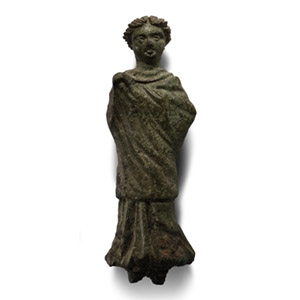
Etruscan Bronze Ceres Statuette
3rd-2nd century B.C.Estimate: £700 - 900 (‡+bp*)
Opening Bid: £389
Female with hair drawn up in a chignon, palla wrapped tightly around the upper body hiding the right arm bent with the hand at the shoulder, lower hem of robe flared; fixing lug to underside. 86 grams, 71 mm
Acquired in the mid 1980s-1990s. Private collection, Switzerland, thence by descent. Private collection, since the late 1990s. This lot is accompanied by an illustrated lot declaration signed by the Head of the Antiquities Department, Dr Raffaele D’Amato. This lot is accompanied by an illustrated lot declaration signed by the Head of the Antiquities Department, Dr Raffaele D'Amato.
This is a figurine of a deity of difficult interpretation representing an ex-voto. This typology is widespread in the votive offerings of Etrusco-Roman sanctuaries, and by analogy with various statuettes could represent Ceres. -
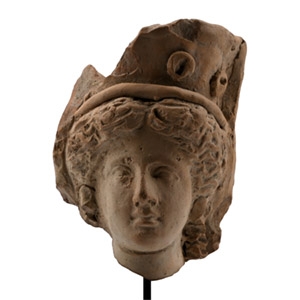
Greek Terracotta Head of a Goddess
5th-3rd century B.C.Sold for (Inc. bp): £910
Hollow-formed female head with flared headdress, applied collar and annulets; mounted on a custom-made stand. 228 grams total, 18.8 cm including stand
Acquired on the European art market in the early 2000s. with Galerie Rhéa, Zurich, Switzerland. This lot is accompanied by an illustrated lot declaration signed by the Head of the Antiquities Department, Dr Raffaele D'Amato. -
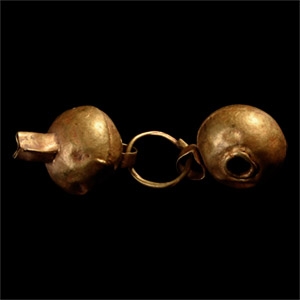
Greek Gold Pomegranate-Shaped Pendant
Circa 5th-3rd century B.C.Sold for (Inc. bp): £234
Comprising a hollow-form body with detailed calyx below, the suspension formed as a hollow collared bead with a thin connecting loop. 0.29 grams, 18 mm
From the collection of a late Japanese collector, 1970s. This lot is accompanied by an illustrated lot declaration signed by the Head of the Antiquities Department, Dr Raffaele D'Amato.
Fruit were generally considered to be a symbol of sensuality, temptation and fertility; the giving and accepting of fruit may be regarded as a symbolic sexual act, or at least a prelude to marriage. It follows naturally that the pomegranate, with its innumerable fleshy seeds symbolising life and fecundity, was an attribute of Aphrodite.
