
Loading, please wait...
LOT 0333
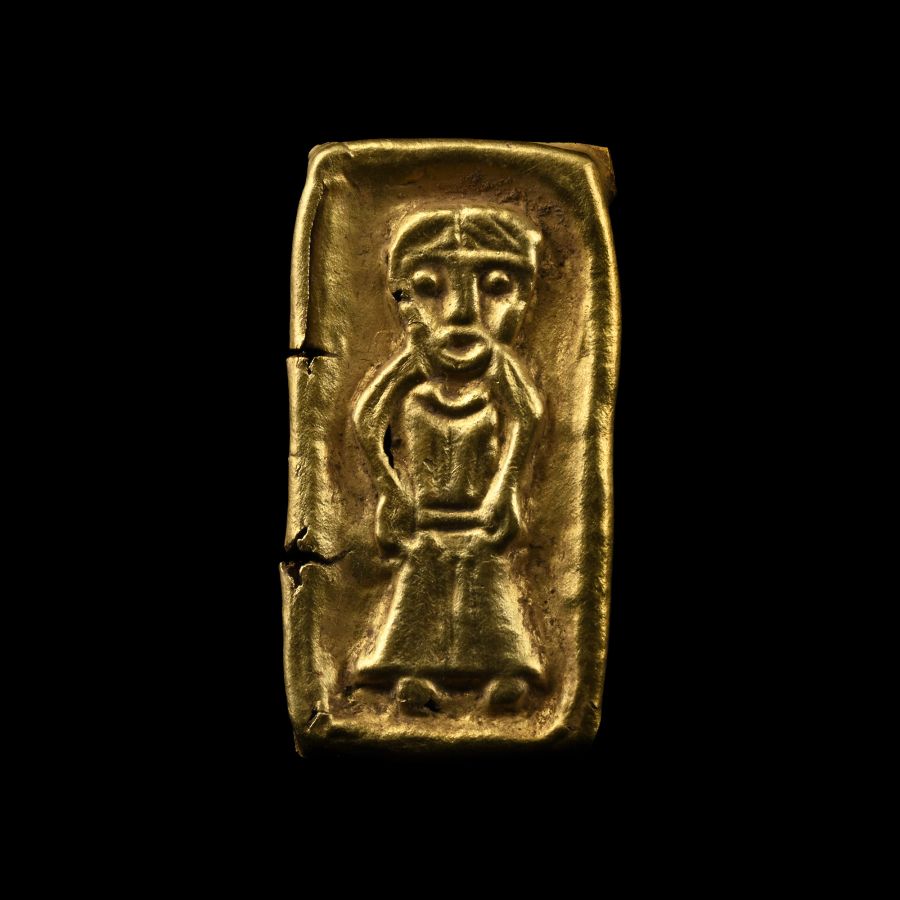
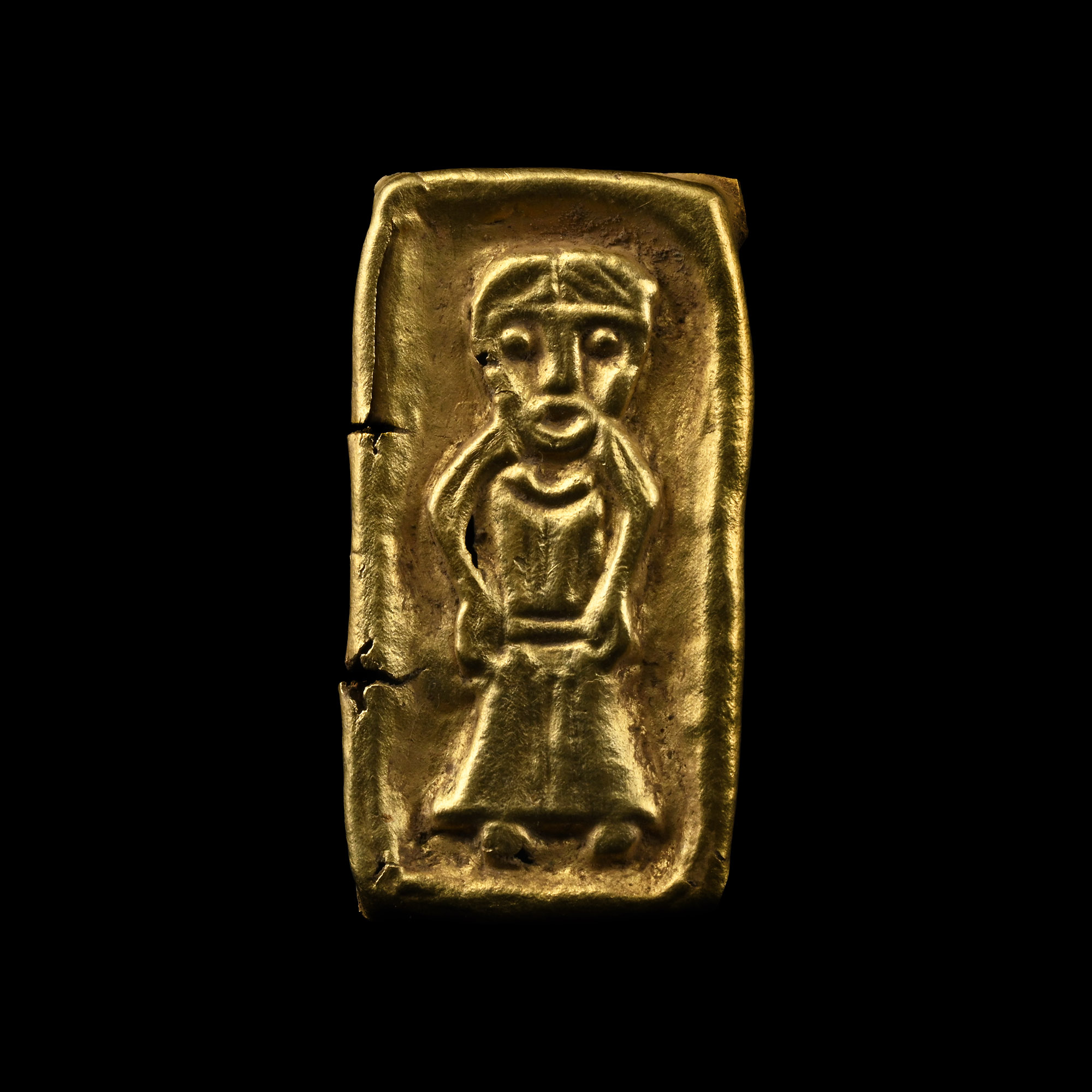
Scandinavian Pre-Viking Gold Votive Plaque of Guldgubbe with Goddess Facing
CIRCA 6TH CENTURY A.D.
1 in. (1.45 grams, 26 mm).
Sheet-gold plaque with folded edges, repoussé image of a facing figure in ankle-length robe, hands resting on the hips.
ProvenanceFrom the private collection of a London gentleman, from his grandfather's collection formed before the early 1970s.
This lot has been checked against the Interpol Database of stolen works of art and is accompanied by a search certificate number no.12755-234703.
This lot has been cleared against the Art Loss Register database, and is accompanied by an illustrated lot declaration signed by the Head of the Antiquities Department, Dr Raffaele D'Amato.
Cf. Franceschi, G., Jorn, A., Magnus, B., Men, Gods and Masks in Nordic Iron Age Art, Koln, 2005, pls.1,33-38 and Adamsen, C. et al., Sorte Muld, Rønne, 2008, p.47, for similar votive plaques.
FootnotesGuldgubbe was originally a Swedish word that has entered in the Scandinavian language and denote tiny human or divine figures either cut from sheet gold or formed over a patrix. Figures of women are extremely rare in metal art before the 7th century A.D. It is only with Guldgubbe that women make their appearance. They are usually viewed both in profile or (like here) frontally.
CONDITIONTimeLine Auctions follows a vetting process to ensure the authenticity and legality of all items, reinforcing our commitment to integrity and responsible trading. Each antiquity, antique, and coin lot undergoes thorough examination by a vetting committee of at least ten external specialists, professional trade association members, scientists, and archaeologists: Our Vetting Process
AUCTIONS:
TimeLine is a leading auction house specialising in antiquities, ancient art, collectables, natural history, coins, medals, and books. Our auctions offer museums, collectors, historians, and enthusiasts the opportunity to acquire unique and historically significant pieces.
LOT 0333
Scandinavian Pre-Viking Gold Votive Plaque of Guldgubbe with Goddess Facing
Sold for (Inc. bp): £4,420
-

Viking Age Bronze Annular Brooch
8th-10th century A.D.Sold for (Inc. bp): £572
With openwork braid detailing to the hoop, spiral finials above and zigzag band behind the rim with granule clusters, row of loops each with an articulated chain and attached jingle; Finno-Ugric type. 157 grams, 15 cm
From the private collection of a London gentleman, from his grandfather's collection formed before the early 1970s. This lot is accompanied by an illustrated lot declaration signed by the Head of the Antiquities Department, Dr Raffaele D'Amato. -

Viking Period Bronze Decorated Bracelet
9th-11th century A.D. or earlierSold for (Inc. bp): £143
Flat-section penannular body with incised roped lines and hatching to the terminals. 15.7 grams, 54 mm
UK private collection before 2000. Acquired on the UK art market. Private collection, London, UK. This lot is accompanied by an illustrated lot declaration signed by the Head of the Antiquities Department, Dr Raffaele D'Amato. -

Pre-Viking Gold Aroma Bucket Pendant
4th-7th century A.D.Sold for (Inc. bp): £780
Miniature drum-shaped vessel with strap handle, beaded wire bands to the bottom and sidewall, polished red stone insert to the base. 1.28 grams, 19 mm
From the private collection of a London gentleman, from his grandfather's collection formed before the early 1970s. This lot is accompanied by an illustrated lot declaration signed by the Head of the Antiquities Department, Dr Raffaele D'Amato.
Pendants in the form of miniature buckets have been found in a number of pagan Anglo-Saxon and Viking contexts and are generally made of bronze or iron, with gold examples being rare; three gold examples were found with the hoard from Hoen, Norway. Bronze bucket amulets have been found at Driffield in Yorkshire, and Vimose bog in Denmark, among other places. In form they represent wooden buckets bound with bronze or iron bands which have been found in Anglo-Saxon and Viking graves and are believed to have held mead or ale and were used to replenish the cups from which warriors drank. As amulets they probably represent the ecstatic power of alcoholic drink and the role of women as the dispensers of these precious beverages.
