
Loading, please wait...
LOT 0297
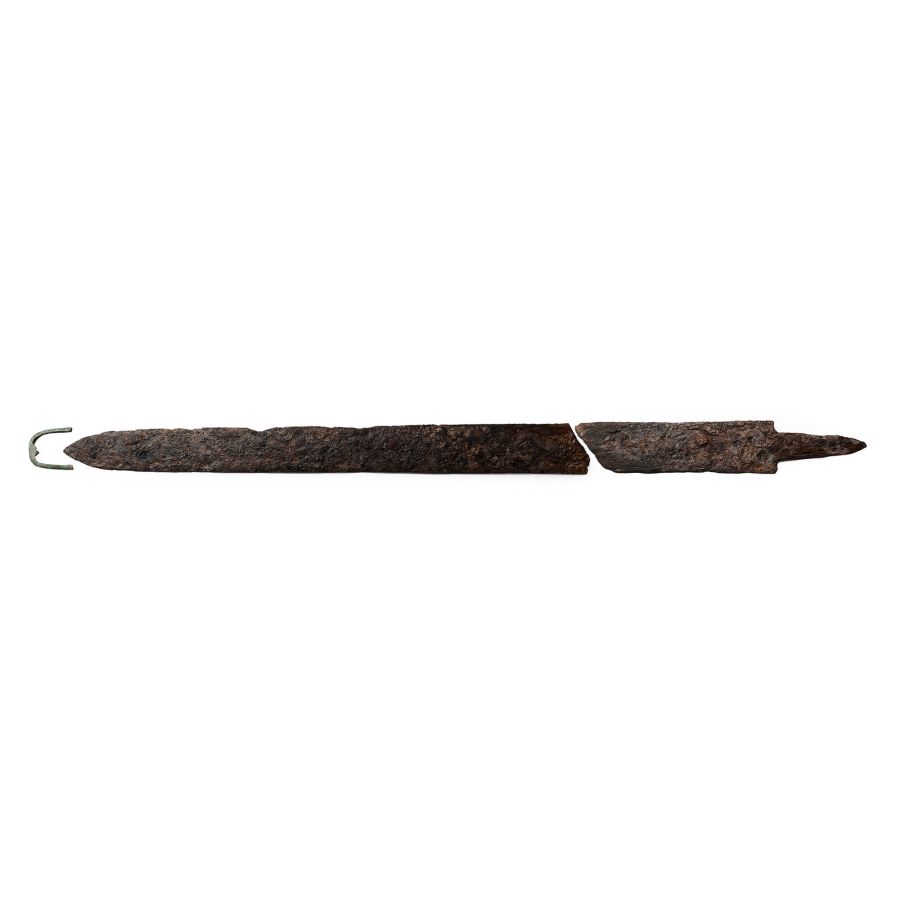
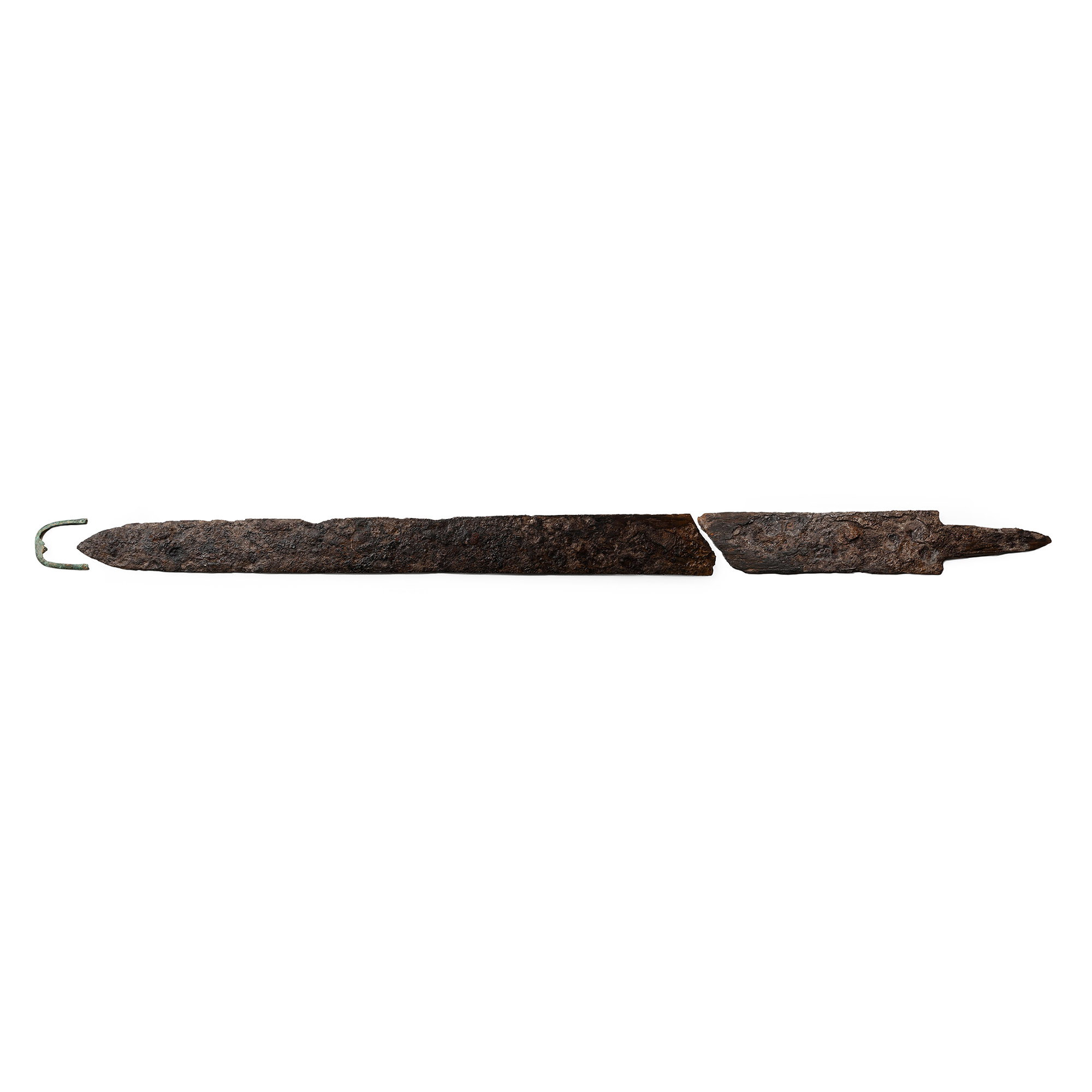
Saxon Sacrificed Iron Spatha with Bronze Chape
5TH-6TH CENTURY A.D.
30 3/4 in. (630 grams total, 78 cm long).
Double-edged long sword (spatha) of type Osterburken-Kemathen; the blade with squared shoulders, broken into two parts for sacrificial reasons, tapering towards the point; sturdy tang partially preserved; wooden traces of the scabbard and hilt still visible; accompanied by a bronze outer rim of a scabbard; restored. [3]
ProvenanceFrom the private collection of a London gentleman, from his grandfather's collection formed before the early 1970s.
LiteratureCf. Herzog, R. & Koller, A., Die Alamannen, Stuttgart, 1997, items 162,166 (spathae von GroB-Karben und Wiesbaden), for type; for the chape see Strassmeir, A., Das Fränkische Heer der Merowingerzeit, Teil 2 : Schild und Schwert, Berlin, 2019, p.46 lett.A.
FootnotesThe deliberate fragmentation of a sword, often into three pieces, was a symbolic act of ‘killing’ the weapon, which was then placed as a grave good or offered in a ceremonial context. This was a Germanic custom already visible in the Vandal Przeworsk culture around the 3rd or 4th century A.D., which continued in Northern European areas until the 5th and the 6th centuries A.D.
CONDITIONTimeLine Auctions follows a vetting process to ensure the authenticity and legality of all items, reinforcing our commitment to integrity and responsible trading. Each antiquity, antique, and coin lot undergoes thorough examination by a vetting committee of at least ten external specialists, professional trade association members, scientists, and archaeologists: Our Vetting Process
AUCTIONS:
TimeLine is a leading auction house specialising in antiquities, ancient art, collectables, natural history, coins, medals, and books. Our auctions offer museums, collectors, historians, and enthusiasts the opportunity to acquire unique and historically significant pieces.
-
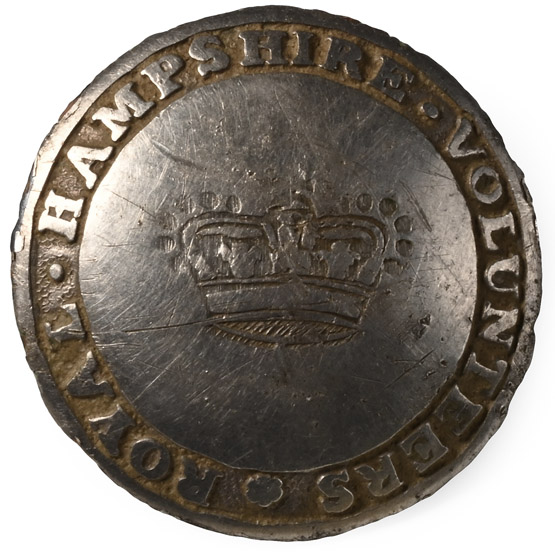
Royal Hampshire Volunteers Silver-Plated Button
19th century A.D.Sold for (Inc. bp): £26
Silver-plated military button bearing the legend 'ROYAL HAMPSHIRE VOLUNTEERS' around a crown; loop to reverse. 2.18 grams, 17 mm
Found Waltham St. Lawrence, Windsor and Maidenhead, UK. Accompanied by a copy of the British Museum's Portable Antiquities Scheme (PAS) report no.BERK-0A5A9A.
From the PAS Report: 'Similar recorded examples have 'I. Nutting' backmark (without '& Son') which indicates a manufacture date of c.1794-1802 ('& Son' being added in 1803, dropped again c1820 when the father died).' The story of the unit is difficult to determine. 'The Volunteer & Militia lists for 1794,1796, 1797, 1799, 1800 & 1801 have all been checked and no unit of this title is listed. Also the Parliamentary Return for December 9th & 13th, 1803 which lists many units that didn't make it into the April 1804 War Office List have been searched, again no such unit is listed. There were a few infantry volunteer regiments raised c1780-1783 as so many of the regular regiments were fighting in the War of American Independence, 'Royal Lancasters Volunteers' was one such that is listed, but there is no mention of one for Hampshire.' -
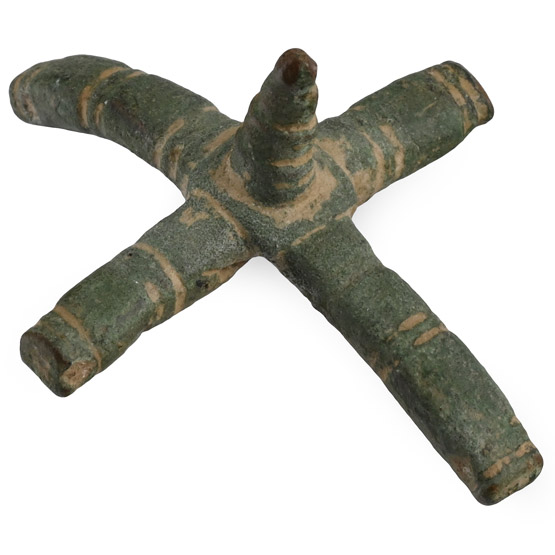
Anglo-Saxon Warrior's Bronze Prick Spur
Late 8th-9th century A.D.Sold for (Inc. bp): £195
Comprising a horizontal D-section curved bar with paired incuse lines, vertical extensions, conical spike at the junction. 13 grams, 47 mm
Found whilst searching with a metal detector near Bottisham, East Cambridgeshire, UK, on Thursday, 1st May 2025. Accompanied by a copy of the British Museum's Portable Antiquities Scheme (PAS) report no.SF-CF48EC.
The Portable Antiquities Scheme states: 'This is a find of note and has been designated: Regional importance.' -
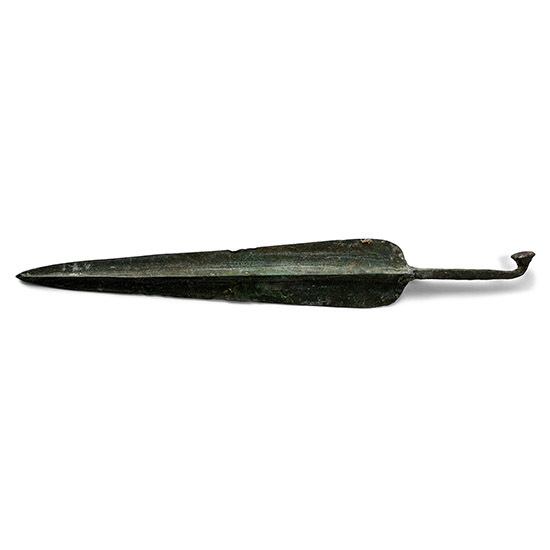
North-Western Persian Bronze Blade
Circa 1st millennium B.C.Sold for (Inc. bp): £117
With a long tapering blade having rounded shoulders and a prominent mid-rib, the tang bent over at the tip with a round stud terminal. 230 grams, 33.5 cm
Ex Abelita family collection, 1980s-2000s.
The metalworking techniques used in making bronze weapons in early Iran were very complex. Surfaces were often finished in repoussé work, and some of the weapons were chased, others engraved. The ruling elites of warrior horsemen were buried with their weapons and horses.
