
Loading, please wait...
LOT 1402
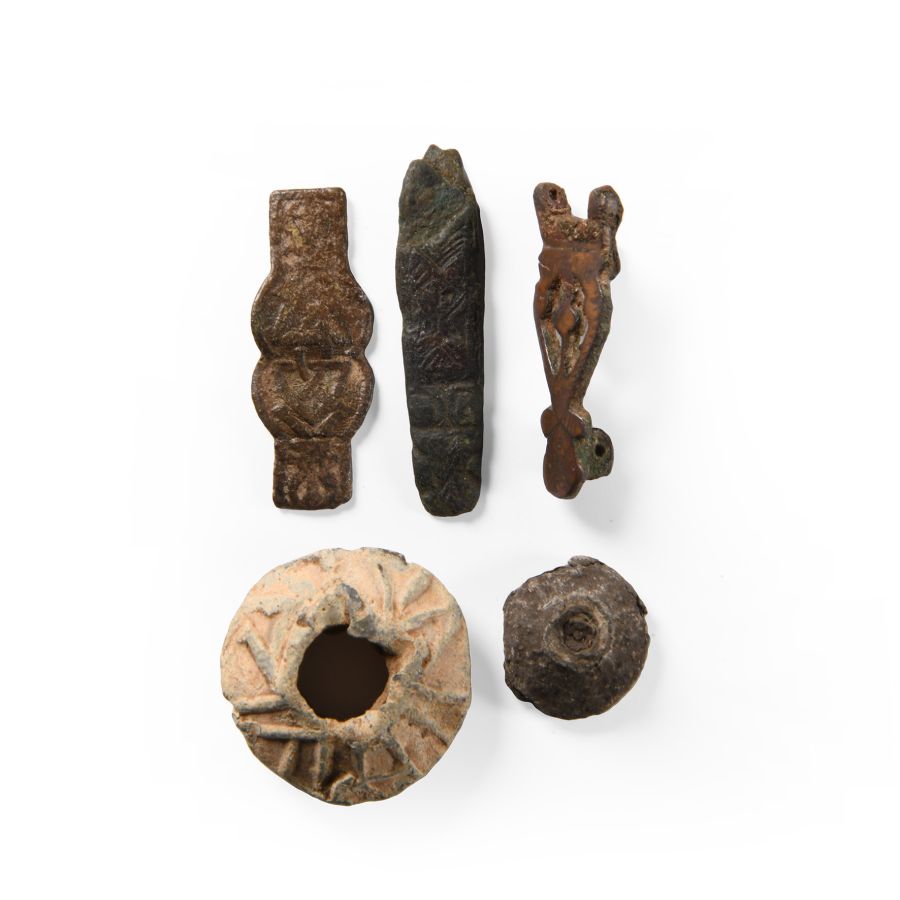
Saxon Period Bronze and Lead Artefact Collection
6TH-11TH CENTURY A.D.
3/4 - 1 3/4 in. (66.2 grams total, 20-46 mm).
Comprising: two lead spindle whorls, one biconvex and the other plano-convex; a bronze buckle plate with niello detailing; a fragment of a mount with low-relief knotwork ornament; a bronze strap end with inlaid silver ornament, stylised beast-head finial. [5, No Reserve]
ProvenanceAcquired on the UK art market.
The strap end from Lincolnshire, 1970s.
Ex private Merseyside, UK, collection.
TimeLine Auctions follows a vetting process to ensure the authenticity and legality of all items, reinforcing our commitment to integrity and responsible trading. Each antiquity, antique, and coin lot undergoes thorough examination by a vetting committee of at least ten external specialists, professional trade association members, scientists, and archaeologists: Our Vetting Process
AUCTIONS:
TimeLine is a leading auction house specialising in antiquities, ancient art, collectables, natural history, coins, medals, and books. Our auctions offer museums, collectors, historians, and enthusiasts the opportunity to acquire unique and historically significant pieces.
-
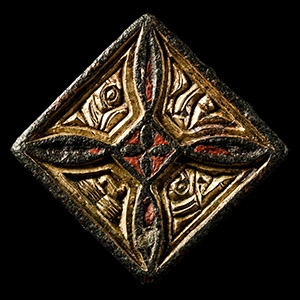
Anglo-Saxon Gilt-Bronze Cruciform Mount
Circa 6th century A.D.Sold for (Inc. bp): £3,380
With a mounting stud at each corner; parcel-gilt surface with central reserved square filled with red enamel; cruciform motif, a scaphoid cell at each corner with red enamel fill, four interstitial panels with chip-carved Style I ornament. 19.8 grams, 31 mm
Found near Lakenheath, Suffolk, UK, circa 2012. This lot has been checked against the Interpol Database of stolen works of art and is accompanied by search certificate no.11892-204383.
The use of enamel is unusual in early Anglo-Saxon contexts, except in parts of East Anglia where it may have been preferred as an alternative to garnet cloisonné. -
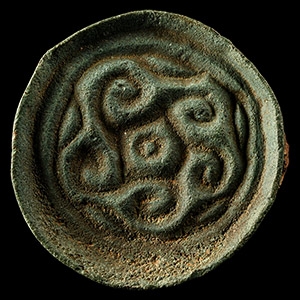
Anglo-Saxon Bronze Saucer Brooch
5th-6th century A.D.Sold for (Inc. bp): £91
Decorated with five spirals emanating from a central ring-and-dot motif, enclosed within a circumferential border; remains of catchplate to reverse. 12 grams, 26 mm
Found Berkshire, UK. Accompanied by a copy of the British Museum's Portable Antiquities Scheme (PAS) report no.BERK-A6EC93. -
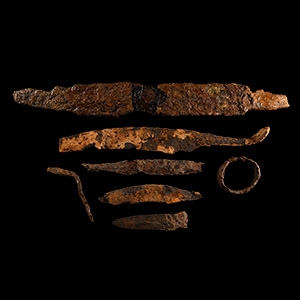
Saxon Iron Artefact Collection
Circa 6th-7th century A.D.Sold for (Inc. bp): £65
Comprising a straight cutting edge battle knife with a short tang; a shorter slender cutting edge battle knife with long tang; three small hunting knives; an iron ring and a possible javelin head. 708 grams total, 8.7-38 cm
UK gallery, early 2000s.
Battle knives are common in 6th -7th century Anglo-Saxon graves. They were, when not used, kept in their sheath and suspended from the belt by a detachable strap with a buckle.
