
Loading, please wait...
LOT 0230
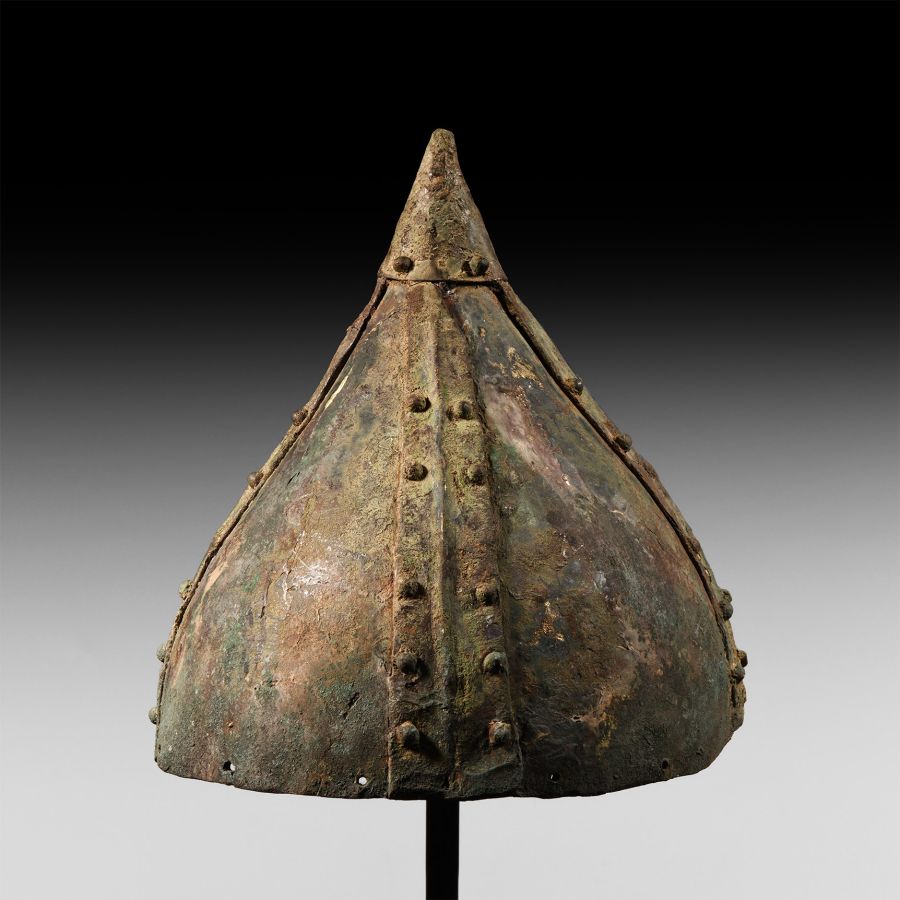
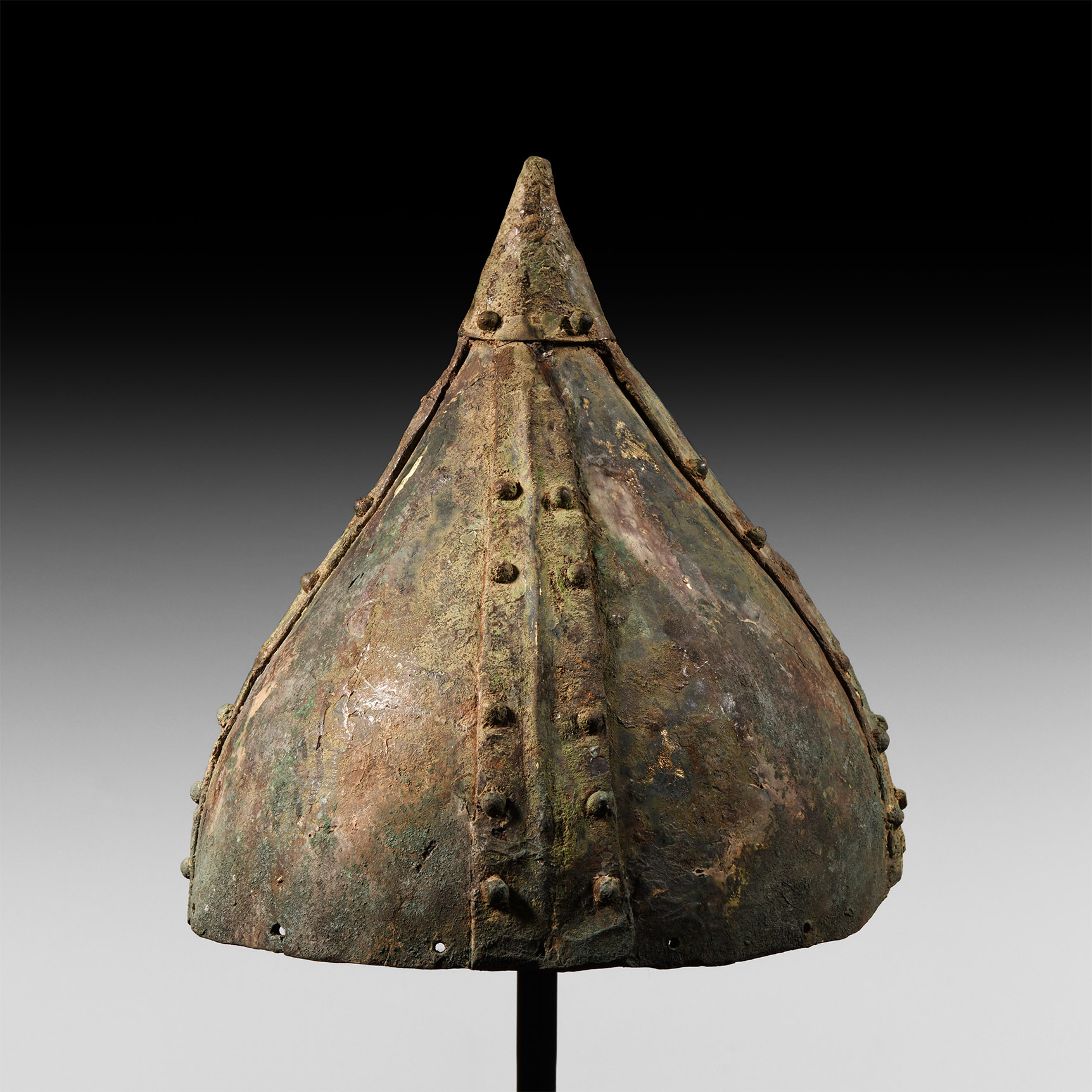
Sassanian Spangenhelm with Rivets
6TH-7TH CENTURY A.D.
9 in. (1.14 kg, 23 cm high).
A copper-alloy multi-segmented spangenhelm with an ogival profile, rivetted conical finial and riveted straps running vertically around the circumference, some restoration.
ProvenanceUK private collection before 2000.
UK art market.
Property of a London gentleman.
Accompanied by an academic report by Dr Raffaele D'Amato.
This lot has been checked against the Interpol Database of stolen works of art and is accompanied by searcher certificate no.11589-199700.
Cf. Grancsay, S.V., ‘A Sasanian Chieftain’s Helmet’ in Metropolitan Museum of Art Bulletin, April, 1963, pp.253-262, fig.6; Kubik, L., ‘Introduction to studies on late Sasanian protective armour. The Yarysh-Mardy helmet’ in Historia I Świat, nr 5 (2016), pp.77-105, figs.5, 12.
FootnotesThe Spangenhelm is a protective headgear made up from segments or plates held together by a frame. As a popular form of helmet it came to prominence in western Europe in the later Roman Empire, and remained in use for some centuries until replaced by helmets formed from a single sheet.
CONDITIONTimeLine Auctions follows a vetting process to ensure the authenticity and legality of all items, reinforcing our commitment to integrity and responsible trading. Each antiquity, antique, and coin lot undergoes thorough examination by a vetting committee of at least ten external specialists, professional trade association members, scientists, and archaeologists: Our Vetting Process
AUCTIONS:
TimeLine is a leading auction house specialising in antiquities, ancient art, collectables, natural history, coins, medals, and books. Our auctions offer museums, collectors, historians, and enthusiasts the opportunity to acquire unique and historically significant pieces.
-
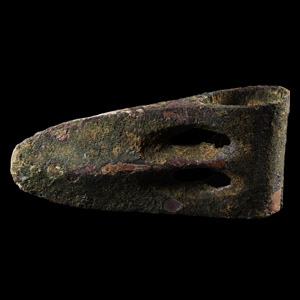
Babylonian Bronze Axehead
2nd millennium B.C.Sold for (Inc. bp): £416
A bronze duck-billed shaft-hole axe head featuring a curved, beak-shaped blade with two pierced eyes and a raised median ridge. 204 grams, 10.5 cm
Acquired early 1990s. Ex private American collection; thence by descent. Private Swiss collection since 1998. -
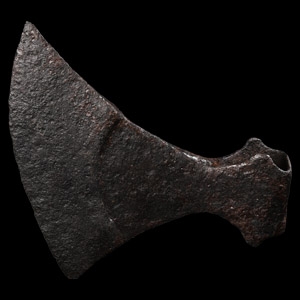
Viking Period Danish Type Broad Axehead
Circa 10th-11th century A.D.Sold for (Inc. bp): £2,340
An iron broad axehead of asymmetrical profile with reinforced curved cutting edge, triangular-section socket with flanking spurs to upper and lower edges. 387 grams, 15.7 cm
Acquired 1971-1972. From the collection of the vendor's father. Property of a London, UK, collector.
The broad axe of type M is a weapon specifically designed as battle-axe with the edge, being Þunssleginn, i.e. thinly forged. These broad axes were the prerogative of the housecarls of the Anglo-Danish King Canute, of the guardsmen fighting with Harold at Stamford Bridge and Hastings in 1066 A.D. and of the famous Varangian Guard of the Roman emperors of Constantinople. -
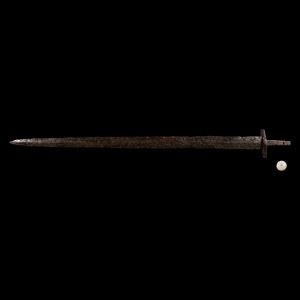
Migration Period Spatha Sword Blade with Sword Bead
Circa 4th-5th century A.D.Sold for (Inc. bp): £572
A double-edged spatha with a lentoid section parallel-sided iron blade with pointed tip; battle nicks to both cutting edges; rhomboid-section cross-guard; a fastening nail on the upper tang; accompanied by a sword bead. 921 grams total, 2.7- 86.5 cm
cleaned and conserved.
Acquired 1971-1972. From the collection of the vendor's father. Property of a London, UK, collector. Accompanied by an academic report by Dr Raffaele D’Amato.
A Migration Period sword, originating from Central Asia, often used by nomadic populations and particularly by the Huns, defined as a Nomadic-Asiatic sword by Menghin, or as a sword with plate guard. The long and thin blade, with a lenticular or lozenge section, was equipped with a guard composed of an iron plate inserted into the tang. Little is known about the scabbard of these swords but it is known that they usually had disc-shaped pommels, and stones hanging from the pommel or hilt. This typology was widespread in Central Europe by the Huns and there are also specimens attested in Gaul in the 5th century.
