
Loading, please wait...
_900x900.jpg "Sassanian Bronze Spangenhelm")
_200x200.jpg "Sassanian Bronze Spangenhelm")
.jpg "Sassanian Bronze Spangenhelm")
LOT 1169
Sassanian Bronze Spangenhelm
6TH-7TH CENTURY A.D.
9 in. (1.14 kg, 23 cm high).
Multi-segmented with an ogival profile, rivetted conical finial and riveted straps running vertically around the circumference; some restoration.
ProvenanceUK private collection before 2000.
UK art market.
Property of a London gentleman.
Accompanied by an academic report by Dr Raffaele D'Amato.
This lot has been checked against the Interpol Database of stolen works of art and is accompanied by searcher certificate no.11589-199700.
Cf. Grancsay, S.V., ‘A Sasanian Chieftain’s Helmet’ in Metropolitan Museum of Art Bulletin, April, 1963, pp.253-262, fig.6; Kubik, L., ‘Introduction to studies on late Sasanian protective armour. The Yarysh-Mardy helmet’ in Historia I Świat, nr 5 (2016), pp.77-105, figs.5, 12.
FootnotesThe Spangenhelm is a protective headgear made up from segments or plates held together by a frame. As a popular form of helmet it came to prominence in western Europe in the later Roman Empire, and remained in use for some centuries until replaced by helmets formed from a single sheet.
CONDITIONTimeLine Auctions follows a vetting process to ensure the authenticity and legality of all items, reinforcing our commitment to integrity and responsible trading. Each antiquity, antique, and coin lot undergoes thorough examination by a vetting committee of at least ten external specialists, professional trade association members, scientists, and archaeologists: Our Vetting Process
AUCTIONS:
TimeLine is a leading auction house specialising in antiquities, ancient art, collectables, natural history, coins, medals, and books. Our auctions offer museums, collectors, historians, and enthusiasts the opportunity to acquire unique and historically significant pieces.
-
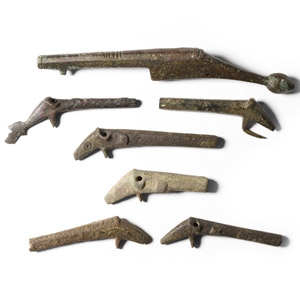
Elizabethan and Later 'Essex' Bronze Petronel Collection
Late 16th-early 17th century A.D.Sold for (Inc. bp): £169
Exhibiting a range of petronel types, including example with ring-and-dot detailing. 106 grams total, 4.8-12 cm
Found Essex, UK. -
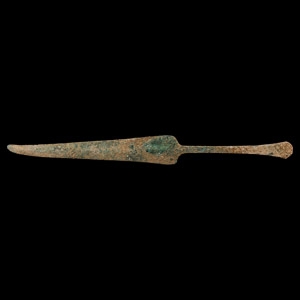
Luristan Bronze Handled Dagger
Circa 1000 B.C.Estimate: £100 - 140 (+bp*)
Opening Bid: £50
Having a narrow triangular blade with gentle midrib and narrow point, scooped shoulders, long flat-section tang with lobe finial. 123 grams, 35 cm
Acquired 1980-2015. Ex Abelita family collection.
The type of the present dirk or dagger corresponds to type IX of Medvedskaya classification. The type consists of a bronze blade with organic handle, possibly made of bone or wood, and a long tang, which was usually bent at the extremity. According to Moorey, the exact dating of these pieces is uncertain. -
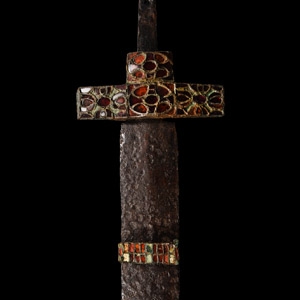
Migration Period Iron Sword with Garnet Cross Guard and Scabbard Fittings
5th-6th century A.D.Sold for (Inc. bp): £7,150
With a double-edged parallel-sided blade with broad pointed tip; the lower guard inlaid with garnet cloisonné divided into four segments; accompanied by a rectangular scabbard slide inlaid with two rows of garnets and other stone; and a part of a sheet-silver chape. 903 grams, 91 cm
Cleaned and conserved.
From the private collection of a London gentleman, from his grandfather's collection formed before the early 1970s. Accompanied by an academic report by Dr Raffaele D’Amato. This lot has been checked against the Interpol Database of stolen works of art and is accompanied by search certificate number no.11819-206855.
The sword belongs to the group of blades with wide guard coming from Eastern Europe, in particular from the regions of the Black Sea. The most striking examples are the sword of Dmytrivka (in the Zaporizhzhia), from a Hunnic grave, the guard and its extending reinforcement collar inlaid with precious stones; the sword of Lermontovskaia (North of Caucasus), from the grave of an Alan warrior (5th century A.D.), having the guard inlaid with coloured glass; the Pokrovsk-Voskhod swords (Region of Saratovo, on the Volga), from a Nomad grave of 5th century A.D., with garnet cloisonné on a gold background (Lebedinsky, 2001,pp.121ff.).
