Loading, please wait...
LOT 1275
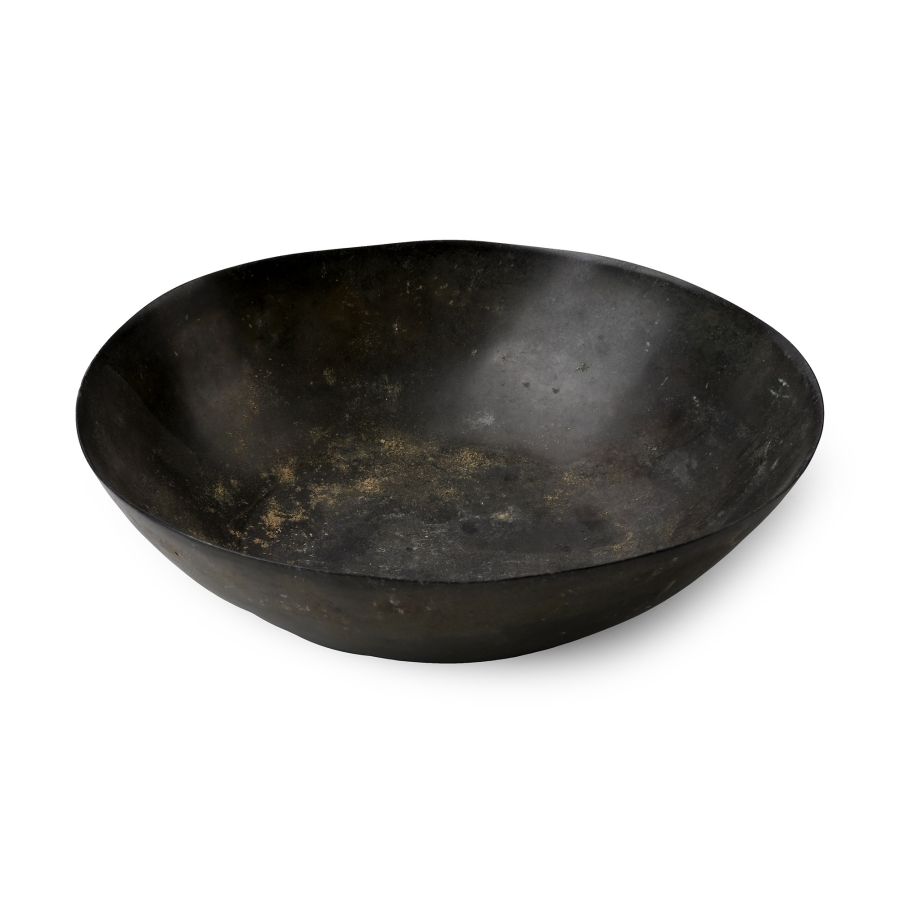
Sasanian Bronze Bowl
CIRCA 4TH-6TH CENTURY A.D.
5 3/8 in. (95 grams, 13.6 cm wide).
Shallow sheet-bronze bowl with sloping walls and flattened base. [No Reserve]
ProvenanceFrom a London, UK, collection, 1990s-2010.
CONDITIONTimeLine Auctions follows a vetting process to ensure the authenticity and legality of all items, reinforcing our commitment to integrity and responsible trading. Each antiquity, antique, and coin lot undergoes thorough examination by a vetting committee of at least ten external specialists, professional trade association members, scientists, and archaeologists: Our Vetting Process
AUCTIONS:
TimeLine is a leading auction house specialising in antiquities, ancient art, collectables, natural history, coins, medals, and books. Our auctions offer museums, collectors, historians, and enthusiasts the opportunity to acquire unique and historically significant pieces.
LOT 1275
Sasanian Bronze Bowl
Estimate £80 - 100€93 - 116 (for guidance only)$108 - 135 (for guidance only)
Opening Bid
£5 (EUR 6; USD 7) +BP*
-
West Central Asian Bronze Double-Headed Heraldic Eagle Seal Matrix
Circa 2300-2000 B.C.Estimate: £100 - 140 (+bp*)
Bids: 1 | Current Bid: £50
Eagle-shaped seal matrix with a large loop on the back, accompanied by an old scholarly note, typed and signed by W.G. Lambert, late Professor of Assyriology, University of Birmingham, 1970-1993, which states: 'Stamp Seal of Bronze, 25 x 21.5 x 1mm. This bears the shape of the design, with flat compartmented face and flat back of which is mounted a loop handle of metal rod. The design shows a heraldic eagle with two heads: heads at the top sideways, wings hanging beneath, and tail feathers spread at the bottom. This comes from west central Asia and dates to c. 2300-2000 B.C. It is a rare type (the double-headed eagle) and in very good condition save for a nick at the bottom.' 9.51 grams, 25 mm
Acquired in the late 1980s-early 1990s. Ex property of a West London businessman. Academically researched and catalogued by the late Professor Lambert in the early 1990s. Accompanied by a copy of a scholarly report, numbered V-850, typed and signed by Professor Wilfrid George Lambert. -
Very Large Bactrian Copper Armband with Animal-Headed Terminals
2nd millennium B.C.Estimate: £2,000 - 3,000 (+bp*)
Opening Bid: £1,111
Penannular armband with shallow D-section hoop and terminals formed as stylised ram-heads, each with exaggerated coiled horns, circular eyes set with cream-coloured beads and shallow semi-circular muzzles; transverse bands of geometric motifs along the neck. 616 grams, 10.4 cm
with a London, UK gallery 1971-early 2000s. Private collection, London, UK.
The bracelet is a product of the Bactria-Margiana Archaeological Complex ('BMAC', also developed from the 'Oxus Civilisation'), which was the dominant culture in the 3rd and 2nd millennium (often dated to c. 2250-1700 B.C.) in that area, corresponding roughly to modern Tajikistan and Afghanistan. The members of the group practised animal husbandry and a limited form of agriculture, with wheeled carts from the 4th millennium B.C. Its craftsmen were proficient at working metals and alloys, including bronze, copper, silver, and gold. Fortified sites with multiple walls are another notable BMAC development. -
Large West Central Asian Bronze Star-Shaped Rosette Seal Matrix
Circa 2300-2000 B.C.Estimate: £100 - 140 (+bp*)
Bids: 1 | Current Bid: £90
Openwork seal with a triangular loop on the reverse, accompanied by an old scholarly note, typed and signed by W.G. Lambert, late Professor of Assyriology, University of Birmingham, 1970-1993, which states: 'Stamp Seal of Bronze, 52 x 51 x 22 mm. This is round, with flat face and flat back, on which a large handle of inverted V-shape is mounted. The design is both compartmented and open-work. It consists of a rosette, with inner circle, band around that, and ten 'petals' from this circle, giving the shape of the piece. This comes from west central Asia and dates to c. 2300-2000 B.C. It is covered with incrustation, which could be removed. The metal beneath appears to be in good condition, as is the piece generally.' 42.3 grams, 51 mm
Acquired in the late 1980s-early 1990s. Ex property of a West London businessman. Academically researched and catalogued by the late Professor Lambert in the early 1990s. Accompanied by a copy of a scholarly report, numbered R-517, typed and signed by Professor Wilfrid George Lambert.