
Loading, please wait...
LOT 0410
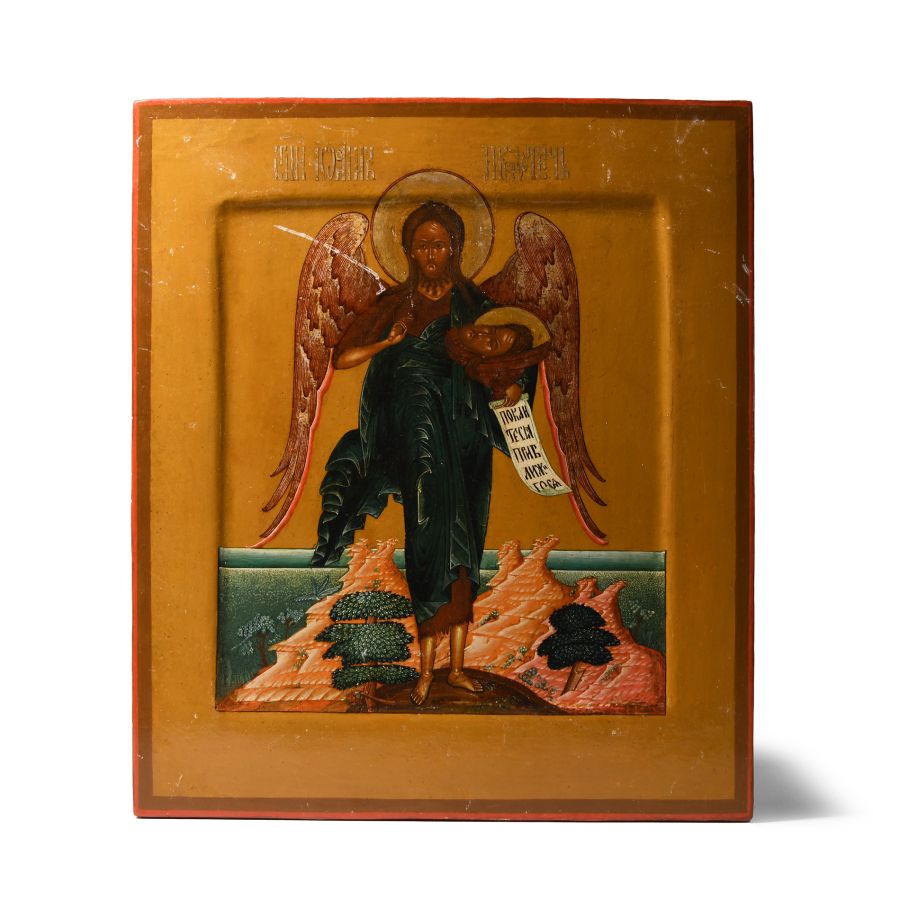
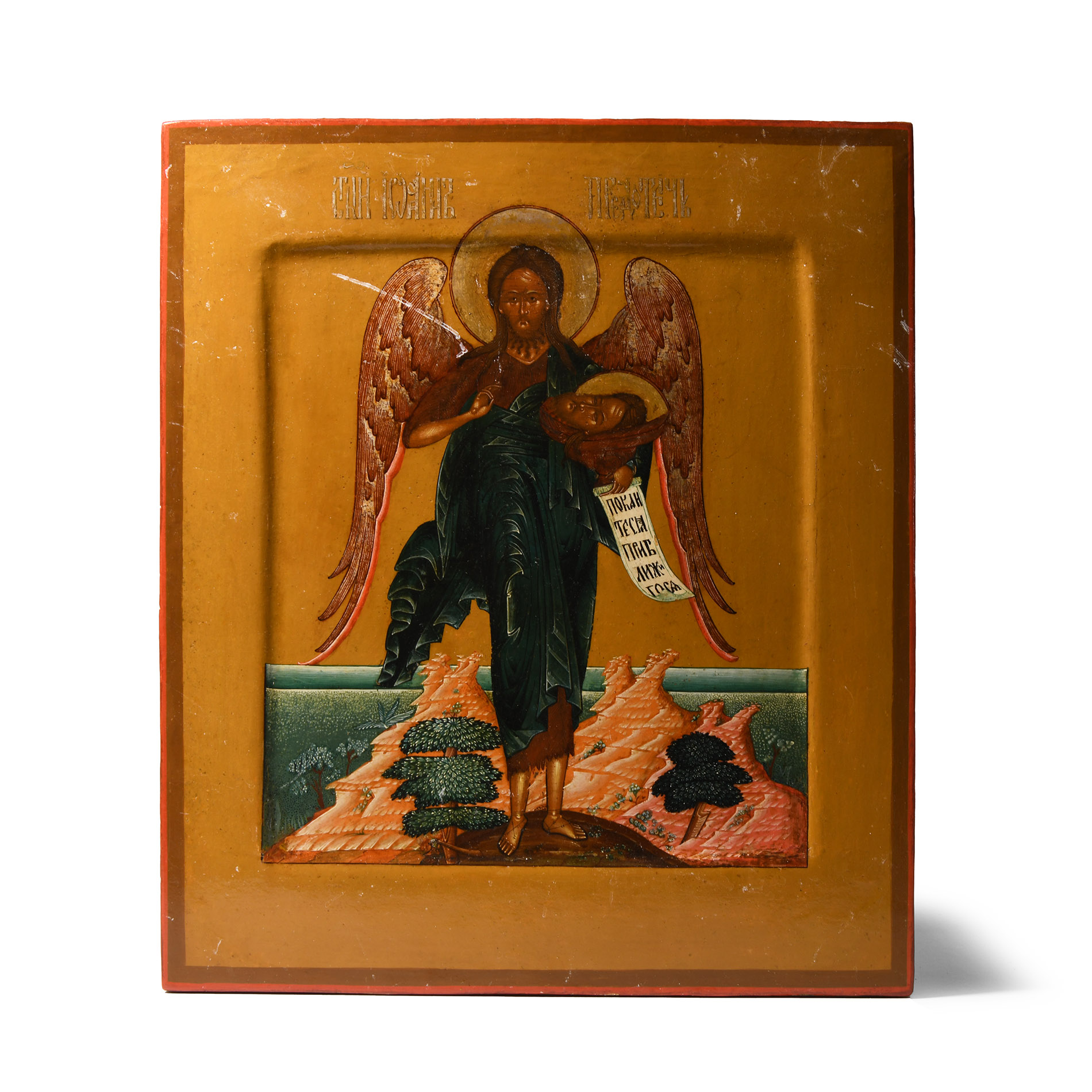
Russian Wooden Icon with St John the Baptist
19TH CENTURY A.D.
12 1/4 in. (1.02 kg, 31 cm high).
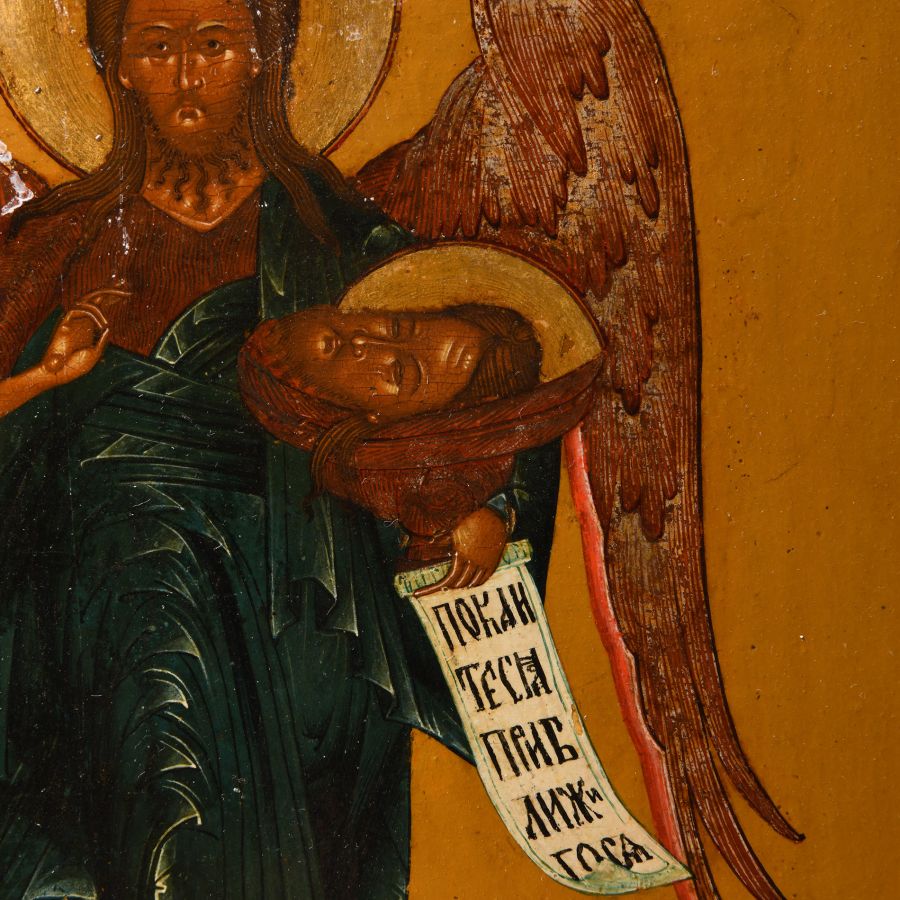
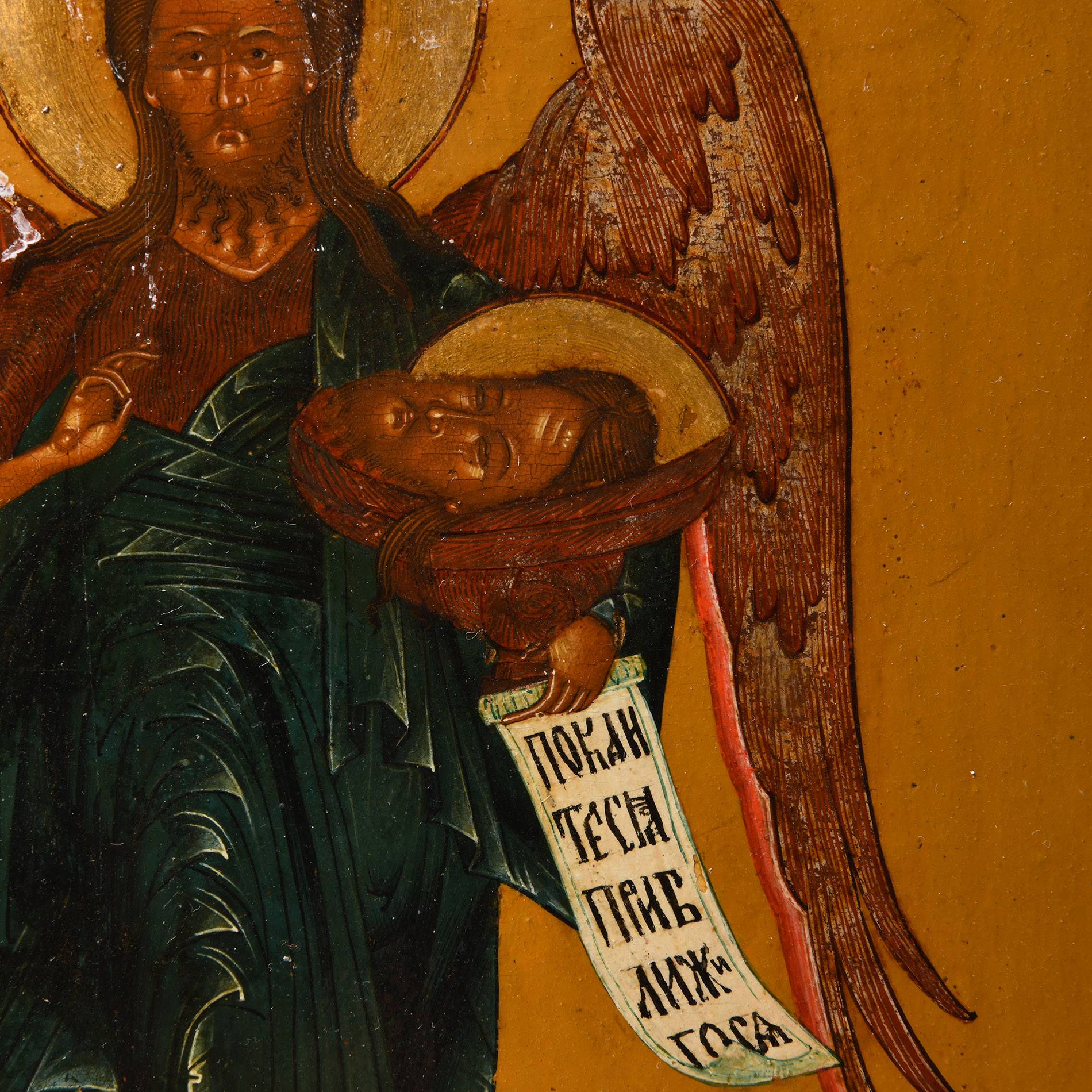
Comprising a painted board with mounting panel and slots to the reverse, gessoed surface with painting of St John the Baptist standing nimbate with wings spread behind him, left hand supporting a bowl containing his severed head and holding an unfurled scroll with Cyrillic text 'Repent ye, for the Kingdom of Heaven is at hand,' (Matthew 3:2); right hand raised in blessing; landscape with sand-dunes and trees; gilded title above; the upper border with gilt Slavonic inscription reading 'Holy John the Forerunner'; from the Palekh Icon School, probably made in Mstera circa 1890.
ProvenanceEx property of a London lady, part of her family's collection.
This lot has been checked against the Interpol Database of stolen works of art and is accompanied by search certificate no.11546-196366.
See Zinoviev, N., Art of Palekh, Leningrad, 1968.
FootnotesThe Palekh icon school emerged in the 17th century, inspired by the Moscow and Suzdal traditions of icon painting. Although preserving many features of traditional Russian iconography, the school created its own style that remained active into the 18th century. The hallmarks of the school include the frequent use of gold on the clothes of the saints and a rich palette. Bodies are shown as tall and slender and abrupt transitions between light and shadow are distinctive features of Palekh icons. The wings of Saint John derive from the double meaning of the Greek word used to describe him in Mark 1:2 - Angelos, meaning both messenger and angel. John is often called a 'Heavenly Man' and 'Earthly Angel' in Orthodoxy. At his feet is shown a small tree with an axe cutting into it, illustrating Luke 3:9, 'And now also the axe is laid unto the root of the tree...'
CONDITIONTimeLine Auctions follows a vetting process to ensure the authenticity and legality of all items, reinforcing our commitment to integrity and responsible trading. Each antiquity, antique, and coin lot undergoes thorough examination by a vetting committee of at least ten external specialists, professional trade association members, scientists, and archaeologists: Our Vetting Process
AUCTIONS:
TimeLine is a leading auction house specialising in antiquities, ancient art, collectables, natural history, coins, medals, and books. Our auctions offer museums, collectors, historians, and enthusiasts the opportunity to acquire unique and historically significant pieces.
LOT 0410
Russian Wooden Icon with St John the Baptist
Estimate £3,000 - 4,000€3,480 - 4,640 (for guidance only)$4,050 - 5,400 (for guidance only)
-
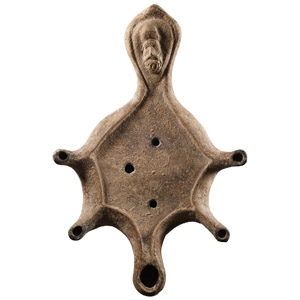
Multi-Spouted Terracotta Oil Lamp
20th century A.D.Sold for (Inc. bp): £39
With basal ring and hollow body, hexagonal in plan with raised sidewall enclosing a broad discus with three separate filler-holes; five radiating stub nozzles, the largest opposite the reflector with loop handle to the underside and high-relief bearded mask. 811 grams, 30 cm
Ex Paris collection. French gallery, Paris, 1990-2000s. -
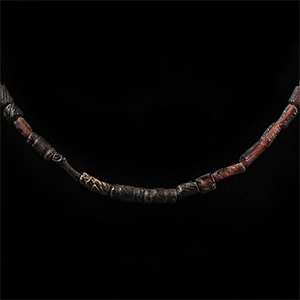
Decorated Aubergine Glass Bead Necklace String
1st century A.D. or laterSold for (Inc. bp): £20
Restrung; composed of translucent tubular beads of graduated size, including decoratively twisted examples and other types. 17 grams, 63 cm long
UK gallery, early 2000s. -
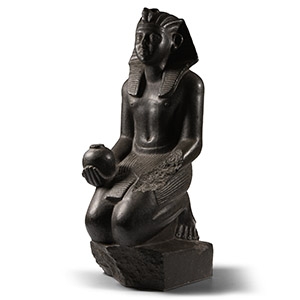
Egyptian Revival Ceramic Sculpture
20th century A.D.Sold for (Inc. bp): £182
A hollow-formed decorative composition figurine based on the figure of Sobekhotep V in the Neues Museum, Berlin under accession no. ÄM 10645; with museum stamp inside the base; after the antique. 3.8 kg, 46.3 cm high
From a French collection, Paris. Ex Parisian gallery, France; latterly with a London, UK, gallery.
