
Loading, please wait...
LOT 2139
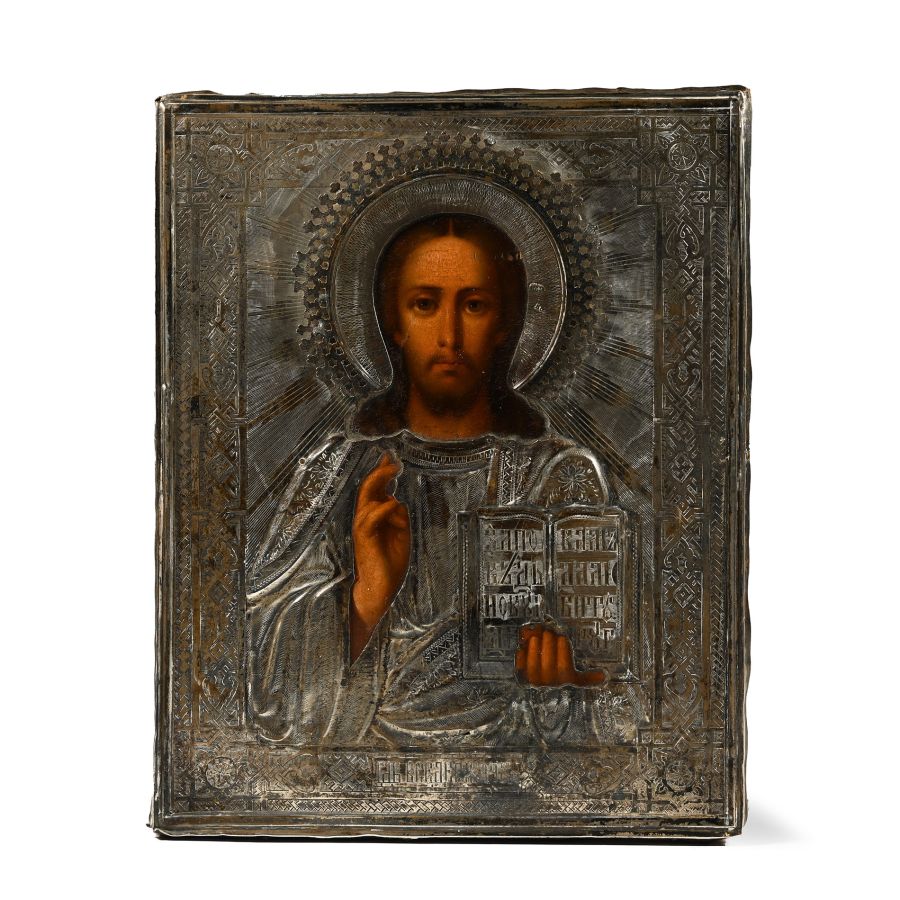
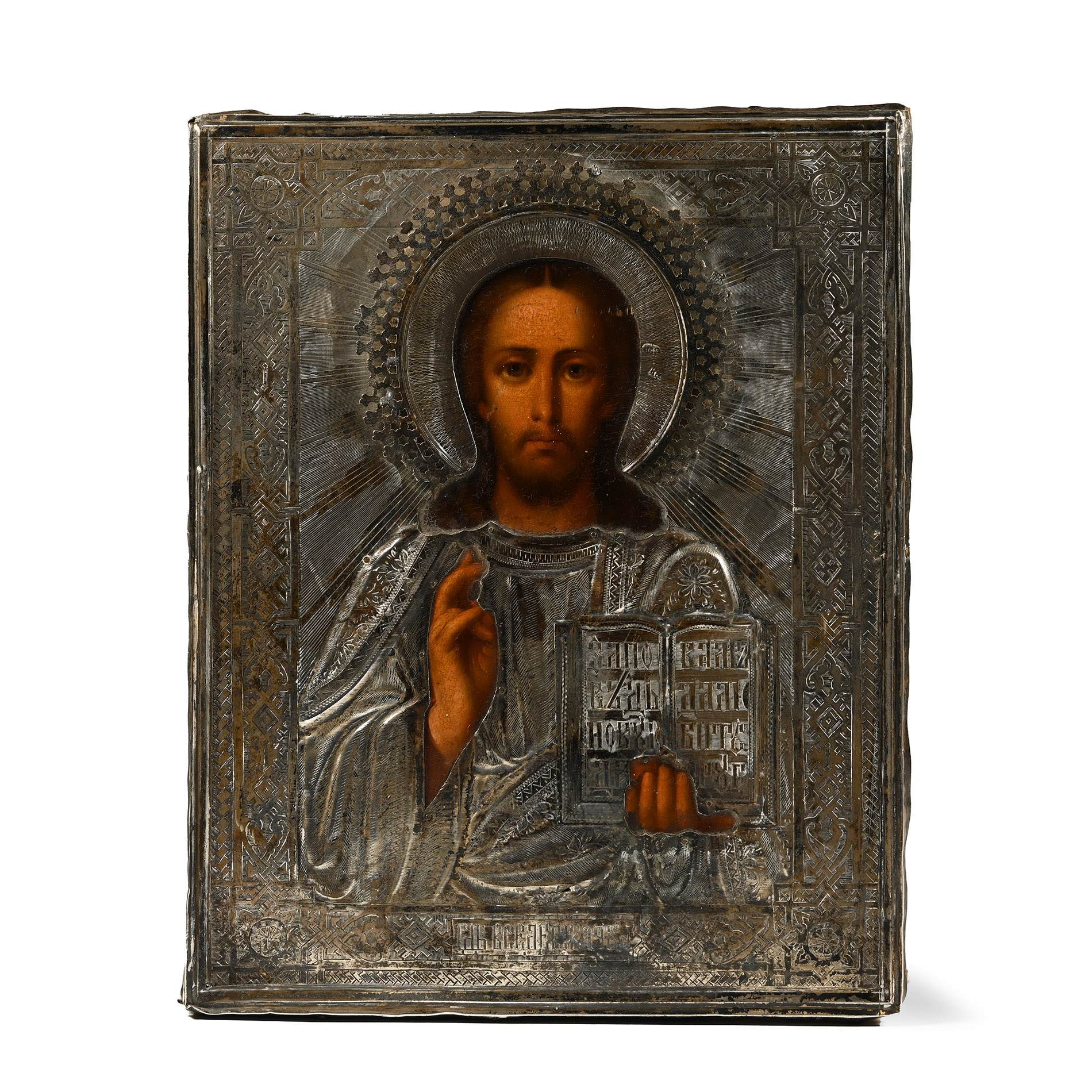
Russian Wooden Icon with Christ Pantocrator with Silver Cover
DATED 1889 A.D.
8 7/8 x 7 in. (498 grams, 22.5 x 18 cm).
Showing Christ Pantocrator (Lord of the Universe) making a blessing gesture with the right hand, the left hand holding the gospel, covered with an elaborate silver oklad marked 84, with repoussé and chased decoration, incised Cyrillic inscription on the Gospel, and on the bottom an incised Cyrillic inscription 'Господь Вседержитель'= Lord Almighty.
ProvenanceProperty of a London, UK, gentleman collector.
This lot is accompanied by an illustrated lot declaration signed by the Head of the Antiquities Department, Dr Raffaele D’Amato.
Cf. similar icons in Moscow Art Centre, Artistic Treasures of Russia, Catalogue of the Icons (in Russian), Moscow, 2022, icons 67, 79, 94.
FootnotesThis fine Russian religious work depicts Christ Pantocrator, ‘Almighty’ or ‘All Powerful’. It is a compound word formed from the Greek words for ‘all’ and the noun ‘strength’ (kratos). In Orthodox Christianity, his icon is one of the most common religious images. The 'oklad', or protective covering of the icon, was made from silver, often gilt, sometimes with cloisonné enamel decorations, and always decorated with geometric floral patterns. The style of Christ recalls the work of Ivan Semenovich Gubkin, an embosser active in Russia at the beginning of 20th century.
CONDITIONTimeLine Auctions follows a vetting process to ensure the authenticity and legality of all items, reinforcing our commitment to integrity and responsible trading. Each antiquity, antique, and coin lot undergoes thorough examination by a vetting committee of at least ten external specialists, professional trade association members, scientists, and archaeologists: Our Vetting Process
AUCTIONS:
TimeLine is a leading auction house specialising in antiquities, ancient art, collectables, natural history, coins, medals, and books. Our auctions offer museums, collectors, historians, and enthusiasts the opportunity to acquire unique and historically significant pieces.
LOT 2139
Russian Wooden Icon with Christ Pantocrator with Silver Cover
Sold for (Inc. bp): £546
-
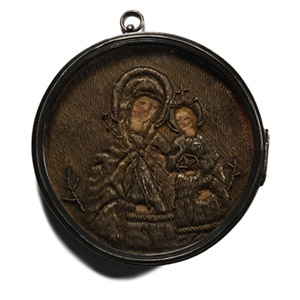
Greek Gold Thread Needle Point with Mary and Jesus in Silver with Inscription to the Archbishop of Jerusalem
Dated 1698 A.D.Sold for (Inc. bp): £520
Depicting Mary holding a lily flower with her right hand and supporting infant Jesus with her left arm; Jesus crowned by a crossed diadem and holding a gospel in his hand; background in gold thread, framed in a circular silver frame with dedicatory inscription to the reverse from a certain Alexander to the Jerusalem’s Archbishop Dositheus, reciting: + Τω ΜΑΚΑΡΙΟΤΑΤω ΚΑΙ CΟΦωΤΑΤω ΠΑΤΡΙΑΡΧΗ ΙΕΡΟCΟΛΥΜωΝ ΔΟCΙΘΕω ΤΙΜΗC ΕΝΕΚΕΝ – μηνι cεπτεμβριω 1698 – Αλεξανδρος – To His Beatitude and Enlighted Patriarch of Jerusalem Dositheus, as a sign of respect – September 1698 – Alexander; internal padding with floral decoration. 82 grams, 10 cm
Property of a London, UK, gentleman collector. This lot is accompanied by an illustrated lot declaration signed by the Head of the Antiquities Department, Dr Raffaele D’Amato.
The art of gold embroidery developed in Constantinople, with its own guild, and continued also after the end of the empire. Important artists like the legendary Despoineta, Mariora, Eusebia and Kokona, were famous in the 'painterly' rendering of religious subjects, not with the brush, but with the needle: red satin, and silver and gold wire created dresses, shadows, volumes with a sense of depth and sculptural quality. The artists conceived their works like a true prayer: a hope, based on human creativity. -
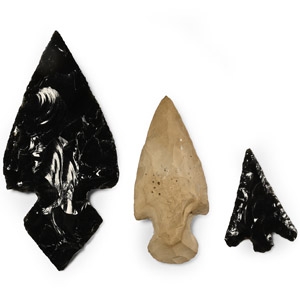
Reproduction Native American Knapped Arrowheads
20th century A.D.Sold for (Inc. bp): £13
Including obsidian and other types, barbed-and-tanged, two with broad tang. 267 grams total, 7-16.2 cm
From the private collection of Kenneth Machin (1936-2020), Buckinghamshire, UK; his collection of antiquities and natural history was formed since 1948; thence by descent. This lot is accompanied by an illustrated lot declaration signed by the Head of the Antiquities Department, Dr Raffaele D’Amato. -
.jpg)
Ethiopian Wooden Diptych Icon of the Virgin and Child with Gabra Manfus Qeddus and Saints
17th century A.D.Sold for (Inc. bp): £2,210
Portable shrine with geometric ornament and crosses to the outer face, opening doors to reveal a diptych with image of Mary Theotokos and Child, escorted by angels Gabriel and Michael with drawn swords, on the left; on the right, Abune Gabra Manfus Qeddus with hands raised, nimbate figures of Takla Haymanot and Ewostatewos with yellow and blue garments on the right; on the lower right corner Saint George (Bet Gorgis) killing the dragon. 453 grams, 21.8 x 19 cm
Sir Alistair McAlpine, circa 2000. This lot is accompanied by an illustrated lot declaration signed by the Head of the Antiquities Department, Dr Raffaele D’Amato.
In the Ethiopian icons, Gabra Manfas Qeddus (Servant of the Holy Spirit) the famous hermit whose sanctity tamed the wild beasts, is often represented. The exterior faces of these diptych panels, like the smaller bilateral diptychs of the 17th century, were carved with centralised cross designs that reflects the carved designs of contemporary wooden altar tablets.
