
Loading, please wait...
LOT 2132
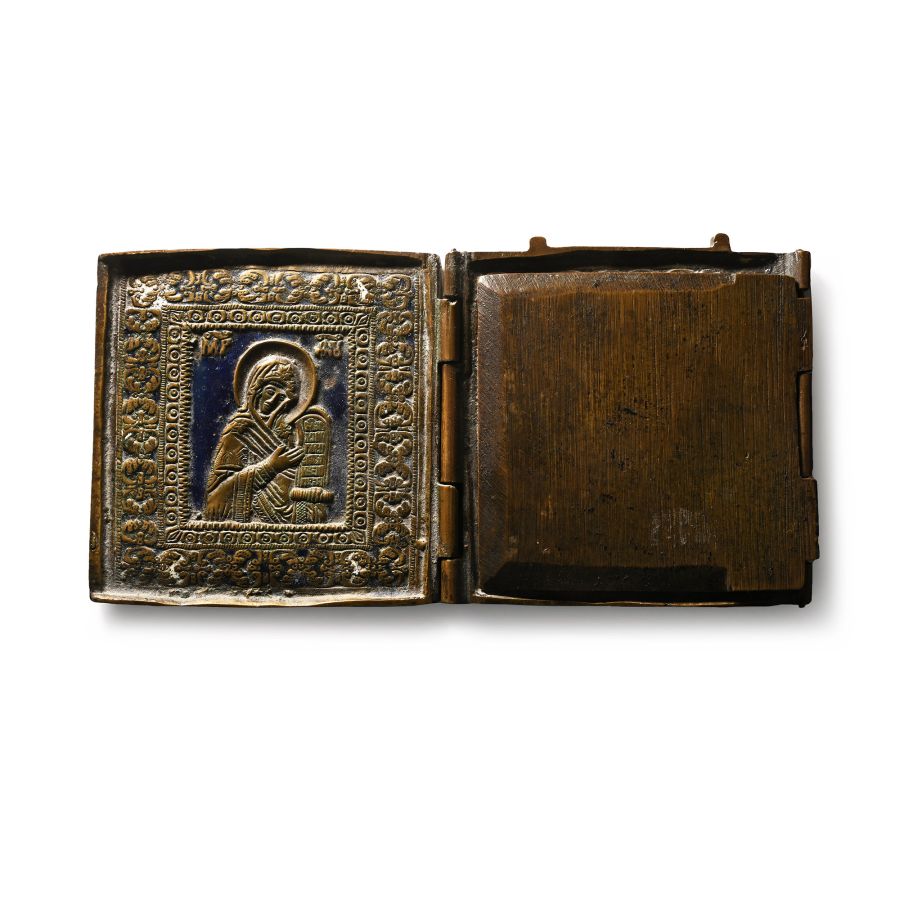
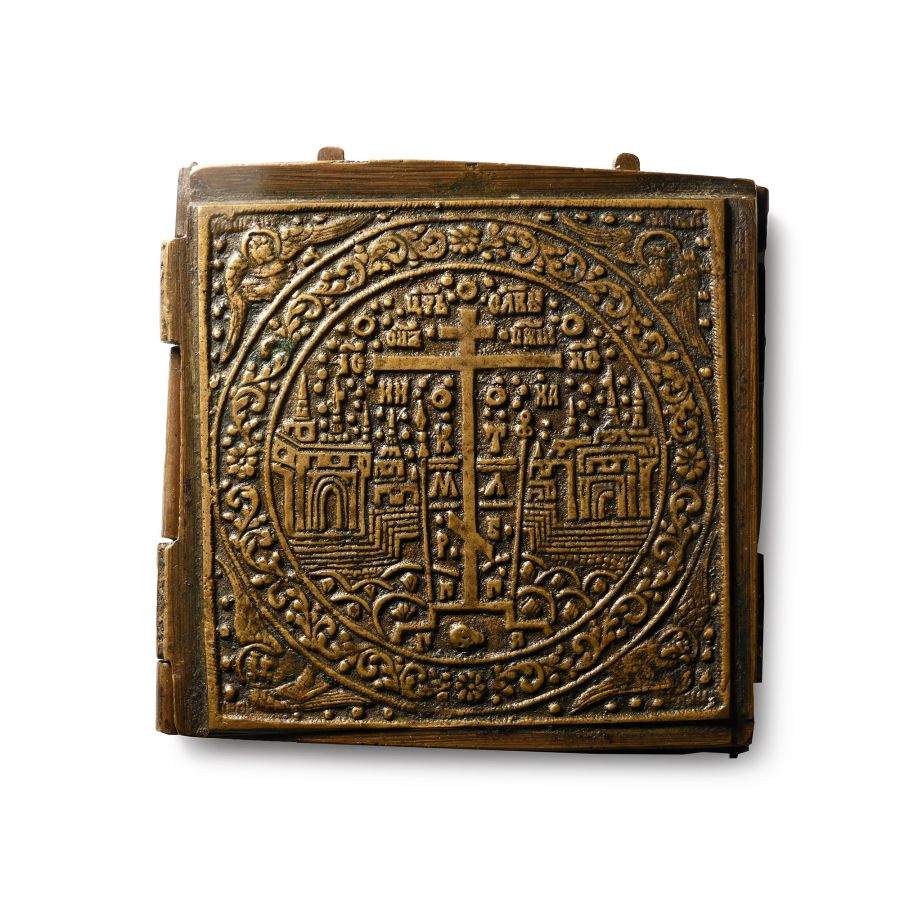
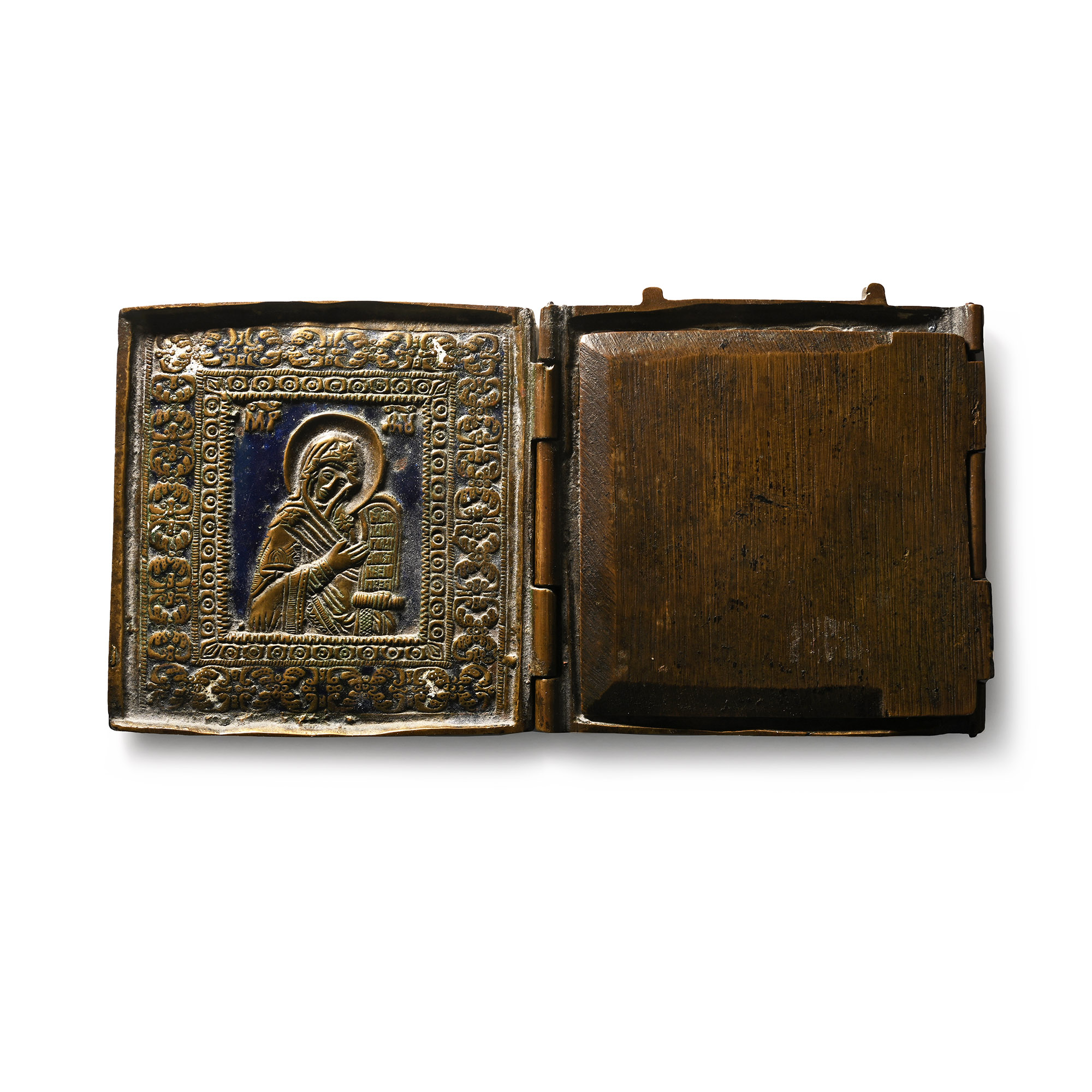
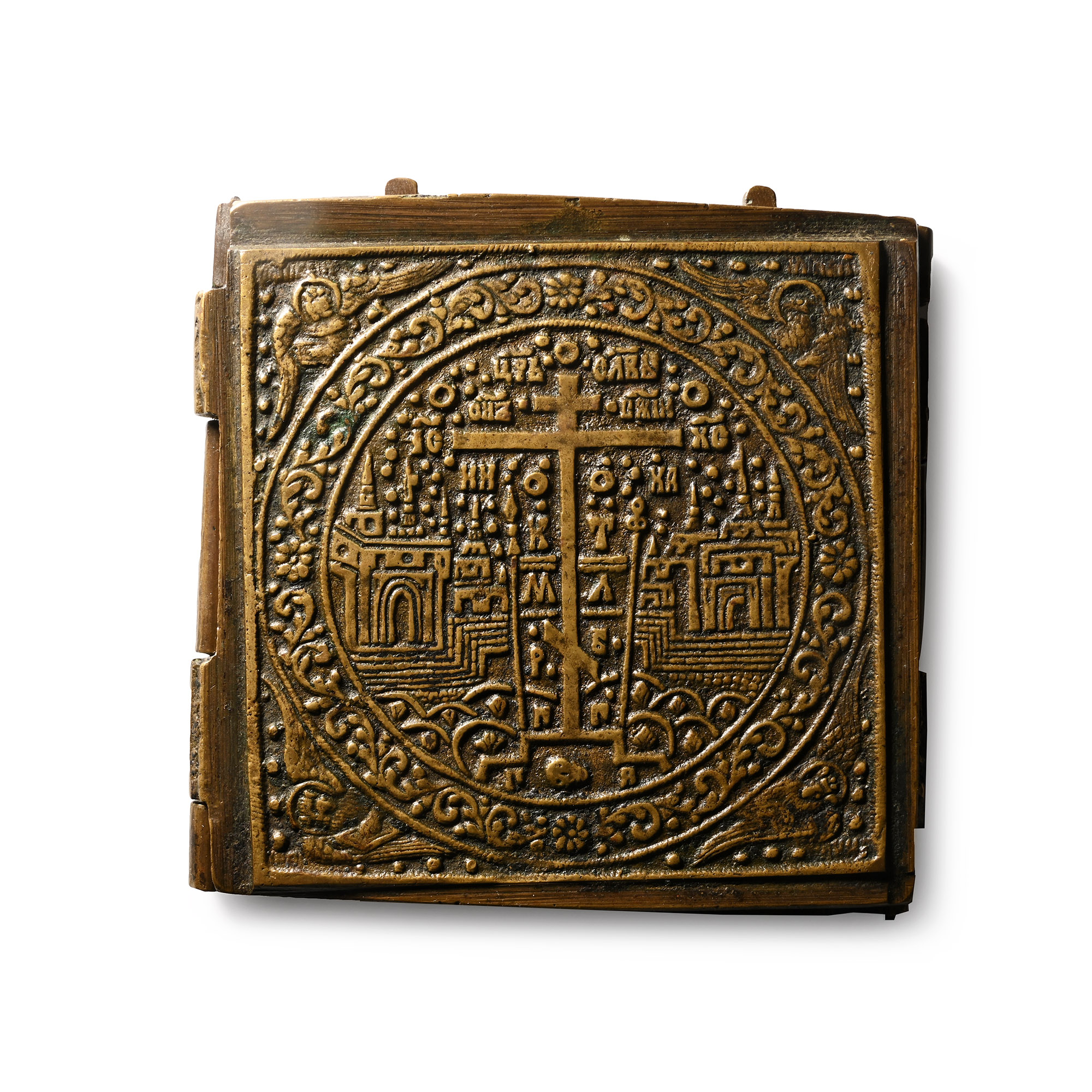
Russian Orthodox Enamelled Bronze Triptych Icon with Christ, Virgin Mary and Saint John
CIRCA 1820 A.D.
4 in. (553 grams, 10 cm).
Depicting the Deesis divided in three panels, with Jesus Christ at the centre, Saint Mary on the left panel and Saint John the Baptist on the right; God holding the Gospel in his left hand and raising his right hand in blessing; Mary with veiled head and mantle, wearing a maphorion mantle over an embroidered robe and holding a scroll; Saint John, portrayed as an elderly man, wearing a camel-skin robe, winged and holding a bowl containing an infant with flexed legs and raised right hand, the saint’s right hand pointing toward the infant Jesus, his left hand holding a scroll with the prophecy of Isaiah, while the right hand is raised in blessing gesture; Old Slavic inscription around the figures: 'ΙC ΧΡ' (Jesus Christ); 'ΜΡ ϴΥ'(Mother of God), ‘Saint John the Precursor’ (Иоа́нн Предте́ча); the images framed by a pseudo-vegetal and abstract decorations; the instruments of the Passion and the city of Jerusalem on the cover.
ProvenanceEx David Miller, Hemel Hempstead, London, UK.
From the private collection of a West London, UK, gentleman, formed since the early 2000s.
Cf. Eighme Ahlborn, R., Beaver-Bricken Espinola, V., Russian Copper Icons and crosses from the Kunz Collection: Castings of Faith, Washington, 1991, nos.25819.083, p.50, 25819.142 and 143, pp.63ff., for similar iconography.
FootnotesThe Deisis or Deesis (Деисус, Gk. for “supplication”) was the depiction of the Virgin, John the Baptist and possibly many more saints interceding with Christ on behalf of mankind.
CONDITIONTimeLine Auctions follows a vetting process to ensure the authenticity and legality of all items, reinforcing our commitment to integrity and responsible trading. Each antiquity, antique, and coin lot undergoes thorough examination by a vetting committee of at least ten external specialists, professional trade association members, scientists, and archaeologists: Our Vetting Process
AUCTIONS:
TimeLine is a leading auction house specialising in antiquities, ancient art, collectables, natural history, coins, medals, and books. Our auctions offer museums, collectors, historians, and enthusiasts the opportunity to acquire unique and historically significant pieces.
LOT 2132
Russian Orthodox Enamelled Bronze Triptych Icon with Christ, Virgin Mary and Saint John
Sold for (Inc. bp): £247
-
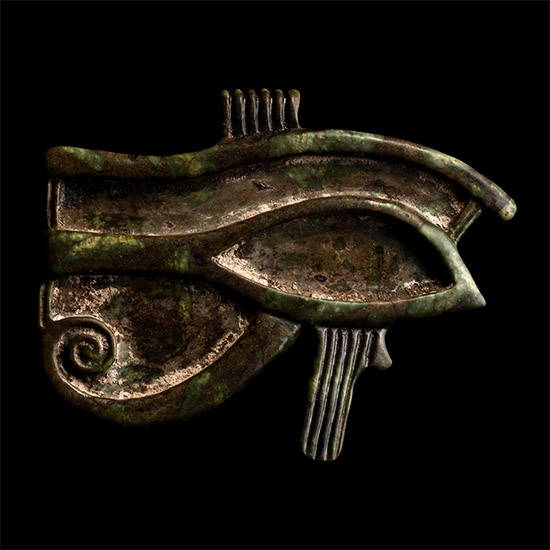
Egyptian Style Green Porphyritic Stone Eye of Horus Pendant
20th century A.D.Estimate: £500 - 700 (+bp*)
Opening Bid: £250
Carved from mottled stone wedjat with raised eyebrow, sclera, teardrop and markings, ribbed suspension loop above. 15 grams, 48 mm
Old French collection. UK private collection, acquired from the above in the 2000s. -
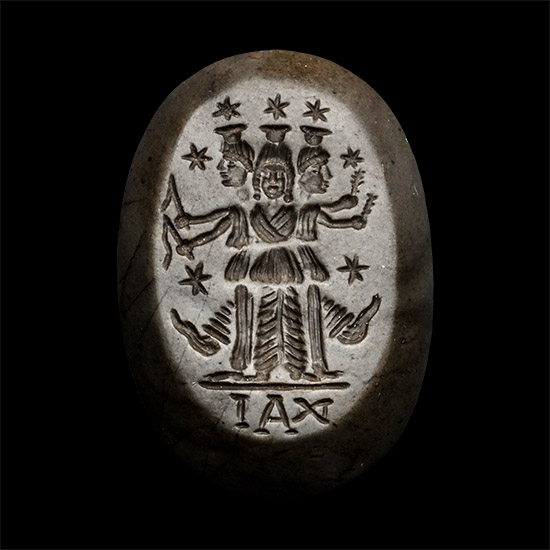
Post Classical Gemstone with Magical Inscription
18th-19th century A.D.Sold for (Inc. bp): £455
Oval variegated dark green intaglio featuring goddess Hekate represented triple-bodied and holding whips and branches, each head wearing a modius, inscription below and seven stars surrounding; the reverse with a magical inscription above a crescent moon and three stars. 7.92 grams, 34 mm
Acquired on the European art market.
Hekate was the goddess of magic, witchcraft, the night, moon, ghosts and necromancy. She received her power over heaven, earth, and sea from her parents, the Titans Perses and Asteria. -
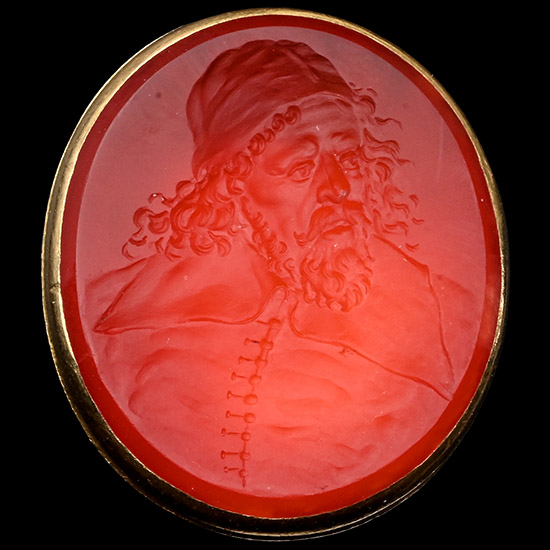
Georgian Era Gold Fob Seal with Carnelian Intaglio of Inigo Jones Attributed to Edward Burch
England, 18th century A.D.Estimate: £1,500 - 2,000 (+bp*)
Opening Bid: £750
Vibrant red carnelian intaglio skilfully carved with a bust of a mature man in three-quarter view, gazing right, wearing a wide-collared, buttoned tunic and a cap, long curly hair framing his bearded face with a deeply furrowed forehead; set in a gold frame with an amphora-like looped handle; supplied with a museum-quality impression. 11.72 grams, 33 mm
Acquired on the European art market.
Edward Burch (1730–1814) was a distinguished English gem engraver and miniaturist, celebrated for his intricate craftsmanship and artistic versatility. A founding member of the Royal Academy of Arts in 1768, Burch gained acclaim for his engraved gemstones, which often depicted classical and mythological themes, reflecting the neoclassical style of the Georgian era. His skill in miniature painting further demonstrated his artistic range and mastery of detail. Highly respected in his time, Burch’s works remain admired for their technical precision and elegance, preserving his legacy as a key figure in 18th-century British art. Inigo Jones (1573–1652) was a pioneering English architect who is widely regarded as the first significant figure to introduce the principles of Renaissance architecture to England. Influenced by his studies in Italy and the works of Andrea Palladio, Jones designed elegant structures characterised by classical symmetry, proportion, and restraint. His most famous works include the Banqueting House at Whitehall, the Queen’s House in Greenwich, and contributions to the layout of Covent Garden. Jones’s adoption of Palladian ideals marked a departure from the Gothic style that had dominated English architecture, laying the foundation for subsequent developments in the Classical tradition.
