
Loading, please wait...
LOT 2314
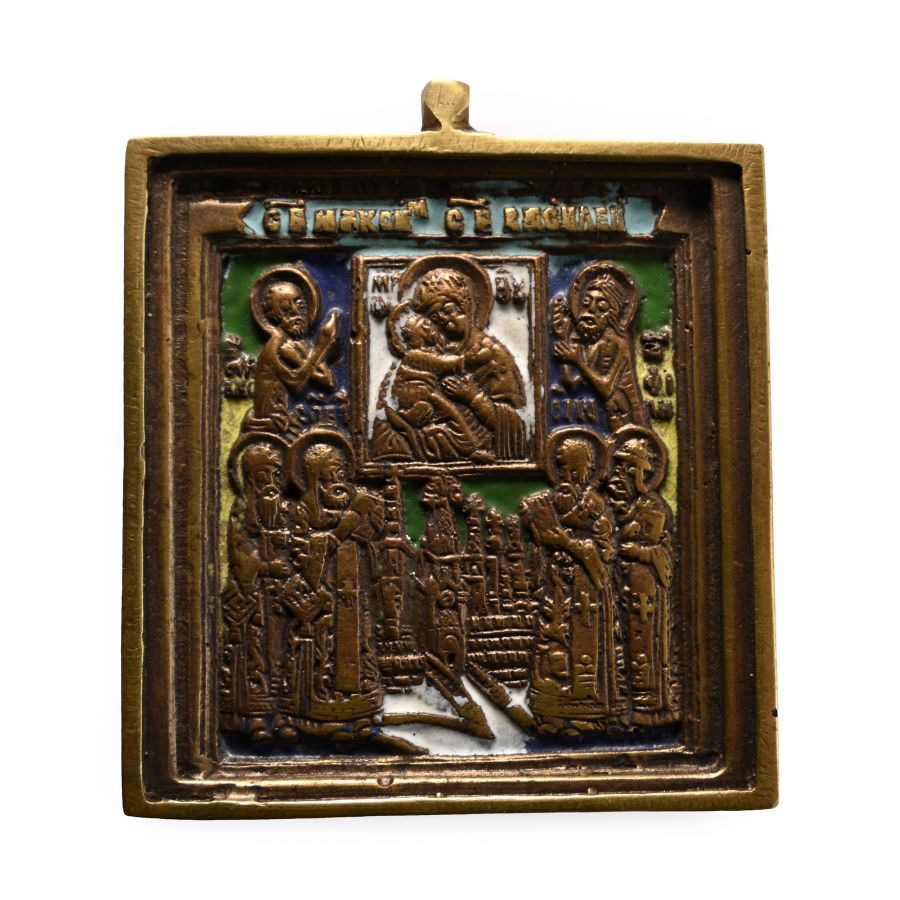
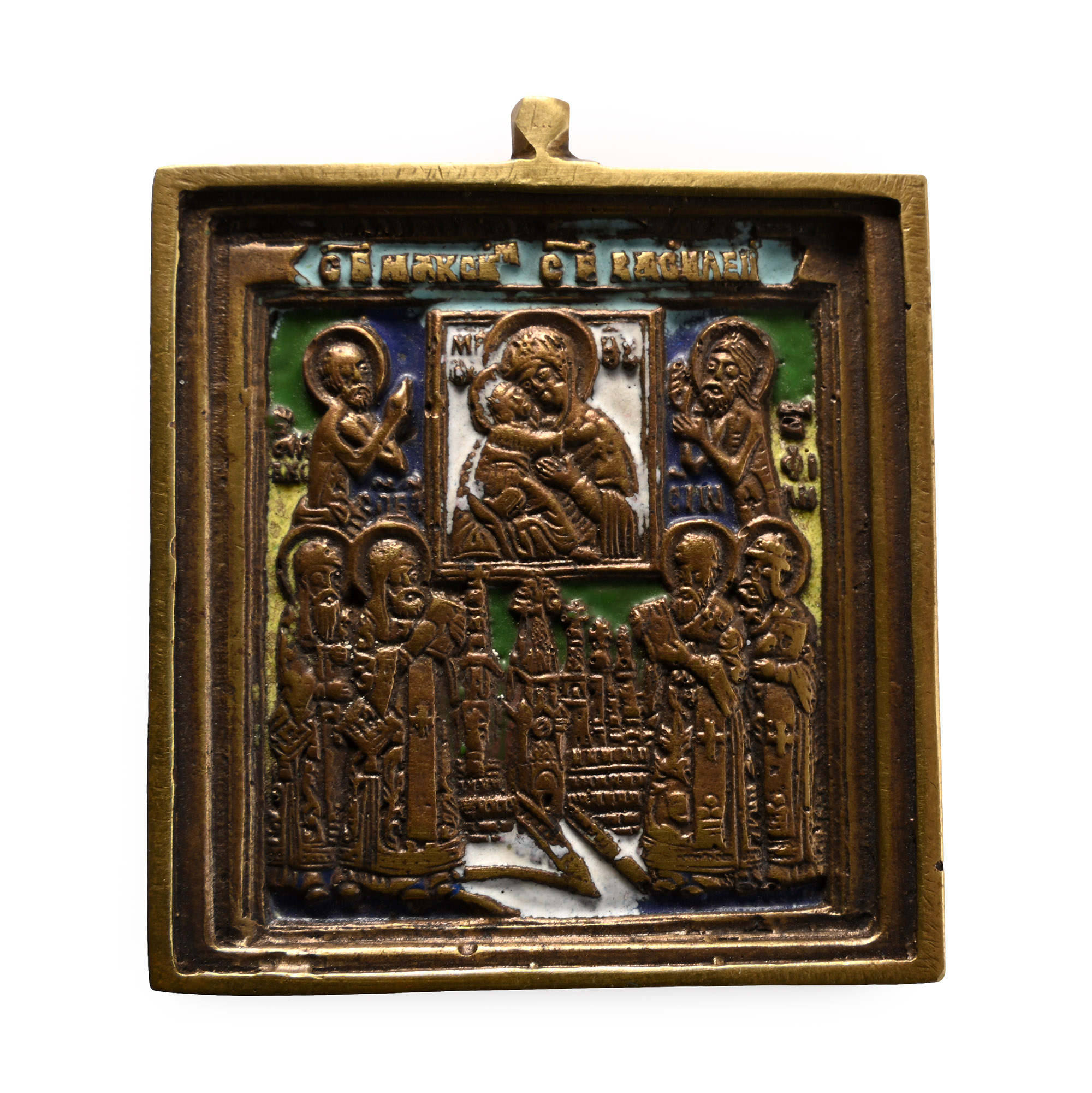
Russian Orthodox Enamelled Bronze Travel Icon with Veneration of the Virgin of Vladimir
19TH CENTURY A.D.
2 3/8 in. (96 grams, 60 mm).
Representing the Vladimir Mother of God with the Divine Child; the half-length figure Mary with covered head turned right and with her left hand raised; holding the embracing infant Jesus in her right hand; above them inscription in Greek letters 'ΜΡ ΘΥ' (Mother of God); flanking the central icon and beneath it the images of the Saints Peter, Paul, Peter of Moscow and John Chrysostomos, Saint Gregory and Saint Dimitri; in the foreground the city of Vladimir.
ProvenanceAcquired from Chris Martin-Zakheim, Iconastas, 5 Piccadilly Arcade, London SW1.
From the private collection of a West London, UK, gentleman, formed since the early 2000s.
Cf. Eighme Ahlborn, R., Beaver-Bricken Espinola, V., Russian Copper Icons and crosses from the Kunz Collection: Castings of Faith, Washington, 1991, nos.25819.106, p.56, for similar iconography.
FootnotesThe original icon prototype of these smaller icons was the icon of the Virgin Mother of Vladimir with the infant Jesus (the original preserved in the Tretyakov Gallery, Moscow), probably the most famous icon of Russia, which was thought to have been created in Constantinople in the early part of 1100s. This image is sometimes referred to as the ‘tenderness icon’, with artists attempting to show the close relationship of mother and son with their cheeks touching as they embrace.
CONDITIONTimeLine Auctions follows a vetting process to ensure the authenticity and legality of all items, reinforcing our commitment to integrity and responsible trading. Each antiquity, antique, and coin lot undergoes thorough examination by a vetting committee of at least ten external specialists, professional trade association members, scientists, and archaeologists: Our Vetting Process
AUCTIONS:
TimeLine is a leading auction house specialising in antiquities, ancient art, collectables, natural history, coins, medals, and books. Our auctions offer museums, collectors, historians, and enthusiasts the opportunity to acquire unique and historically significant pieces.
LOT 2314
Russian Orthodox Enamelled Bronze Travel Icon with Veneration of the Virgin of Vladimir
Sold for (Inc. bp): £98
-
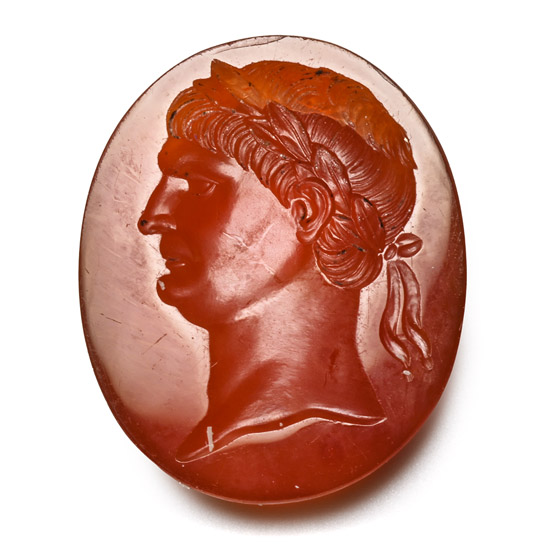
Neoclassical Carnelian Gemstone of Roman Emperor Trajan
Italy, 18th century A.D.Sold for (Inc. bp): £520
Intaglio profile bust with short hair and laurel wreath; supplied with a museum-quality impression. 3.01 grams, 21 mm
Private English collection, formed between the late 1970s and early 1990s. Private collection, London, UK. -
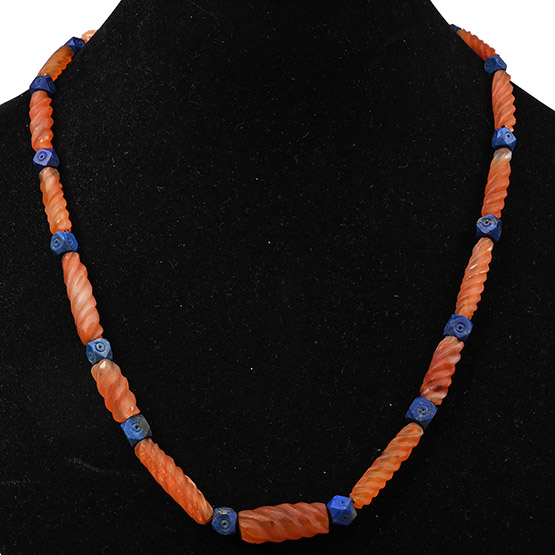
Western Asiatic Style Lapis Lazuli and Carnelian Bead Necklace String
20th century A.D.Sold for (Inc. bp): £7
Designer necklace composed of cornerless cube beads interspersed with barley twist beads; restrung. 50 grams, 53 cm
Ex London, UK, art market 1990s. -
.jpg)
Large Natural Pink Sapphire in 24 Carat Gold Mughal Ring
Burma, circa 18th century A.D.Estimate: £12,000 - 17,000 (+bp*)
Opening Bid: £6,000
Comprising a solid round-section ring with a large, rectangular bezel set with a vibrant pink sugarloaf-shaped sapphire. 20.3 grams, 33.21 mm overall, 16.21x17.28 mm internal diameter (approximate size British M 1/2, USA 6 1/4, Europe 13.09, Japan 12)
From the private collection of Lord Ian Balfour, author of 'Famous Diamonds'; received by gift to the present owner circa 2001. Accompanied by a copy of a Gemmological Certification Services lab report invoice no.41731. This lot has been checked against the Interpol Database of stolen works of art and is accompanied by search certificate number no.13268-251909.
According to the GCS report, there is no indication of heating, and they have estimated the weight of the sapphire to be between 10 and 20 carats. Subsequent CT scanning has confirmed that the weight of the sapphire is 16.3 carats.
