Loading, please wait...
LOT 2357
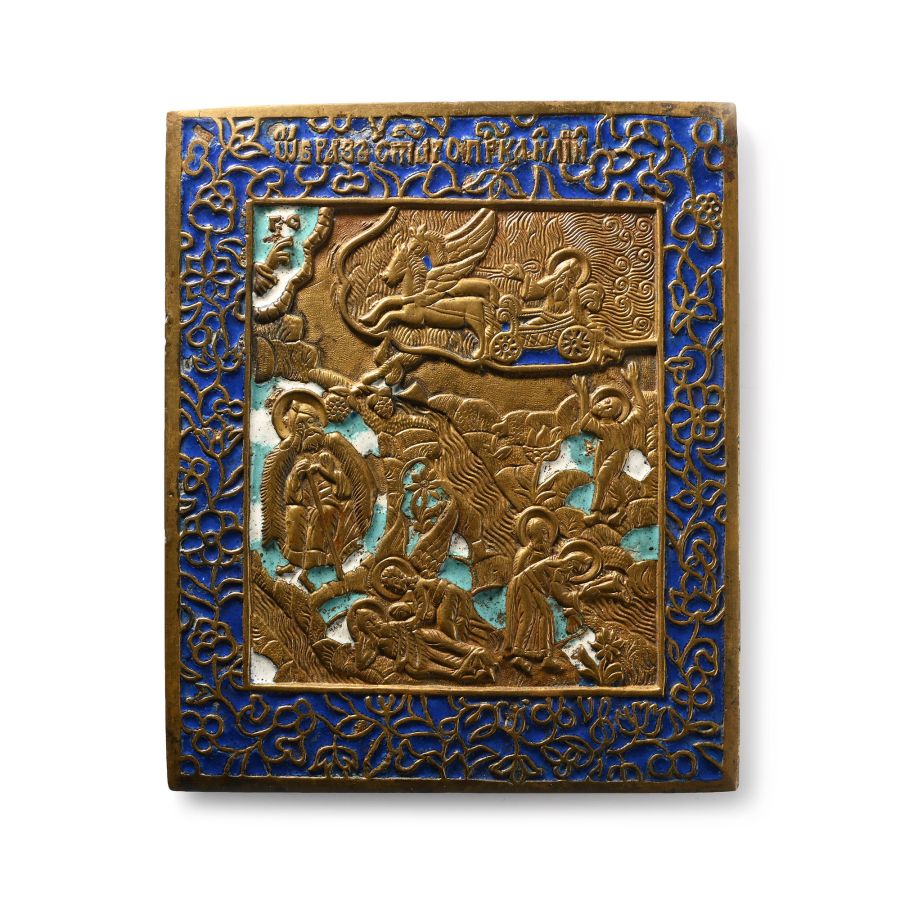
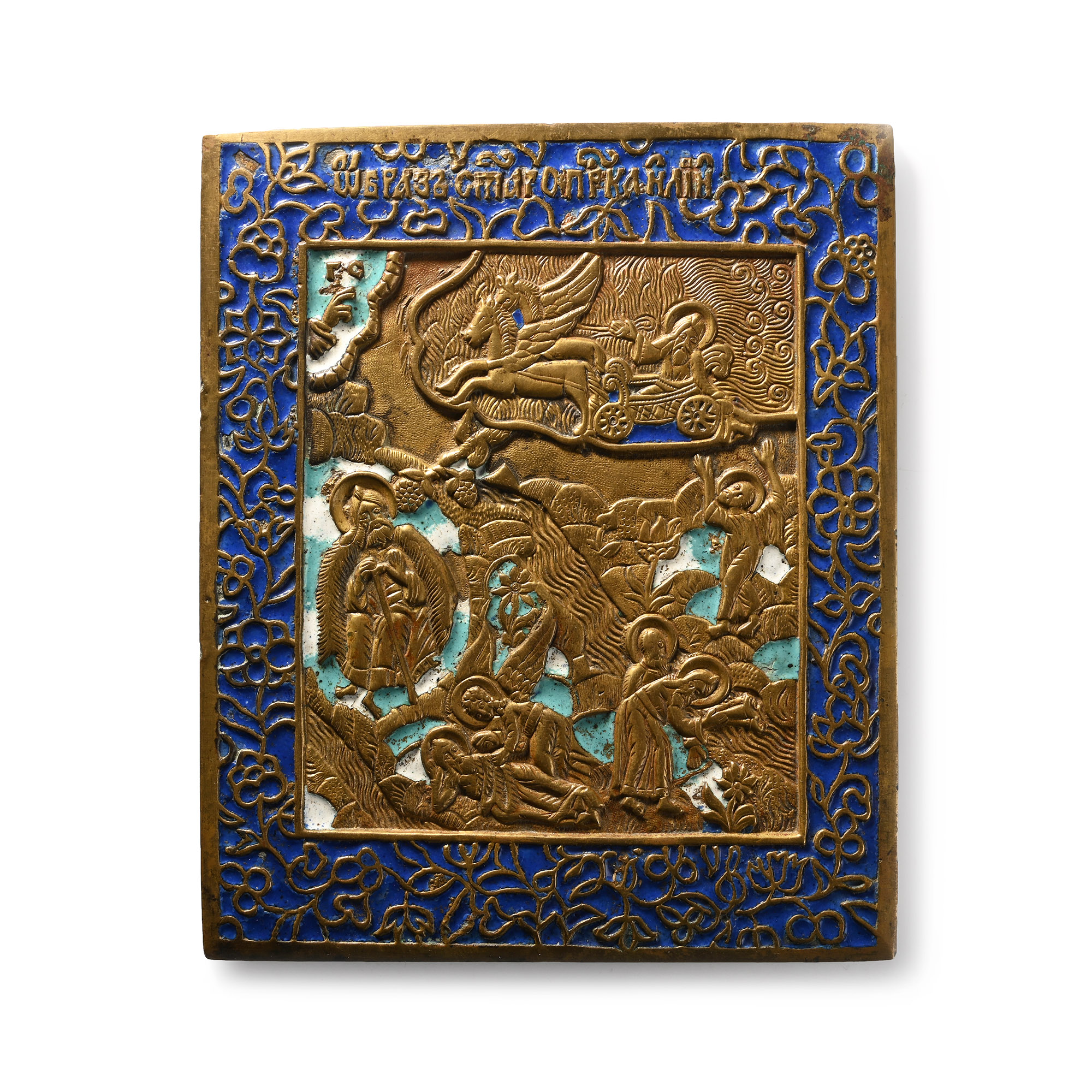
Russian Orthodox Enamelled Bronze Travel Icon with Scenes of the Life of the Prophet Elijah
19TH CENTURY A.D.
5 5/8 in. (585 grams, 14.3 cm).
With blue champlevé enamel, depicting scenes of the life of Prophet Elijah: on the bottom right Elijah rolling up his mantle and dividing the waters of the Jordan, in front of his disciple Elisha; on the bottom left Elijah watched over by the Angel; on the top right Elijah ascending to heaven on a Chariot of Fire, assisted by the hand of God; on the left Elijah, covered by his mantle, fed by ravens; frame with blue enamel over gilded pseudo-vegetal decorations.
ProvenanceAcquired from Chris Martin-Zakheim, Iconastas, 5 Piccadilly Arcade, London SW1.
From the private collection of a West London, UK, gentleman, formed since the early 2000s.
Cf. Tarasov, O., Icon and devotion, Sacred Spaces in Imperial Russia, London, 2002, pp.157ff., for the study of this iconography.
FootnotesThe icon represents the Ascension of the prophet Elijah and other scenes from his life. Elijah is ascending to heaven in a fiery chariot drawn by horses, leaving his mantle to the disciple Elisha, symbolising the transmission of his prophetic mission. Among the great figures of the Bible, the prophet Elijah was one of the most venerated figures in history in Orthodoxy.
CONDITIONTimeLine Auctions follows a vetting process to ensure the authenticity and legality of all items, reinforcing our commitment to integrity and responsible trading. Each antiquity, antique, and coin lot undergoes thorough examination by a vetting committee of at least ten external specialists, professional trade association members, scientists, and archaeologists: Our Vetting Process
AUCTIONS:
TimeLine is a leading auction house specialising in antiquities, ancient art, collectables, natural history, coins, medals, and books. Our auctions offer museums, collectors, historians, and enthusiasts the opportunity to acquire unique and historically significant pieces.
LOT 2357
Russian Orthodox Enamelled Bronze Travel Icon with Scenes of the Life of the Prophet Elijah
Estimate £250 - 350€290 - 410 (for guidance only)$340 - 470 (for guidance only)
-
Post-Byzantine Gold Archbishop's Pectoral Pendant
16th-17th century A.D.Sold for (Inc. bp): £7,020
Round enkolpion with finely worked icons both on the front and back, and eight small side eyelets for lost pearl ropes on the edge; at the top, a double eyelet for the chain; bordered by a delicate beaded edge with a slight knock in one place due to age; embossed depictions on both sides, finely rendered in repoussé; on the obverse a frontal bust portrait of the deceased Saviour, both arms of Christ limply hanging at his sides, the lifeless head resting on his right shoulder, behind him a nimbus and the cross, to the left of the soma (body of Christ) the abbreviation 'IC' (= Jesus), on the right 'XC' (= Christus), above the head a plaque with a Greek two-line inscription: 'O Basilevs tis doxis Christos' (Christ, the King of Glory); the Virgin Mary (Theotokos) depicted on the back, her hands raised in a gesture of prayer (orans) with exquisitely modelled facial features, flanked by an inscription referring to the Mother of God: the abbreviation 'MP' on the left, 'THY' on the right, furthermore, she is invoked as 'He Gorgoepikoo' (She who is quick to hear). 21.3 grams, 44 mm
Acquired by the previous owner on the European art market in the late 1990s. Property of a German university professor. Hermann Historica, Auction 87, 2020 no.19. This lot has been checked against the Interpol Database of stolen works of art and is accompanied by search certificate number no.13291-254371.
Adorned with an icon of Christ and the Virgin Mary, this outstanding enkolpion symbolises purity of heart and the seal of confession and faith. Since the Byzantine era, golden enkolpia were pontifical insignia and usually worn by bishops. In this case, the size, the artistic craftsmanship, and the topics of the icons, depictions of Christ and the Theotokos, lead to the conclusion that it must have been the enkolpion of a high-ranking primate or archbishop. Extremely rare in this size and quality. Remarkable is also the artist's choice to depict the Mother of God slightly turned to the right and not show her frontally, as is common. -
Stuart Period Gold Memento Mori Ring with Skull and Crossed Bones for Ian Shepherd
Dated 1724 A.D.Sold for (Inc. bp): £3,900
Comprising a D-shaped hoop with foliate and floral decoration, rectangular bezel set with a facetted rock crystal(?) gemstone with a skull and crossed bones beneath the gem; engraved to the inner face 'In˚ Shepherd Obt 20 Jan 1724 æt 62' and a worn maker's mark. 4.60 grams, 22.48 mm overall, 18.44 mm internal diameter (approximate size British Q 1/2, USA 8 1/4, Europe 18.12, Japan 17)
Acquired from a London, UK, auction house. From a private Bristol, UK, collection. This lot has been checked against the Interpol Database of stolen works of art and is accompanied by search certificate number no.13213-249807.
The memento mori jewellery of the 16th-18th centuries served as wearable ‘reminders of mortality’. Typical motifs within this genre included skulls, skeletons, crossbones, hourglasses, coffins, the gravedigger’s pick and shovel, and various other emblems of death and decay. -
Large Framed Book Plate with Egyptian Amulets
19th century A.D.Sold for (Inc. bp): £33
Large-format engraved plate illustrating amulets of various types (figures of Bes and Pataikos, multiple wedjat, Taweret with dorsal pillar, etc.), from the book series La Description de l'Egypte published after the French army's Egyptian campaign (1798-1801), Book A, Volume V, plate 88; mounted in a modern glazed frame. 3 kg total, 70.6 x 53 cm including frame
Private collection, London, UK.
Produced between February 1802 and 1830 on the orders of Napoleon Bonaparte; published between 1809 and 1828. Just 1,000 copies were distributed to various institutions, printed on laid paper with an 'Égypte ancienne et moderne' watermark. The book is subtitled Recueil des observations et des recherches qui ont été faites en Égypte pendant l’expédition de l’Armée française, publié par les ordres de Sa Majesté l’Empereur Napoléon le Grand (Gathering of observations and discoveries which were made in Egypt during the expedition of the French army, published on the orders of His Majesty the Emperor Napoleon the Great). It was the world's first encyclopedia devoted exclusively to the remains of ancient Egypt.