
Loading, please wait...
LOT 2295
Russian Orthodox Enamelled Bronze Travel Icon with Saint Nicholas
19TH CENTURY A.D.
4 1/4 in. (348 grams, 10.7 cm).
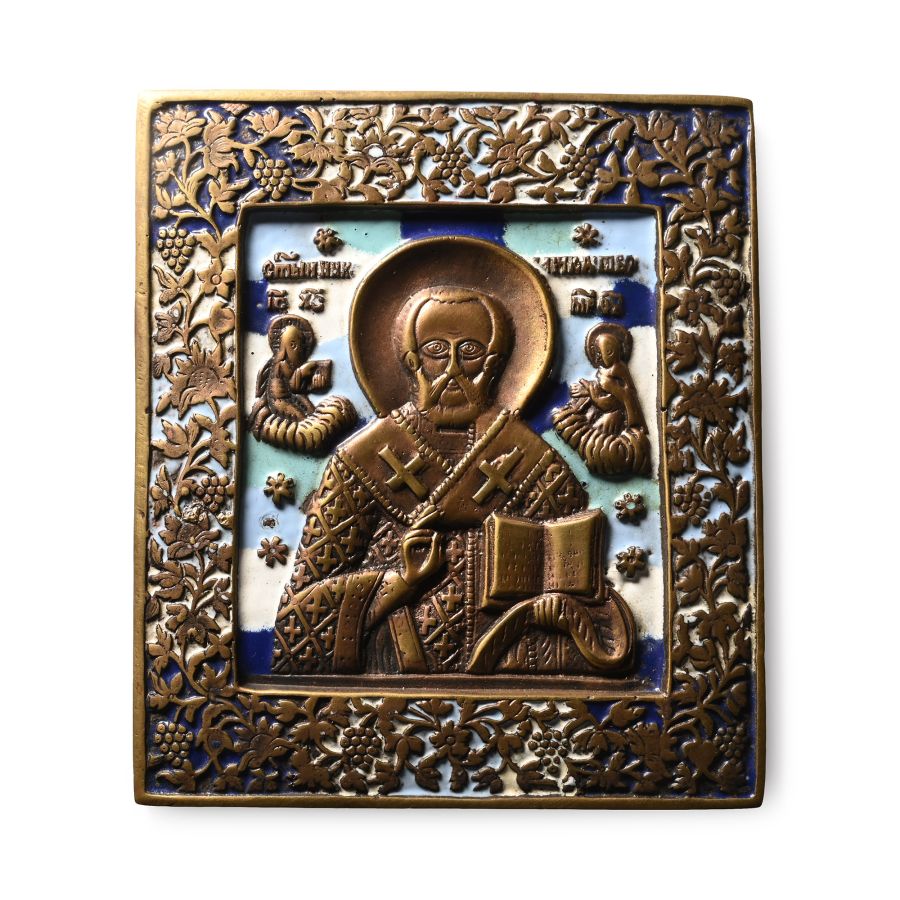
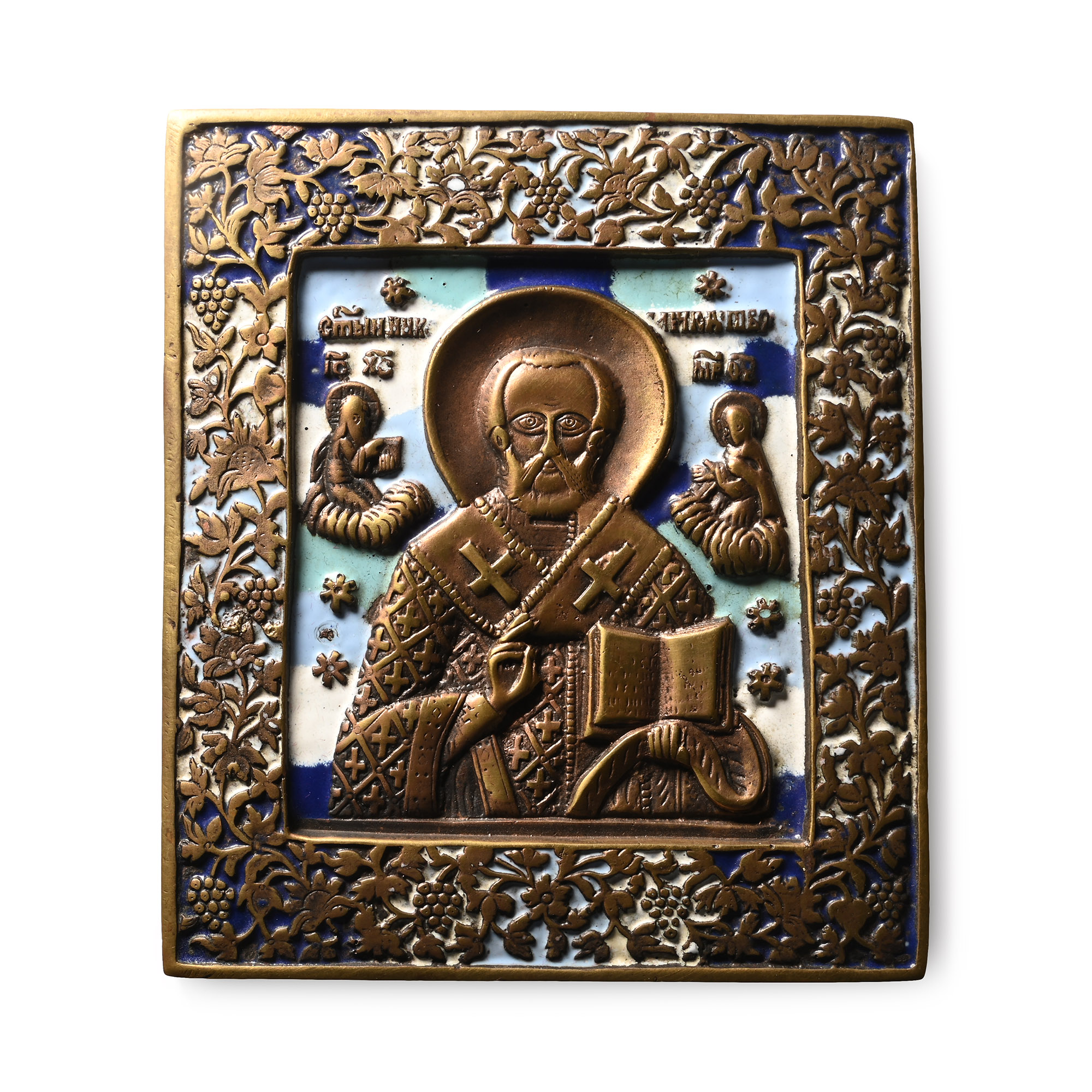
Representing Saint Nicholas of Myra with a book in his left hand and making the gesture of blessing with his right, dressed as a bishop with sticharion, covered by omophorion, and surmounted by an epitrachelion embroidered with crosses; the saint flanked by Jesus and Virgin Mary, Christ holding the gospel, Mary the bishop’s epitrachelion; Cyrillic inscriptions 'Saint Nikolaos the Wonderworker (СВЯТЫЙ НИКОЛА ЧУДОТВОРЕЦ), Iesus Christos (ΙΣ ΧC) and Mother of God (ΜΡ ΘΥ)' on the enamelled background.
ProvenanceAcquired from Chris Martin-Zakheim, Iconastas, 5 Piccadilly Arcade, London SW1.
From the private collection of a West London, UK, gentleman, formed since the early 2000s.
Cf. Eighme Ahlborn, R., Beaver-Bricken Espinola, V., Russian Copper Icons and crosses from the Kunz Collection: Castings of Faith, Washington, 1991, nos.25819.156, p.67, for similar iconography.
FootnotesThe icon features meticulous craftsmanship typical of Orthodox iconography. The enamel colors, despite the passage of time, retain their vibrant intensity, highlighting the key elements of the depicted images. The refined details and use of enamel give depth and luminosity to the icon, making it a precious example of the Russian Orthodox tradition.
CONDITIONTimeLine Auctions follows a vetting process to ensure the authenticity and legality of all items, reinforcing our commitment to integrity and responsible trading. Each antiquity, antique, and coin lot undergoes thorough examination by a vetting committee of at least ten external specialists, professional trade association members, scientists, and archaeologists: Our Vetting Process
AUCTIONS:
TimeLine is a leading auction house specialising in antiquities, ancient art, collectables, natural history, coins, medals, and books. Our auctions offer museums, collectors, historians, and enthusiasts the opportunity to acquire unique and historically significant pieces.
LOT 2295
Russian Orthodox Enamelled Bronze Travel Icon with Saint Nicholas
Estimate £200 - 300€230 - 350 (for guidance only)$270 - 410 (for guidance only)
-
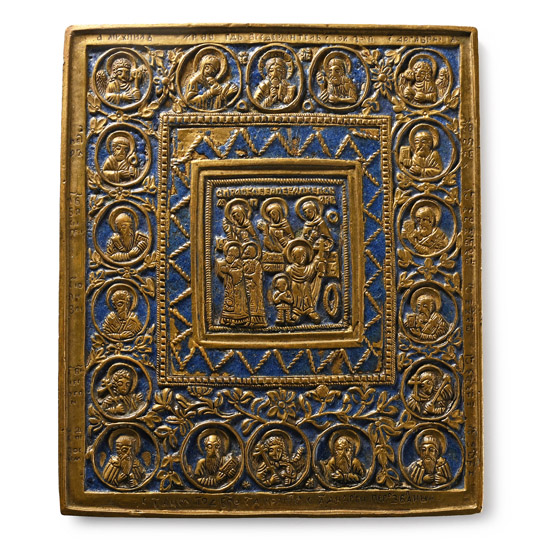
Russian Orthodox Enamelled Bronze Travel Icon with Saint Julitta, Cyricus and Deesis
19th century A.D.Estimate: £250 - 350 (+bp*)
Opening Bid: £108
With blue enamel and framed by a raised border; Saint Julitta and her son, Cyricus, Saint Gregory the Theologian and Saint John the Chrysostom standing beside them at the centre; three half-length figures above: St. Paraskeva (right), Eudokia, and Barbara (left); OCS inscriptions identifying the saints framing the scene; on the top a deesis, with Christ Pantokrator at the centre, flanked by Saint Mary and Saint John the Precursor; at the top left corner Archangel Michael, on the top right corner the Archangel Gabriel; beneath Saint Gabriel, in vertical order, Saint Paul, Saint Gregory the Theologian, Saint Nicholas of Myra, Saint Demetrios; beneath Saint Michael, in vertical order, Saint Peter, Saint Basil the Great, Saint John Chrysostomos and Saint George; in the last row, nearby Saint Andrew, at the centre, the Archangel Raphael, with sword and cross. 360 grams, 14 cm
Acquired from Chris Martin-Zakheim, Iconastas, 5 Piccadilly Arcade, London SW1. From the private collection of a West London, UK, gentleman, formed since the early 2000s.
This icon was intended for private devotion, often carried by pilgrims and Orthodox believers for spiritual protection. St. Julyttas and her son Cyricus (Ки́рик и Иули́тта), among the most venerated figures in Russian tradition, are depicted in the centre, surrounded by other saints, a symbol of the communion of the righteous in front of the Divine Deesis. -

Moche-Sican Style Gilded Ear Spools with Warriors
20th century A.D. or earlierSold for (Inc. bp): £85
Each with a gold surface and red-brown cinnabar colouration; the spools are discoid with raised bands and a capped and pierced central cylindrical neck to the reverse; the discs present almost identical scenes of a standing warrior wearing a headdress and holding a club and shield; in the style of the Lambayeque Valley, circa 200-500 A.D. 173 grams total, 10.7 cm each
Formerly acquired before 1950. From the collection of Mr Razeto, acquired in the 1950s-1960s. Ex private American collection, circa 1960s. Acquired from Gloria Lisset Reyes Garcia, Florida, USA. From the private collection of Mr Michael J. Vaupel, Miami, USA.
The age of the Moche people has been lauded as the 'Master Craftsman Period' by archaeologists. Alongside other developments and innovations, the Moche excelled at metalwork, such as this pair of earrings, which may have been worn by high-status men or women. The pair would likely have been deposited as grave goods. The Moche culture existed between 200 and 850 AD, before the advent of the Inca. Although they never formed a single centralised political entity, they built thriving cultural regional centres stretching from the Nepeña River Valley in the south to the Piura River, close to the modern border with Ecuador, developing coastal regions into fertile farmlands and exploiting the maritime resources of the Pacific Ocean's Humboldt Current. -
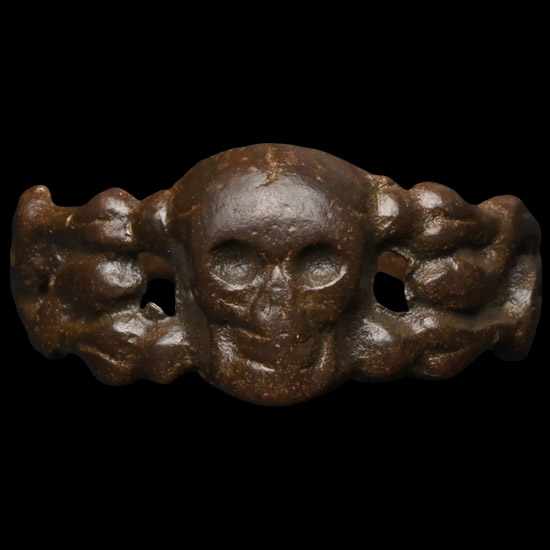
Post Medieval Bronze Skull Ring
Circa 19th century A.D.Sold for (Inc. bp): £59
Slender hoop formed as a pair of long bones with a snake curled around the shafts at the shoulders, the bezel a skull with recessed eye sockets. 3.44 grams, 22.68 mm overall, 18.29 mm internal diameter (approximate size British O 1/2, USA 7 1/4, Europe 15.61, Japan 15)
Ex German art market, 2000s. Acquired from an EU collector living in London. From the collection of a Surrey, UK, gentleman.
