
Loading, please wait...
LOT 2013
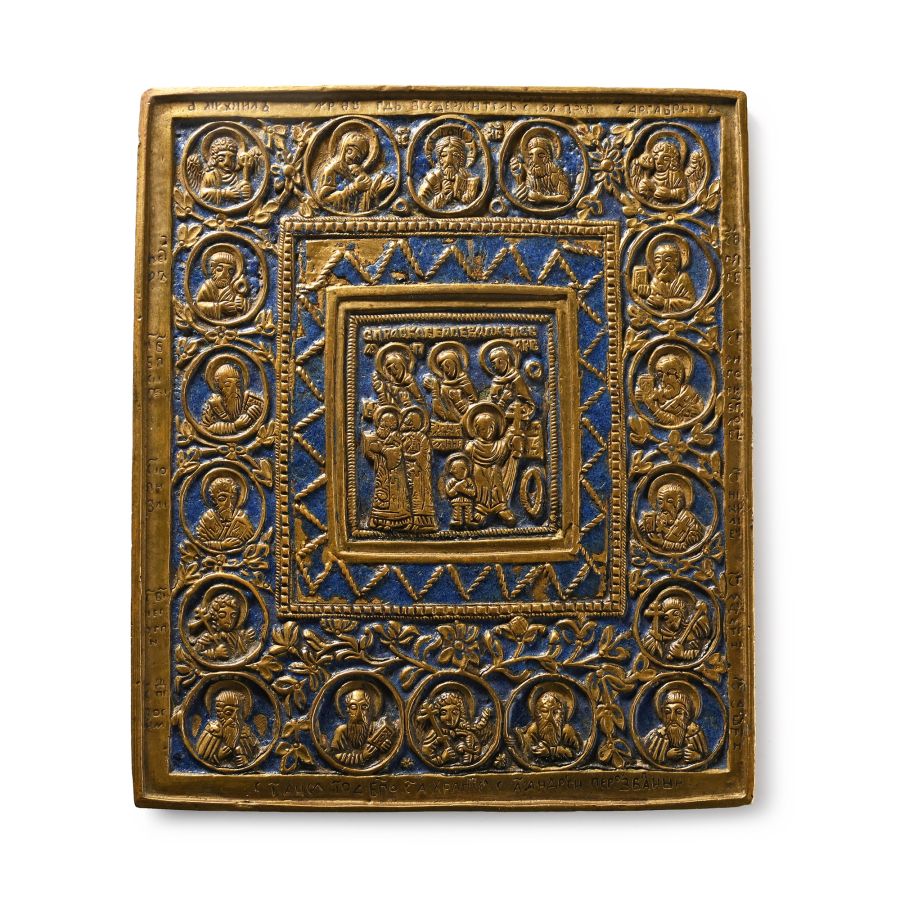
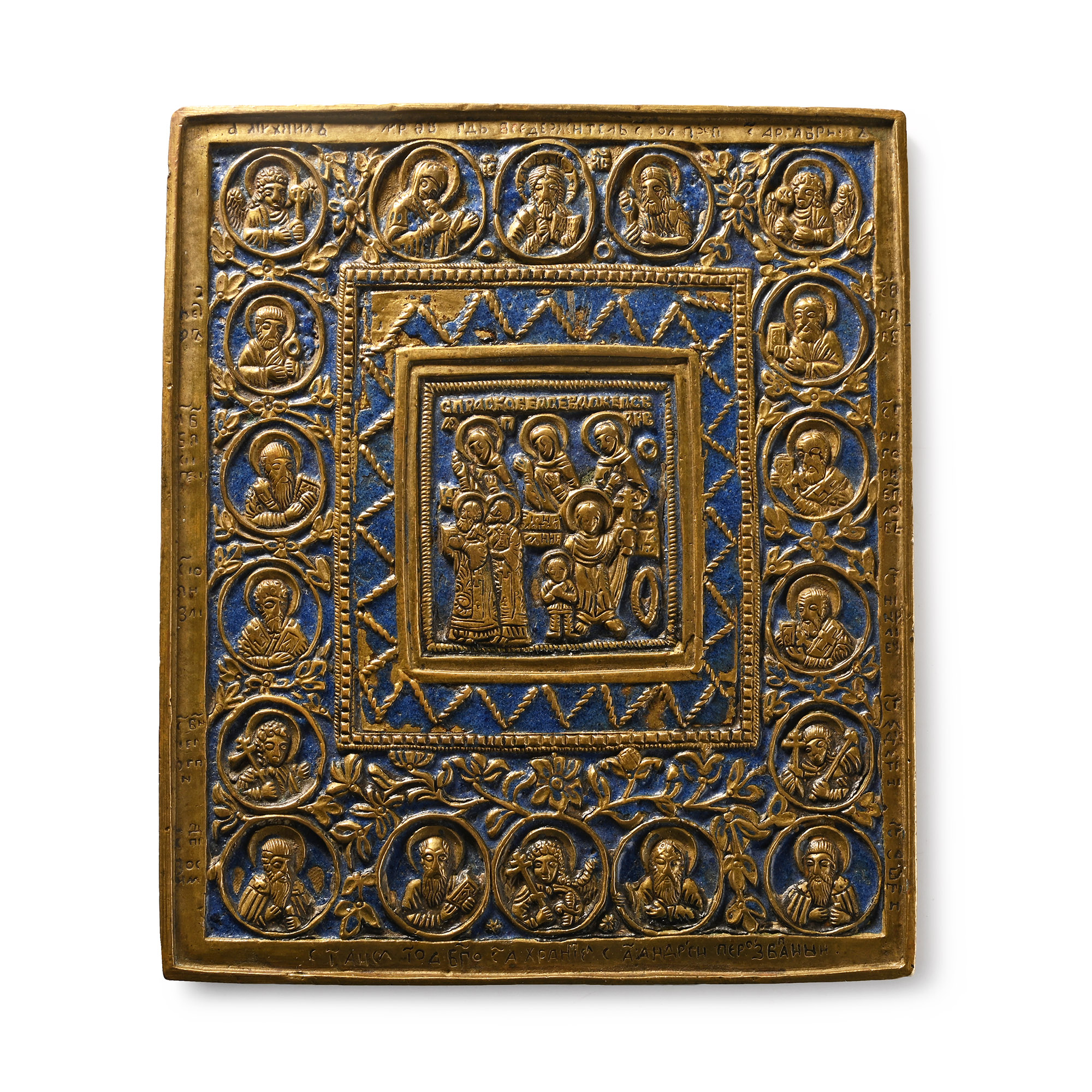
Russian Orthodox Enamelled Bronze Travel Icon with Saint Julitta, Cyricus and Deesis
19TH CENTURY A.D.
5 1/2 in. (360 grams, 14 cm).
With blue enamel and framed by a raised border; Saint Julitta and her son, Cyricus, Saint Gregory the Theologian and Saint John the Chrysostom standing beside them at the centre; three half-length figures above: St. Paraskeva (right), Eudokia, and Barbara (left); OCS inscriptions identifying the saints framing the scene; on the top a deesis, with Christ Pantokrator at the centre, flanked by Saint Mary and Saint John the Precursor; at the top left corner Archangel Michael, on the top right corner the Archangel Gabriel; beneath Saint Gabriel, in vertical order, Saint Paul, Saint Gregory the Theologian, Saint Nicholas of Myra, Saint Demetrios; beneath Saint Michael, in vertical order, Saint Peter, Saint Basil the Great, Saint John Chrysostomos and Saint George; in the last row, nearby Saint Andrew, at the centre, the Archangel Raphael, with sword and cross.
ProvenanceAcquired from Chris Martin-Zakheim, Iconastas, 5 Piccadilly Arcade, London SW1.
From the private collection of a West London, UK, gentleman, formed since the early 2000s.
Cf. Eighme Ahlborn, R., Beaver-Bricken Espinola, V., Russian Copper Icons and crosses from the Kunz Collection: Castings of Faith, Washington, 1991, nos.25819.130 and 25819.133, pp.49,58, for similar iconography.
FootnotesThis icon was intended for private devotion, often carried by pilgrims and Orthodox believers for spiritual protection. St. Julyttas and her son Cyricus (Ки́рик и Иули́тта), among the most venerated figures in Russian tradition, are depicted in the centre, surrounded by other saints, a symbol of the communion of the righteous in front of the Divine Deesis.
CONDITIONTimeLine Auctions follows a vetting process to ensure the authenticity and legality of all items, reinforcing our commitment to integrity and responsible trading. Each antiquity, antique, and coin lot undergoes thorough examination by a vetting committee of at least ten external specialists, professional trade association members, scientists, and archaeologists: Our Vetting Process
AUCTIONS:
TimeLine is a leading auction house specialising in antiquities, ancient art, collectables, natural history, coins, medals, and books. Our auctions offer museums, collectors, historians, and enthusiasts the opportunity to acquire unique and historically significant pieces.
LOT 2013
Russian Orthodox Enamelled Bronze Travel Icon with Saint Julitta, Cyricus and Deesis
Sold for (Inc. bp): £234
-
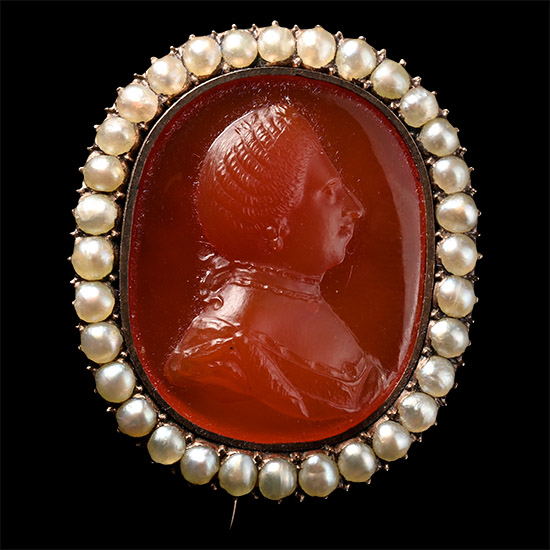
German Carnelian Cameo of Maria Theresa Mounted in a Brooch
18th century A.D.Estimate: £1,000 - 1,400 (+bp*)
Opening Bid: £500
Skilfully carved cameo depicting the jewelled profile bust of Maria Theresa facing right, the background is highly polished, whilst the relief is rendered with contrasting polished and matt elements; the high-carat gold brooch setting likely original to the jewel and set with a border of blister pearls. 9.69 grams, 37 mm
Acquired on the European art market.
Maria Theresa Walburga Amalia Christina (c.1717-80) was ruler of the Habsburg dominions from 1740 until she died in 1780, and the only woman to hold the position suo jure. She was the sovereign of Austria, Hungary, Croatia, Bohemia, Transylvania, Mantua, Milan, Lodomeria and Galicia, the Austrian Netherlands, and Parma. -
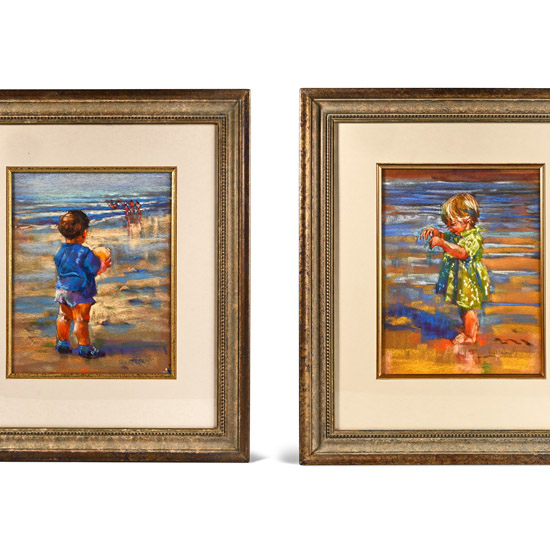
Pair of Pastel Paintings of Children on a Beach by Sue McDough
Circa 1999 A.D.Sold for (Inc. bp): £85
Comprising: a pastel of a young girl dressed in a green dress, playing with sand, her bare feet sinking in the sand, and shallow waves lapping in the background; the other pastel showing a young boy dressed in blue and holding a ball in his hands, gazing into the distance where a group of people are playing in the water; both set in glazed frames and signed to the bottom right-hand corner. 4.65 kg total, 46 x 54 - 47 x 54.5 cm
Property of an Essex, UK, lady. Accompanied by two original receipts from Frinton Gallery. -
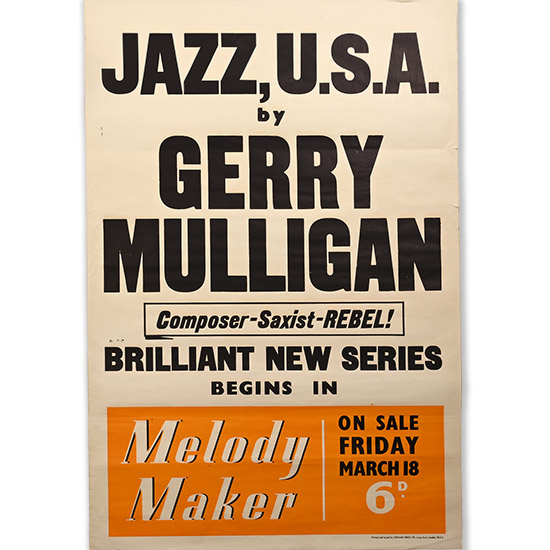
Jazz, U.S.A. by Gerry Mulligan Original Advertising Poster
Circa March 1955 A.D.Sold for (Inc. bp): £416
Off-white ground with black overprinted text and spot yellow block; 'Melody Maker' advertising poster; footnote 'Printed and issued by Odhams Press, Long Acre, London WC2'. 22 grams, 76.2 x 50.6 cm
30 x 20 in.
Acquired on the UK art market. Property of a Harwich, UK, collector.
Gerry Mulligan was an important 20th century composer, arranger, saxophonist and conductor, who played a leading role in the development of jazz and contemporary music. The poster advertises a serialised commentary on the contemporary music scene which appeared in 'Melody Maker'. The footnote reference is to the Odhams publishing venture which folded in 1968.
