
Loading, please wait...


LOT 2012
Russian Orthodox Enamelled Bronze Icon with St. Nicholas
19TH CENTURY A.D.
4 in. (163 grams, 10.2 cm).
Travel icon with hinged doors, featuring Saint Nicholas with a book in his left hand and making the gesture of blessing with his right, dressed as a bishop with a sticharion, covered by an omophorion, and surmounted by an epitrachelion embroidered with crosses; the saint flanked by Jesus and Virgin Mary, Christ holding the gospel, Mary holding the bishop’s epitrachelion. [No Reserve]
ProvenanceEx P. Chapman collection, 1980s-1990s.
CONDITIONTimeLine Auctions follows a vetting process to ensure the authenticity and legality of all items, reinforcing our commitment to integrity and responsible trading. Each antiquity, antique, and coin lot undergoes thorough examination by a vetting committee of at least ten external specialists, professional trade association members, scientists, and archaeologists: Our Vetting Process
AUCTIONS:
TimeLine is a leading auction house specialising in antiquities, ancient art, collectables, natural history, coins, medals, and books. Our auctions offer museums, collectors, historians, and enthusiasts the opportunity to acquire unique and historically significant pieces.
LOT 2012
Russian Orthodox Enamelled Bronze Icon with St. Nicholas
Sold for (Inc. bp): £65
-
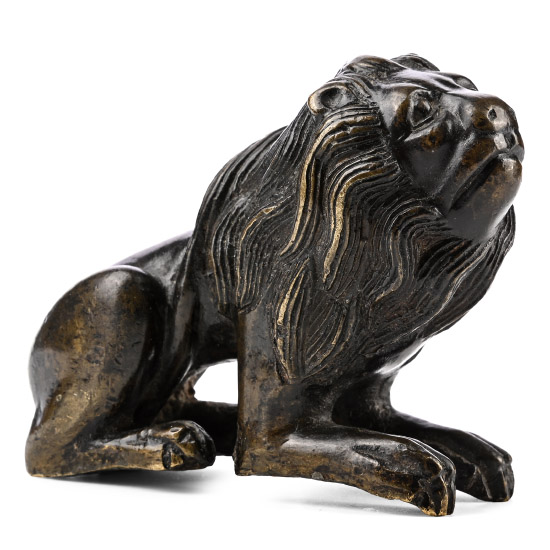
Nuremberg Brass Lion Statue
Germany, 16th century A.D.Estimate: £500 - 700 (+bp*)
Opening Bid: £250
Modelled in a half-seated pose, gazing upwards with compact body, broad forequarters, the mane rendered in long, parallel strands; the tail emerging from underneath the body and resting diagonally on top of the neck. 855 grams, 96 mm
Acquired on the European art market.
The treatment reflects the continuation of late Gothic conventions within German workshops, while also aligning with the more classicising tendencies found in North Italian bronze production of the period. The anatomical structure is simplified yet purposeful, characteristic of functional or cabinet bronzes produced across central Europe in the sixteenth century. Its scale and form correspond to small bronzes intended for Kunstkammer settings or as elements within larger composite objects such as inkstands or caskets, where the lion served as an emblem of vigilance, authority, and learned taste. -

Tudor Period Knight's Gilt-Bronze Belt Mount Group
Circa 16th century A.D.Sold for (Inc. bp): £7
Matched pair of rectangular mounts with low-relief floral decoration flanked by pelletted borders and openwork finials. 8.9 grams total, 35-43 mm
From the private collection of Graham Slater (1927-2024), Cambridge, UK; formed 1980s-1990s. -
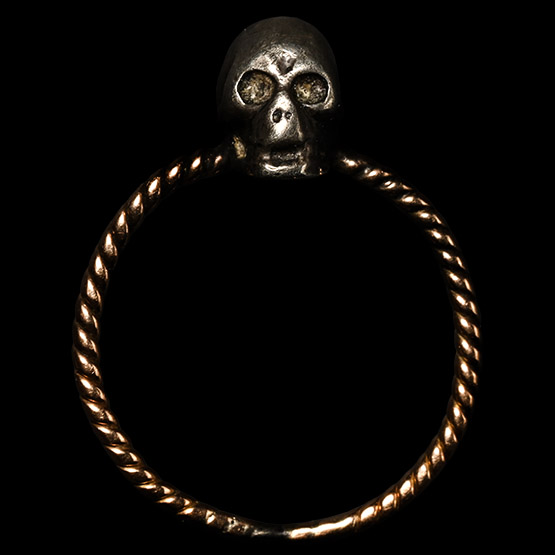
Georgian Gold Ring with Silver Skull
19th-20th century A.D.Sold for (Inc. bp): £585
Beaded wire hoop with applied silver skull motif; usage wear to inner face. 2.93 grams, 25.00 mm overall, 16.81 mm internal diameter (approximate size British M, USA 6, Europe 12.46, Japan 12)
Private collection, Europe. Acquired on the English art market.
