
Loading, please wait...

LOT 2189
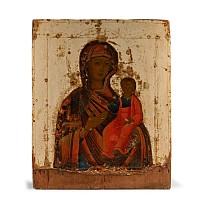
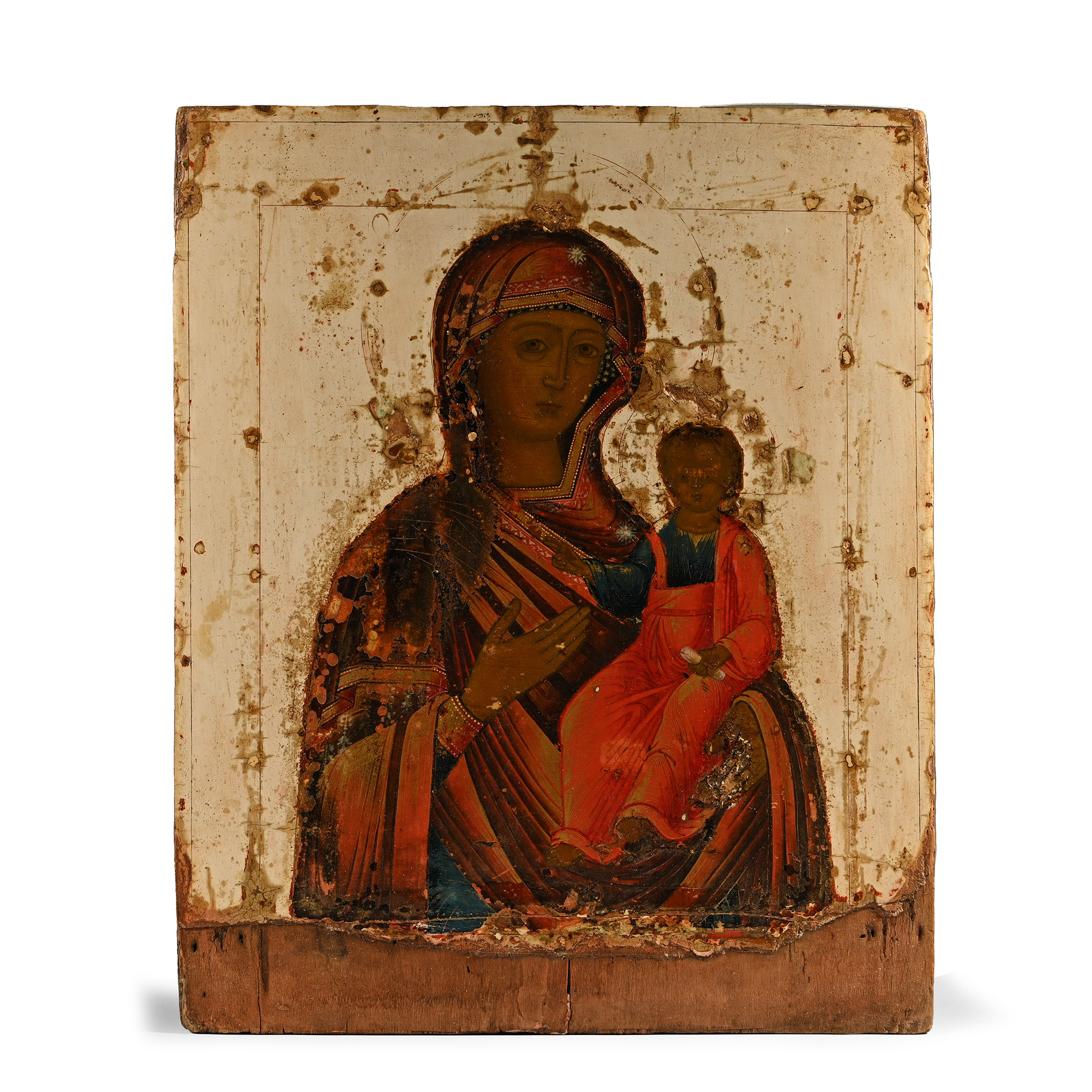
Russian Icon with Mother of God and Christ
SMOLENSKAYA, EARLY 19TH CENTURY A.D.
12 5/8 x 10 1/4 in. (1.12 kg, 32 x 26 cm).
Depicting nimbate Mary Theotokos with veiled head and wearing a red maphorion mantle over a dark blue robe with gold cuffs, inclined towards the infant Jesus supported by her left hand, wearing a bright red mantle and a blue tunic highlighted with gold, his left arm holding a roll and the right hand in a gesture of blessing; white field, tempera on wood, Smolenskaya type.
ProvenanceAcquired from Portobello Road, London, circa 2000.
Property of a London, UK, gentleman collector.
This lot is accompanied by an illustrated lot declaration signed by the Head of the Antiquities Department, Dr Raffaele D’Amato.
Cf. Korolev. A.A., 'The Holy Virgin of Smolensk in the 17th century: Catholic Legend of an Orthodox Icon' in Srednie veka, 2022, Vol.83, no.4, pp.142-167.
FootnotesThe model for the icon, painted in 16th century style, is the one of the Mother of God of Smolensk, associated with the Byzantine icon of the Hodegetria ('She who shows the ways). According to the legend, the icon of Smolensk received the name after healing two blind men. The original icon of Smolensk was a gift of the Roman Emperor Constantine Monomachus to her daughter Anna when she married the Russian Prince Vsevolod. Later Anna presented the icon to his son Vladimir who put it in the Vladimir Cathedral.
CONDITIONTimeLine Auctions follows a vetting process to ensure the authenticity and legality of all items, reinforcing our commitment to integrity and responsible trading. Each antiquity, antique, and coin lot undergoes thorough examination by a vetting committee of at least ten external specialists, professional trade association members, scientists, and archaeologists: Our Vetting Process
AUCTIONS:
TimeLine is a leading auction house specialising in antiquities, ancient art, collectables, natural history, coins, medals, and books. Our auctions offer museums, collectors, historians, and enthusiasts the opportunity to acquire unique and historically significant pieces.
LOT 2189
Russian Icon with Mother of God and Christ
Estimate £300 - 400€350 - 460 (for guidance only)$410 - 540 (for guidance only)
-
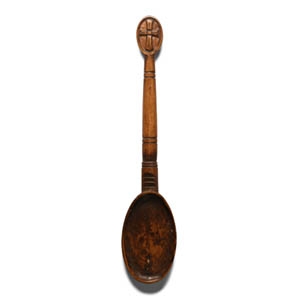
Wooden Spoon with Cross
Circa 19th century A.D.Sold for (Inc. bp): £72
With low rim to the ovoid bowl, balustered handle and ellipsoid finial with reserved cross motif. 10.7 grams, 13.5 cm
Acquired on the London art market in the late 1980s-1990s. From the family collection of an East London, UK, gentleman. This lot is accompanied by an illustrated lot declaration signed by the Head of the Antiquities Department, Dr Raffaele D’Amato. -
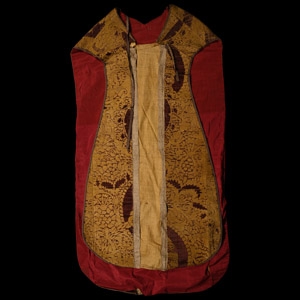
Post Medieval Fabric Garment
England, circa 1480-1500 A.D.Sold for (Inc. bp): £715
Woven fabric panel, possibly a chasuble or other ecclesiastical vestment, in burgundy-red and gold-yellow with supplementary mounting strip to straight edge, braided binding to curved outer edge; mounted on a modern fabric backing. 1.03 kg total, 211 cm
with Sotheby's, London, 26 November 2003, no.204. This lot is accompanied by an illustrated lot declaration signed by the Head of the Antiquities Department, Dr Raffaele D’Amato. -
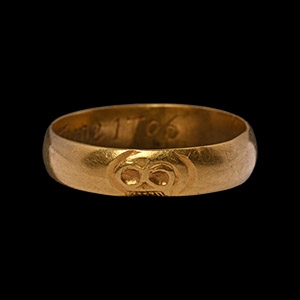
Queen Anne Engraved Gold Memento Mori Skull Ring
Dated 1706 A.D.Sold for (Inc. bp): £1,300
With stylised skull to the outer face, engraved to the inner face 'E. Judd ob. 6 June 1706 and maker's mark 'ID' for Josiah Daniel, London goldsmith of the early 18th century. 4.30 grams, 20.77 mm overall, 18.03 mm internal diameter (approximate size British P 1/2, USA 7 3/4, Europe 16.86, Japan 16)
Acquired on the UK art market. Property of an East Sussex collector. This lot is accompanied by an illustrated lot declaration signed by the Head of the Antiquities Department, Dr Raffaele D’Amato.
