
Loading, please wait...
LOT 0323
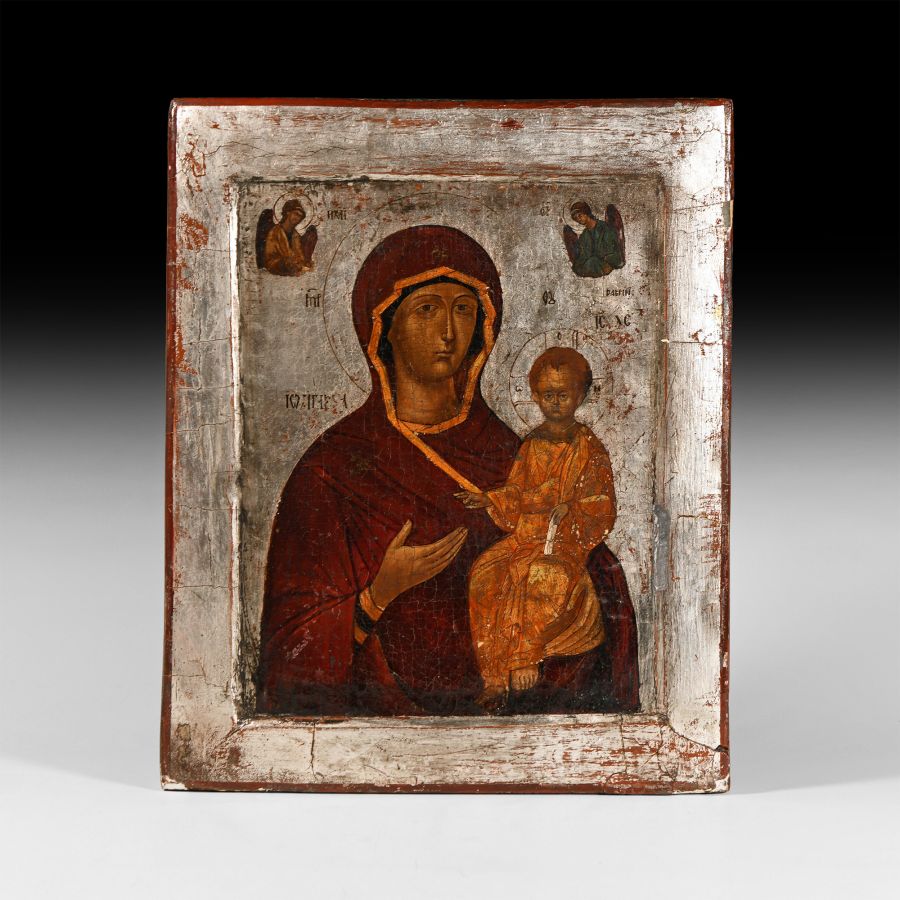
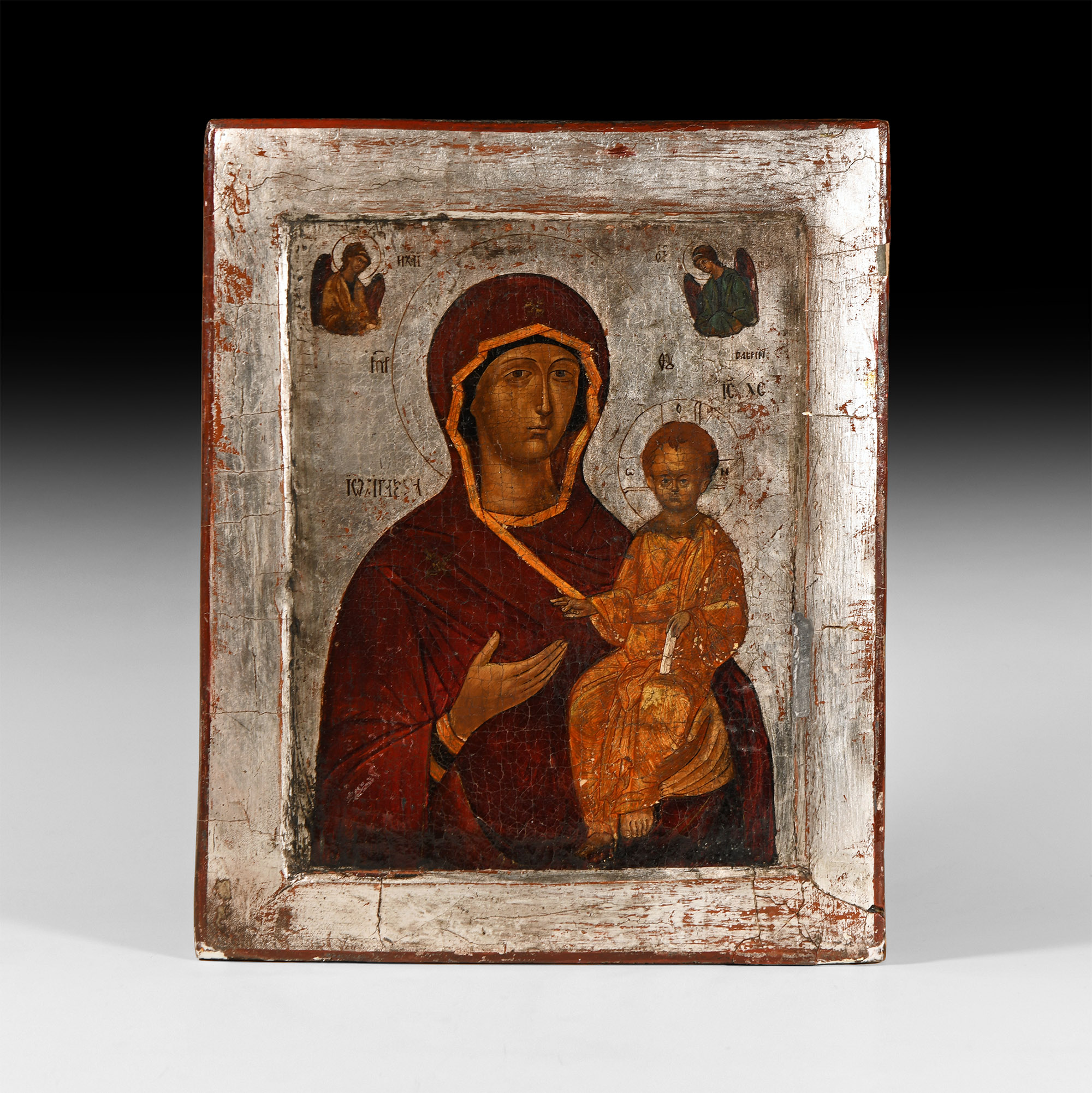
Russian Icon of the Hodegetria of Constantinople
19TH CENTURY A.D.
11 3/4 x 9 1/2 in. (869 grams, 29.8 x 24 cm).
An icon of Hodegetria with the Virgin wearing a red maphorion embroidered with gold, a dark veil and a dark chiton with double gold embroidery on the cuffs; holding the Child on her left arm and gesturing towards him with the right hand; the Child wearing a yellow brown, gold-woven chiton, holding a scroll in his left hand, while the right one is making the gesture of blessing; the angels Michael and Gabriel to the left and right of the Virgin; on each side of the head of the Virgin inscriptions 'ΜΡ' and 'ΘΥ' (Μήτηρ (τοῦ) Θεοῦ = Mother of God), inscription in Greek letters 'IC XC' (IHCOYC XPICTOC = Jesus Christ) above the child, three letters inside the nimbus of Christ representing the continuous divine self-existence of Christ as God ('O ѾN' = The Only One who always exists); the names of the angles inscribed next to each figure (Aghios Michail and Aghios Gavriil).
ProvenanceProperty of a London lady, part of her family's collection.
LiteratureCf. Lidov, A., 'The flying Hodegetria the miraculous icon as bearer of sacred space' in Thunø, E., Wolf, G. (eds.), The miraculous image in the Late Middle Ages and Renaissance. Papers from a conference held at the Accademia di Danimarca in collaboration with the Bibliotheca
Hertziana (Max-Planck-Institut für Kunstgeschichte), Rome, 31 May - 2 June 2003, Rome 2004, pp. 273-304 (Analecta Romana Instituti Danici : Supplementum ; 35), fig.10, for a photo of the original icon.
The painting is a copy of the famous replica of the Hodegetria of Constantinople, a Byzantine icon of 14th century, repainted by the icon painter Dionisi in 1482, and today preserved in State Tretyakov Gallery, Moscow. The original icon was destroyed by the Turks at the capture of Constantinople in 1453. The replica was venerated as an 'original' real Hodegetria in the Ascension Convent in Kremlin, Moscow. The icon led the liturgical processions on June 23, August 26, May 21 and October 22 in which the Patriarchs and the Russian Tsars took part.
CONDITIONTimeLine Auctions follows a vetting process to ensure the authenticity and legality of all items, reinforcing our commitment to integrity and responsible trading. Each antiquity, antique, and coin lot undergoes thorough examination by a vetting committee of at least ten external specialists, professional trade association members, scientists, and archaeologists: Our Vetting Process
AUCTIONS:
TimeLine is a leading auction house specialising in antiquities, ancient art, collectables, natural history, coins, medals, and books. Our auctions offer museums, collectors, historians, and enthusiasts the opportunity to acquire unique and historically significant pieces.
-
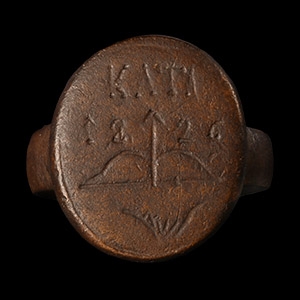
Post Medieval Ring with Bow and Arrow
1226 h. (1811 A.D.)Sold for (Inc. bp): £26
A copper-alloy ring composed of a broad hoop with slightly convex outer face, large oval-shaped bezel engraved with an archer's bow with nocked arrow, separating the numbers '12 / 26' and aimed towards the letters 'KΛTΛ'. 8.88 grams, 24.70 mm overall, 21.66 mm internal diameter (approximate size British V 1/2, USA 10 3/4, Europe 24.4, Japan 23)
Private collection formed since the 1940s. UK art market. Property of an Essex gentleman. -
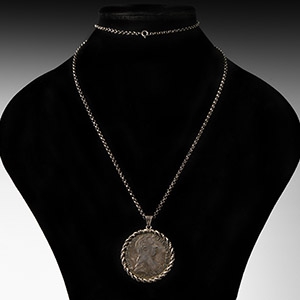
Post Medieval Silver Thaler Pendant Necklace
20th century A.D.Sold for (Inc. bp): £52
A silver circular corded pendant mount containing an Austrian restrike silver thaler coin of Maria Theresa (bearing the frozen date '1780'); with suspension loop, bale and chain. 53 grams, 85 cm long
Fine condition; tarnished.
Acquired before 2000. From the collection of a European gentleman living in the UK. -
.jpg)
Post Medieval Reclining Female Statue
Late 19th-early 20th century A.D.Sold for (Inc. bp): £1,300
A bronze study of a reclining nymph on a draped chaise longue, nude with head tilted back and lips sensuously parted, left hand stroking her luxuriant hair, right hand lifting a fold of the cloth cover, left leg bent and held beneath the right leg, cushioned headrest with tassel; hollow to the underside; unsigned. 5.4 kg, 34 cm long
English private collection.
